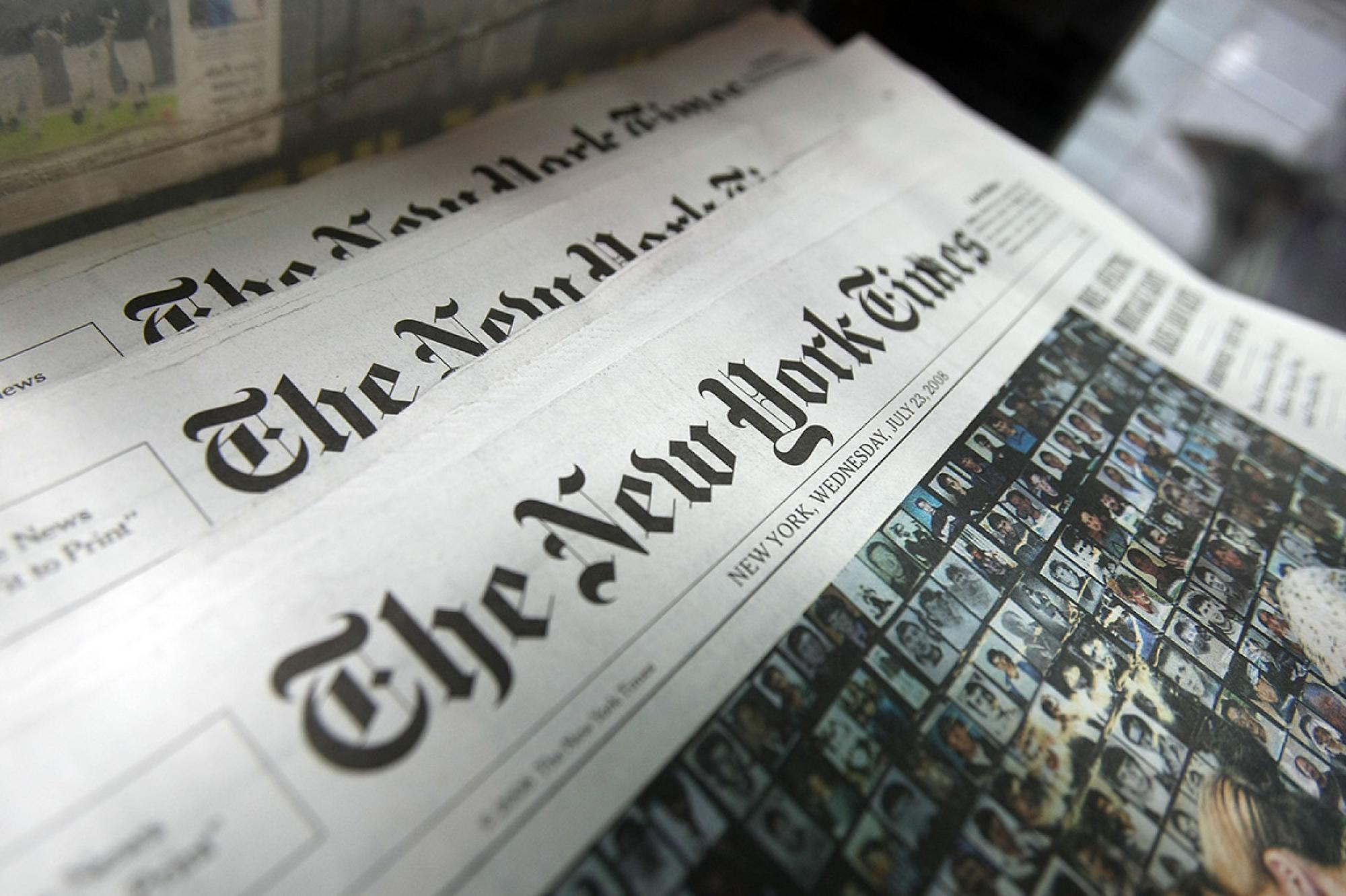
Last month, I revealed internal Twitter and Department of Homeland Security emails showing that the agency had successfully pressured the social media platform to censor the New York Times during the 2020 presidential election. It was impossible to get the Times to comment on my reporting that revealed that a government agency, enacted to protect national security, had muzzled one of its own. The paper remained silent. That was the case until last week when the Times finally mentioned the issue. In a lengthy article that falsely paints efforts to promote free speech as orchestrated entirely by Trump supporters, the Times buried an acknowledgment of our reporting some 52 paragraphs down. The backhanded way in which the Times finally noted that the government had suppressed the speech " in an article that essentially argues that free speech is a dangerous right-wing plot " reflects the institution's changing nature. Many in the public may view the paper as a beacon of the free press. After all, the most important Supreme Court case enshrining media rights was New York Times v. U.S., the 1971 case that made it clear that journalists have the right to publish even classified documents. There are sprawling constitutional issues at heart here that should go beyond left and right. This government or the next administration may use the DHS apparatus to control what is said about almost any political issue. DHS bureaucrats ... have planned to suppress "misinformation" about the Ukraine war, the origins of COVID-19, and topics as broad as "racial justice." That power can easily be exploited. Last month, I testified before Congress on the importance of free speech. I also filed an amicus brief to the Supreme Court ... urging the justices to consider the lengthy evidence that the government has already overstepped its authority with respect to online censorship.
Latest
Latest News
Each news summary is created according to strict standards. Here's how we do it.
Each summary is created using a consistent editorial procedure. The target length is approximately 16 lines of 11-point Arial text in a 650-pixel-wide column. Up to 25% of a summary may be set in bold to emphasize the most important ideas. Summaries are composed of verbatim excerpts presented in the same sequence as they appear in the original news source, with very minor editorial additions. Where material has been omitted between excerpts, the omission is indicated with ellipses (...). Any words added by an editor for clarity or context appear in [brackets]. Our original news editor was Fred Burks. Tod Fletcher edited most summaries from 2007 through 2014, and Mark Bailey has served as news editor since 2014.