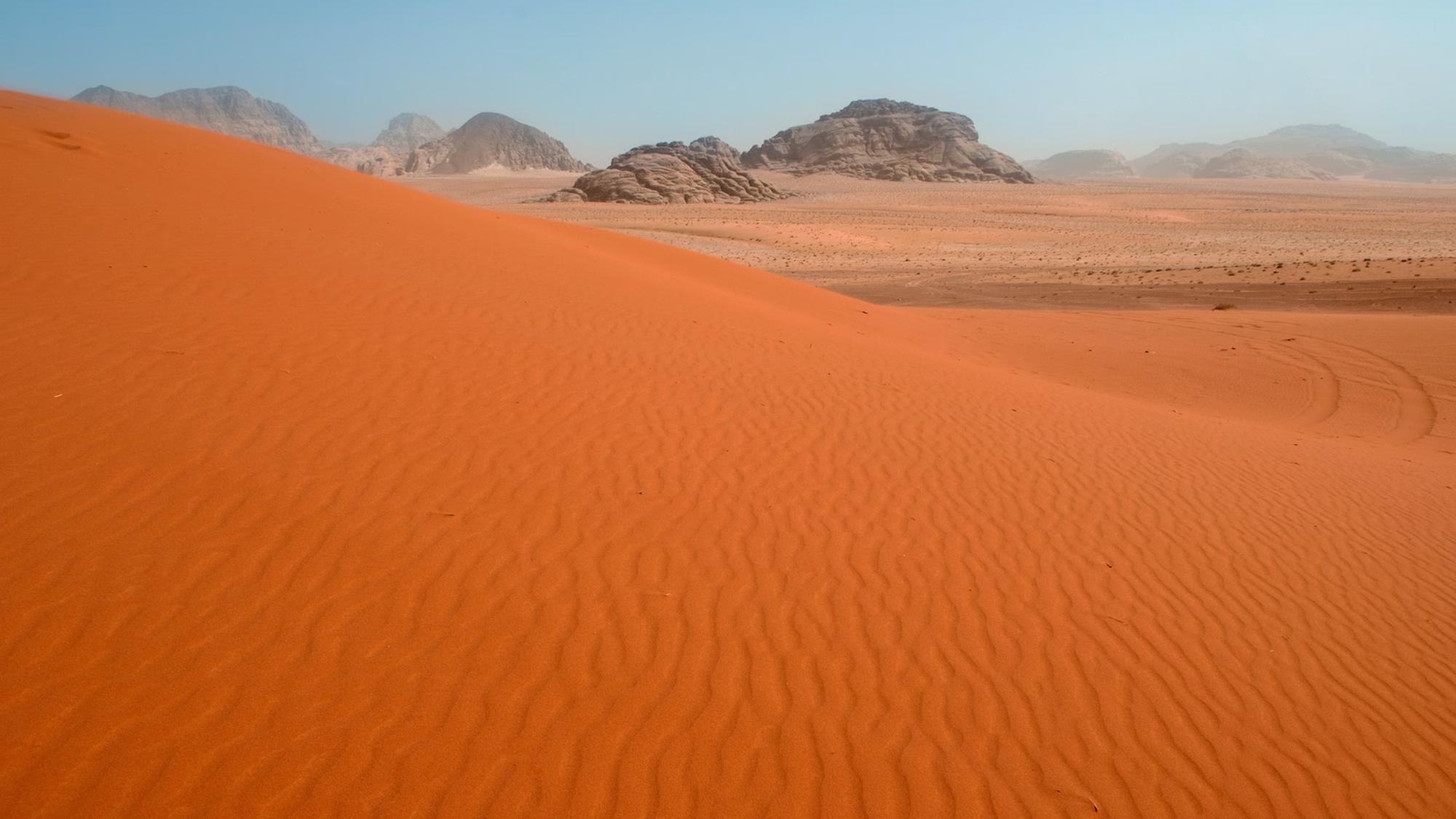
Entrepreneurs in Jordan have created a sophisticated machine that pulls water from the desert air at a rate that could cure the country's water woes. 1,000 units of their flagship device have already been pre-ordered by the Jordanian government, and the success of the invention has allowed the innovators to attract dozens of promising scientists who can hopefully expand on their success and bring water resources up to speed in the relatively-stable Near Eastern nation. Aquaporo [is] a relatively straightforward, air conditioning-sized machine that can harvest 35 liters of water every day in a desert climate of 20% humidity. Aquaporo CEO Kyle Cordova and engineering director Husam Almassad got their start at Jordan's Royal Scientific Society. Their invention looked a bit like a chest freezer. Inside, rows of nanomaterials formed into tubes and other shapes act like a sieve that filters water out of the air. The physics behind it are much the same as those found in this Classical Indian architectural feature and takes advantage of air's tendency to speed up as it moves through a narrow passageway; called the Venturi Effect. It leaves behind the heavier water vapor, which condenses, drops into a collection apparatus, and is fed then into a reservoir. Research on the efficacy of Aquaporo's invention shows it can achieve levels of water purity greater than Nestle brand bottled water, and collects it from the air at double the rate of existing moisture capture technology.
Latest
Latest News
Each news summary is created according to strict standards. Here's how we do it.
Each summary is created using a consistent editorial procedure. The target length is approximately 16 lines of 11-point Arial text in a 650-pixel-wide column. Up to 25% of a summary may be set in bold to emphasize the most important ideas. Summaries are composed of verbatim excerpts presented in the same sequence as they appear in the original news source, with very minor editorial additions. Where material has been omitted between excerpts, the omission is indicated with ellipses (...). Any words added by an editor for clarity or context appear in [brackets]. Our original news editor was Fred Burks. Tod Fletcher edited most summaries from 2007 through 2014, and Mark Bailey has served as news editor since 2014.