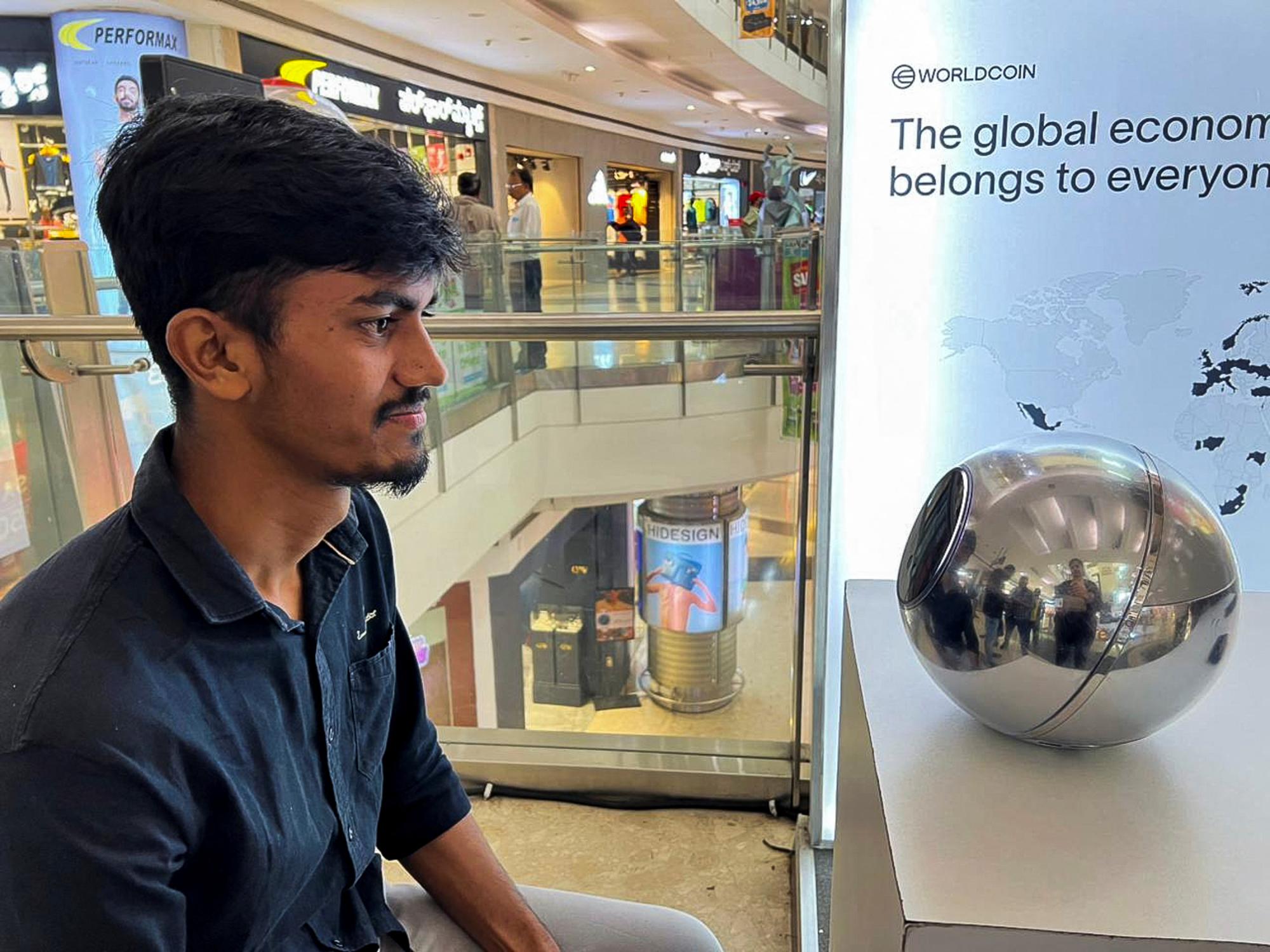
People around the world are getting their eyeballs scanned in exchange for a digital ID and the promise of free cryptocurrency. The Worldcoin project says it aims to create a new identity and financial network" and that its digital ID will allow users to, among other things, prove online that they are human, not a bot. The project launched on Monday, with eyeball scans taking place in countries including Britain, Japan and India. At a crypto conference in Tokyo, people on Tuesday queued in front of a gleaming silver globe flanked by placards stating: "Orbs are here." Applicants lined up to have their irises scanned by the device, before waiting for the 25 free Worldcoin tokens the company says verified users can claim. Worldcoin's data-collection is a "potential privacy nightmare," said the Electronic Privacy Information Center. Worldcoin's privacy policy ... says that data may be passed to subcontractors and could be accessed by governments and authorities. UK privacy campaign group Big Brother Watch said there was a risk biometric data could be hacked or exploited. "Digital ID systems increase state and corporate control over individuals' lives and rarely live up to the extraordinary benefits technocrats tend to attribute to them," senior advocacy officer Madeleine Stone said. In a mall in Bengaluru, India, orb-operators approached passers-by on Tuesday and showed them how to sign up. Most interviewed by Reuters said they were not worried about privacy.
Latest
Latest News
Each news summary is created according to strict standards. Here's how we do it.
Each summary is created using a consistent editorial procedure. The target length is approximately 16 lines of 11-point Arial text in a 650-pixel-wide column. Up to 25% of a summary may be set in bold to emphasize the most important ideas. Summaries are composed of verbatim excerpts presented in the same sequence as they appear in the original news source, with very minor editorial additions. Where material has been omitted between excerpts, the omission is indicated with ellipses (...). Any words added by an editor for clarity or context appear in [brackets]. Our original news editor was Fred Burks. Tod Fletcher edited most summaries from 2007 through 2014, and Mark Bailey has served as news editor since 2014.