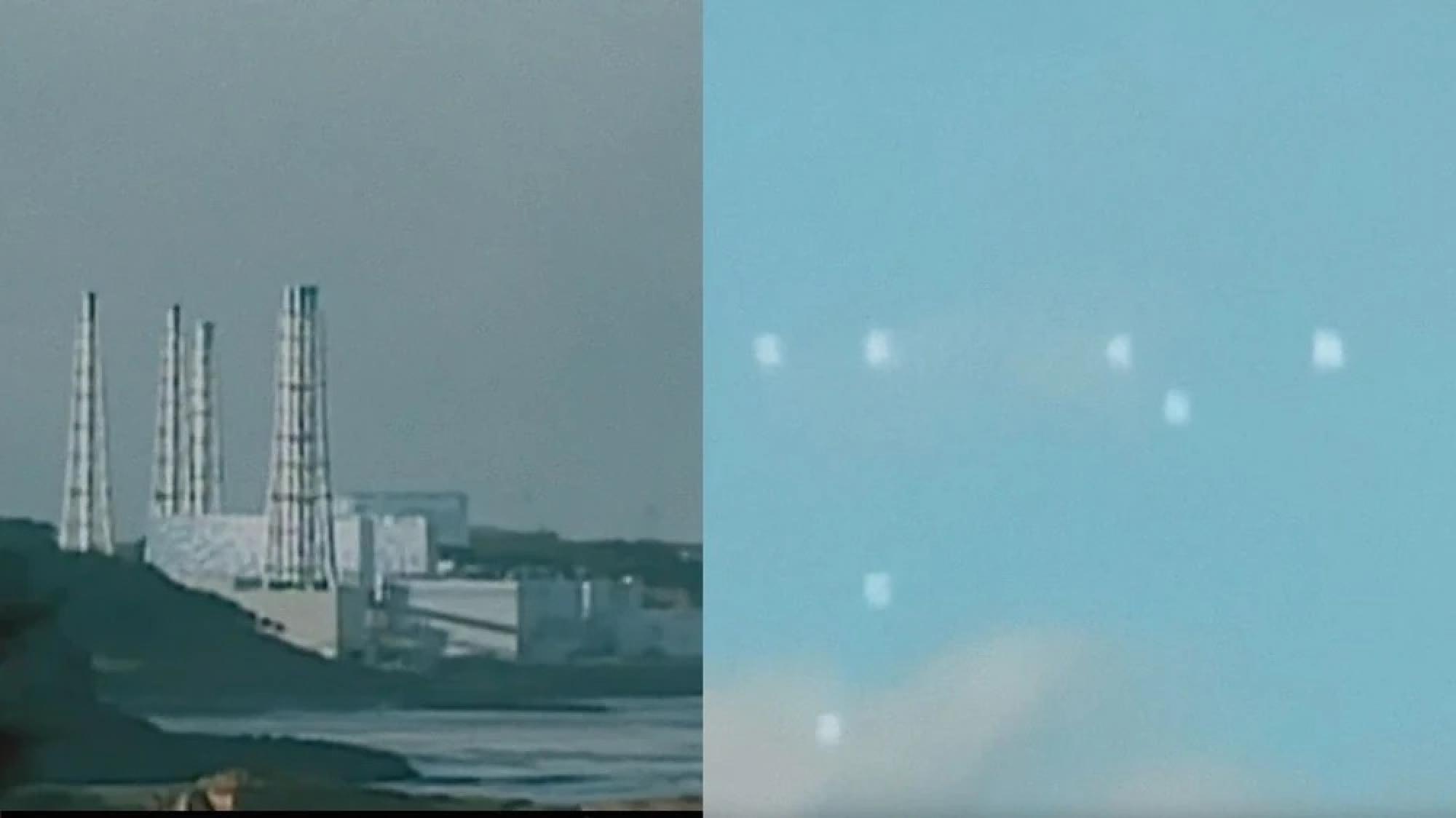
The Enmyoin Temple in the Fukushima prefecture of Japan is now known colloquially by a different name, said its Chief Monk, Tomonori Izumi: "The Miracle Temple." On March 11 2011, the Fukushima Daiichi nuclear plant was the site of one of the worst nuclear disasters ever after an earthquake and subsequent tsunami caused its electrical grid to fail. The simultaneous disasters laid waste to much of the surrounding area, but "miraculously, the temple was untouched." " The UFO's came after the explosion. There were so many of them. I was shocked ... Radioactive energy was leaking everywhere. I believe the UFOs came to readjust the flood of radioactive energy in order to save us. That's my theory, anyway," said [Chief Monk, Tomonori Izumi]. UFO's have been documented repeatedly around places where humans have spawned nuclear activity. [Author Dr. Jensine Andresen] cited declassified U.S. government reports from agencies like the FBI and CIA about UFO sightings near nuclear sites, saying she had looked at 39 different accounts between the 1940s and 1990s. "It goes back to the 1930s when the science and research was being done to understand fission. But then it really heats up in the 1940s, in particular, right after the detonation of the two atomic bombs in Japan in 1945. Then ... you see one after another event occurring in proximity specifically to sites associated with nuclear weapons," said Andresen. "There was a lot of UFO activity reported [around Chernobyl] also. At the height of the fire in Chernobyl, the reading was 3000 milliroentgens, which is a unit of ionizing radiation. And right at the height of the fire, many people observed a UFO come, stayed for 3 minutes, shown a light right at Unit 4 and departed," she said. "They took another reading and it had apparently dropped to 800. That seems like a very conscious attempt to remediate the danger caused by the malfunction there."
Latest
Latest News
Each news summary is created according to strict standards. Here's how we do it.
Each summary is created using a consistent editorial procedure. The target length is approximately 16 lines of 11-point Arial text in a 650-pixel-wide column. Up to 25% of a summary may be set in bold to emphasize the most important ideas. Summaries are composed of verbatim excerpts presented in the same sequence as they appear in the original news source, with very minor editorial additions. Where material has been omitted between excerpts, the omission is indicated with ellipses (...). Any words added by an editor for clarity or context appear in [brackets]. Our original news editor was Fred Burks. Tod Fletcher edited most summaries from 2007 through 2014, and Mark Bailey has served as news editor since 2014.