























Media Articles
Below are key excerpts of revealing news articles from reliable news media sources. If any link fails to function, a paywall blocks full access, or the article is no longer available, try these digital tools.
For further exploration, delve into our comprehensive Information Centers.

The so-called “hard problem of consciousness,” famously articulated by philosopher David , asks why and how physical processes in the brain give rise to subjective experience. Why does neural activity in the visual cortex generate the qualia of red, or neurochemical shifts involving oxytocin result in the felt sense of love? Despite significant advances in cognitive neuroscience, this explanatory gap remains unresolved. Transpersonal psychology, rooted in an expanded ontology that embraces the spiritual dimension of human life, offers a compelling framework for reimagining consciousness beyond mechanistic assumptions. This paper proposes that consciousness is not a byproduct of brain activity but rather ontologically fundamental. The filter theory of consciousness ... posits that the brain does not generate consciousness but functions as a filter, receiver, or reducing valve. In this analogy, just as a radio tunes into and selects specific frequencies from the broad spectrum of electromagnetic waves, the brain filters and constrains a vast, undifferentiated field of consciousness into a form adapted for practical survival and everyday functioning within the material world. Empirical research supports this filter model in several ways. Importantly, this model explains why non-ordinary states of consciousness, whether induced by trauma, meditation, psychedelics, or mystical absorption, often feel subjectively “more real” or authentic than ordinary waking consciousness.
Note: Explore more positive stories like this on the mysterious nature of reality.
In May, prosecutors in Seattle charged a sheriff’s deputy with raping a 17-year-old girl. The deputy met the teenager while he was an adviser in his department’s youth mentorship program known as Explorers. Law enforcement departments across the country have Explorer programs — overseen by Scouting America, formerly known as Boy Scouts of America — and they have a history of sexual abuse and misconduct. Ride-alongs, in which young people accompany officers on their patrol shifts, are a key perk of the Explorers program. They are also a gateway to abuse. The Marshall Project examined hundreds of abuse allegations in law enforcement Explorer programs and found that about a quarter of them involved officers on ride-alongs with teens — some as young as 14 years old. The Marshall Project reviewed ... the 217 cases currently in our database. The review found that at least a third of the cases involved alleged abuses in an officer’s vehicle. More specifically, about a quarter of the cases involved officers grooming, harassing, or sexually assaulting young people during Explorer ride-alongs. A 2003 report by the University of Nebraska at Omaha found that more than 40% of the cases of officers abusing teenage girls that researchers identified nationwide involved police Explorer programs. “And it’s just like other types of police crime, we don’t see a whole lot of changes as a result of police reforms,” [said criminologist Philip Stinson].
Note: For more along these lines, read our concise summaries of news articles on police corruption and sexual abuse scandals.
When politicians insist that they’re “following the science”—as if it reveals impersonal, unquestionable truths—they promote a dangerous illusion. Evolutionary psychologist Pascal Boyer warns that, like traditional diviners reading horoscopes or entrails, leaders invoke “the science” to offload responsibility, avoid conflict, and cloak decisions in inevitability. But science is no oracle: it is a human process of debate, judgement and dissent. This came to a head during the years of the virus, a period during which governments in many nations tried to enforce all manner of rules and regulations, presenting them as directly derived from “the science.” It is now clear that some of these measures were pointless, damaging or counter-productive—see, for example, scientific reviews on masks or lockdowns. That, of course, did little to bolster the public’s trust in experts and “the science.” The science used by politicians and administrations in this case only provided information about one aspect of the required decision-making. It did not quantify the social and economic costs of closing down places where people huddle together, like schools, small stores, theaters and restaurants, or of suspending all manner of “non-essential” economic activity.
Note: “Trust the science” sounds noble—until you realize that even top editors of world-renowned journals have warned that much of published medical research is unreliable, distorted by fraud, corporate influence, and conflicts of interest. In our latest Substack, COVID Revisited: A Complete Guide to Pandemic Propaganda and the Search for Truth in a Divided World, we explore how many COVID-era policies and mandates didn’t actually have a scientific basis, and failed to hold up in the face of real world evidence. We also emphasize the devastating public health costs of fear, division, and social isolation.
Walking into Brightworks could be a shock for helicopter parents. The K-12 school is alive with invention, autonomy and what founder Gever Tulley calls “the energy of a big multi-generational family household.” Therefore there are no traditional grades or classes at Brightworks. Students are grouped into “bands” by interest and maturity, not by age. There are no teachers — just “collaborators,” and parents are invited to visit and join as they please. Agency is woven into every part of Brightworks’ ecosystem. Students move freely through the buildings. “The first instinct can’t be, ‘Where are you supposed to be?’” Tulley explains. “You have to assume they’re on a mission — maybe to grab a wrench from the shop or to take a walk. That’s part of the culture here.” Students can’t hide behind textbooks or screens; each semester, they must propose, plan and find collaborators for their own project — and eventually present it to the entire school, known as the “Brightworks family.” Tulley believes this kind of learning — driven by curiosity — pays off for life: “We see students as heroes on their own journey.” His aim is also to prepare kids for the future. “Twenty years from now, every industry will need small teams of highly specialized people solving complex problems,” he says — people who can also communicate and collaborate well. Brightworks graduates have been accepted at top-tier universities, including Harvard.
Note: Explore more positive stories like this on reimagining education.
The insecticide chlorpyrifos is a powerful tool for controlling various pests, making it one of the most widely used pesticides during the latter half of the 20th century. Like many pesticides, however, chlorpyrifos lacks precision. In addition to harming non-target insects like bees, it has also been linked to health risks for much larger animals – including us. Now, a new US study suggests those risks may begin before birth. Humans exposed to chlorpyrifos prenatally are more likely to exhibit structural brain abnormalities and reduced motor functions in childhood and adolescence. Progressively higher prenatal exposure to chlorpyrifos was associated with incrementally greater deviations in brain structure, function, and metabolism in children and teens, the researchers found, along with poorer measures of motor speed and motor programming. This supports previous research linking chlorpyrifos with impaired cognitive function and brain development, but these findings are the first evidence of widespread and long-lasting molecular, cellular, and metabolic effects in the brain. Subjects in this urban cohort were likely exposed to chlorpyrifos at home, since many were born before or shortly after the US Environmental Protection Agency banned residential use of chlorpyrifos in 2001. The pesticide is still used in agriculture around the world. "Widespread exposures ... continue to place farm workers, pregnant women, and unborn children in harm's way," says senior author Virginia Rauh.
Note: Did you know that chlorpyrifos was originally developed by Nazis during World War II for use as a nerve gas? Read more about the history and politics of chlorpyrifos, and how U.S. regulators relied on falsified data to allow its use for years.
The government has released 33,295 pages of Jeffrey Epstein-related records that it received from the U.S. Department of Justice. “Today, the House Committee on Oversight and Government Reform released 33,295 pages of Epstein-related records that were provided by the U.S. Department of Justice,” the committee wrote in a statement. “On August 5, Chairman Comer issued a subpoena for records related to Mr. Jeffrey Epstein, and the Department of Justice has indicated it will continue producing those records while ensuring the redaction of victim identities and any child sexual abuse material. Epstein-related documents can be found here.“ “The victims themselves have stated this is a lot bigger than I think anyone anticipated,” Rep. Anna Paulina Luna, R-Fla., said after the meeting. “There are some very rich and powerful people that need to go to jail ... it is very much so a possibility that Jeffrey Epstein was an intelligence asset working for our adversaries, but also, the question we have is, ‘How much did our own government know about it?'” On Wednesday, a pair of bipartisan lawmakers will host a news conference at the Capitol to advance their efforts to force the Trump administration to release all of the government’s Epstein files. To ramp up the pressure, the lawmakers — Reps. Thomas Massie, R-Ky., and Ro Khanna, D-Calif. — will be joined by several Epstein accusers.
Note: When undeniable evidence of Epstein’s child sex trafficking ring came to court in 2008, the entire system moved to shield him and his associates from the gravity of his crimes. Major news outlets suppressed key evidence. Prosecutors shut down an FBI investigation and gave him a sweetheart deal. Alexander Acosta, the US attorney who signed off on the deal, later said he was told Epstein “belonged to intelligence, and to leave it alone.” Even after his conviction as a sex offender, Epstein was meeting with top officials at the CIA and the White House. Read our comprehensive Substack investigation covering the connection between Epstein’s child sex trafficking ring and intelligence agency sexual blackmail operations.
Every breath people take in their homes or car probably contains significant amounts of microplastics small enough to burrow deep into lungs, new peer-reviewed research finds, bringing into focus a little understood route of exposure and health threat. The study ... estimates humans can inhale as much as 68,000 tiny plastic particles daily. Previous studies have identified larger pieces of airborne microplastics, but those are not as much of a health threat because they do not hang in the air as long. The smaller bits measure between 1 and 10 micrometers, or about one-seventh the thickness of a human hair, and present more of a health threat because they can more easily be distributed throughout the body. The findings “suggest that the health impacts of microplastic inhalation may be more substantial than we realize”, the authors wrote. Microplastics are tiny bits of plastic either intentionally added to consumer goods, or which are products of larger plastics breaking down. The particles contain any number of 16,000 plastic chemicals, of which many, such as BPA, phthalates and Pfas, present serious health risks. The study measured air in multiple rooms throughout several apartments. The source of the microplastics in the apartments is thought to be degrading plastic in consumer products, from clothing to kitchen goods to carpets. The concentration of plastic in ... cars’ air was about four times higher than in the apartments.
Note: For more along these lines, read our concise summaries of news articles on health and toxic chemicals.
AI could mean fewer body bags on the battlefield — but that's exactly what terrifies the godfather of AI. Geoffrey Hinton, the computer scientist known as the "godfather of AI," said the rise of killer robots won't make wars safer. It will make conflicts easier to start by lowering the human and political cost of fighting. Hinton said ... that "lethal autonomous weapons, that is weapons that decide by themselves who to kill or maim, are a big advantage if a rich country wants to invade a poor country." "The thing that stops rich countries invading poor countries is their citizens coming back in body bags," he said. "If you have lethal autonomous weapons, instead of dead people coming back, you'll get dead robots coming back." That shift could embolden governments to start wars — and enrich defense contractors in the process, he said. Hinton also said AI is already reshaping the battlefield. "It's fairly clear it's already transformed warfare," he said, pointing to Ukraine as an example. "A $500 drone can now destroy a multimillion-dollar tank." Traditional hardware is beginning to look outdated, he added. "Fighter jets with people in them are a silly idea now," Hinton said. "If you can have AI in them, AIs can withstand much bigger accelerations — and you don't have to worry so much about loss of life." One Ukrainian soldier who works with drones and uncrewed systems [said] in a February report that "what we're doing in Ukraine will define warfare for the next decade."
Note: As law expert Dr. Salah Sharief put it, "The detached nature of drone warfare has anonymized and dehumanized the enemy, greatly diminishing the necessary psychological barriers of killing." For more, read our concise summaries of news articles on AI and warfare technology.
In mid-2014, during training flights off the coast of Virginia Beach, Virginia, F/A-18 pilot and U.S. Navy Lieutenant Ryan Graves began to notice something strange. The radar returns looked off—phantom blips moving with unfathomable speed and precision. The objects on one occasion finally came into view. Graves reported seeing a dark gray or black cube inside a clear sphere, between five and 15 feet in diameter, coming within 50 feet of their jets. Over the next year, Graves’s squadron recorded sightings of unidentified objects almost daily. Sometimes the objects flew in loose formations. Other times they traveled alone. They had no exhaust, no visible propulsion, no wings. Some of these craft—now classified as UAPs (unidentified anomalous phenomena)—appeared to be capable of transmedium travel, meaning they are able to move from air to sea without slowing, splashing, or emitting heat. They challenged every assumption held by aerospace engineers and radar operators. Since at least the 1950s, military sources have reported strange objects plunging into the ocean—what they call USOs (unidentified submerged objects). Today Graves is one of the most vocal advocates for UAP transparency. He’s the founder of Americans for Safe Aerospace, the largest UAP-focused pilot safety initiative in the world. He doesn’t claim that these craft are alien, but he’s certain that they aren’t using known human tech.
Note: Watch a new video by Amber Yang on recent exciting developments in UFO/UAP disclosure. For more along these lines, read our concise summaries of news articles on UFOs.
A push to restrict agricultural pesticides appears to be stalling, and a draft of a report obtained by ABC News does not signal any intention to eliminate them. This comes as a separate landmark study links negative effects of certain pesticides on children's brains. Pesticides are ubiquitous in our food supply. Numerous studies over the years have shown the detrimental effects of various chemicals on neuro development, but this is the first study to follow a large sample of children from pregnancy and get precise brain measurements. For the first time, researchers can tell you exactly how pesticides can cause harm in the offspring of exposed pregnant women. CHLA and Columbia University researchers said pesticides trigger inflammation and oxidative stress, which harms neurons and slows down how energy flows through the brain. "So that would be evident in things like penmanship, and spelling, and motor speed, performance," said [study author Dr. Bradley] Peterson. Researchers studied 270 children from birth up to 14 years old. Their mothers had been exposed to pesticides from having their homes fumigated and from using commercial sprays, but researchers say these moms were also exposed to chemicals in the produce and grains they ate. Peterson ... recommends more eco-friendly ways to eliminate pests and eating organic produce and grains when possible. "If you're able to afford it and can find it, we would recommend that," he said.
Note: Our Substack, "The Pesticide Crisis Reveals The Dark Side of Science. We Have The Solutions to Regenerate," uncovers the scope of the widespread conspiracy to poison our food, air, and along with the powerful remedies and solutions to this crisis. For more along these lines, read our concise summaries of news articles on government corruption and toxic chemicals.
“Ice is just around the corner,” my friend said, looking up from his phone. A day earlier, I had met with foreign correspondents at the United Nations to explain the AI surveillance architecture that Immigration and Customs Enforcement (Ice) is using across the United States. The law enforcement agency uses targeting technologies which one of my past employers, Palantir Technologies, has both pioneered and proliferated. Technology like Palantir’s plays a major role in world events, from wars in Iran, Gaza and Ukraine to the detainment of immigrants and dissident students in the United States. Known as intelligence, surveillance, target acquisition and reconnaissance (Istar) systems, these tools, built by several companies, allow users to track, detain and, in the context of war, kill people at scale with the help of AI. They deliver targets to operators by combining immense amounts of publicly and privately sourced data to detect patterns, and are particularly helpful in projects of mass surveillance, forced migration and urban warfare. Also known as “AI kill chains”, they pull us all into a web of invisible tracking mechanisms that we are just beginning to comprehend, yet are starting to experience viscerally in the US as Ice wields these systems near our homes, churches, parks and schools. The dragnets powered by Istar technology trap more than migrants and combatants ... in their wake. They appear to violate first and fourth amendment rights.
Note: Read how Palantir helped the NSA and its allies spy on the entire planet. Learn more about emerging warfare technology in our comprehensive Military-Intelligence Corruption Information Center. For more, read our concise summaries of news articles on AI and Big Tech.
Speculation is growing that Ghislaine Maxwell could soon be freed. Despite campaigning on the promise to release the Epstein Files, there are increasing signs that the Trump administration is considering pardoning the world’s most notorious convicted sex trafficker. For years, Maxwell aided her partner Jeffrey Epstein in trafficking and raping girls and young women. Epstein’s associates included billionaires, scientists, celebrities, and politicians, including President Trump, whom he considered his “closest friend.” While many of Ghislaine Maxwell’s crimes have come to light, less well-known are her family’s myriad connections to both the U.S. and Israeli national security states. Chief among these are those of her father, disgraced media baron and early tech entrepreneur, Robert Maxwell. Maxwell’s biographers ... write that he was first recruited by Israeli intelligence in the 1960s and began buying up Israeli tech corporations. Israel used these companies and their software to carry out spying and other clandestine operations. Maxwell amassed a vast business empire of 350 companies, employing 16,000 people. He owned an array of newspapers, including The New York Daily News. Throughout the 1990s, Epstein’s biographer Julie K. Brown noted, he openly boasted about working for both the CIA and Mossad. Epstein met with U.S. Deputy Secretary of State William Burns three times in 2014. Burns would later be named director of the CIA.
Note: Read our comprehensive Substack investigation covering the connection between Epstein’s child sex trafficking ring and intelligence agency sexual blackmail operations. For more along these lines, read our concise summaries of news articles on Epstein's criminal enterprise and intelligence agency corruption.
The chapel of San Quentin prison was abuzz as more than 100 incarcerated men and their friends and families took their seats. A banner with large orange lettering hanging at the front read “Arms Down: Teaching there are options between the first and second amendment”, and the mood was festive, with the men hugging their spouses, parents and siblings. Arms Down is a “mutual help group for firearm offenders”, meant to help incarcerated people understand the reasons that they carried and used guns. Understanding will lead to healing, the program’s creators hope, and insights the men gain in the program will travel beyond the prison’s walls and help reduce violence in the free world. “This is an opportunity you have to give back to your community. We’re the untapped resource,” said Jemain Hunter, the program’s founder. “People are scared because they don’t understand what we’re doing as gun offenders – as far as rehabilitation goes – to come out and not commit these sorts of crimes again.” “I’m just trying to make sure people don’t end up like me,” he continued. The sessions, many of the participants said, allowed them to talk about the shame and regret they feel over their offenses, and connect the dots between the violence they witnessed in their youth and the harm they have caused others. Word about Arms Down has spread to other California prisons, which Hunter hopes can introduce other incarcerated people to a new way of thinking about their crimes.
Note: Explore more positive stories like this on repairing criminal justice.
AI’s promise of behavior prediction and control fuels a vicious cycle of surveillance which inevitably triggers abuses of power. The problem with using data to make predictions is that the process can be used as a weapon against society, threatening democratic values. As the lines between private and public data are blurred in modern society, many won’t realize that their private lives are becoming data points used to make decisions about them. What AI does is make this a surveillance ratchet, a device that only goes in one direction, which goes something like this: To make the inferences I want to make to learn more about you, I must collect more data on you. For my AI tools to run, I need data about a lot of you. And once I’ve collected this data, I can monetize it by selling it to others who want to use AI to make other inferences about you. AI creates a demand for data but also becomes the result of collecting data. What makes AI prediction both powerful and lucrative is being able to control what happens next. If a bank can claim to predict what people will do with a loan, it can use that to decide whether they should get one. If an admissions officer can claim to predict how students will perform in college, they can use that to decide which students to admit. Amazon’s Echo devices have been subject to warrants for the audio recordings made by the device inside our homes—recordings that were made even when the people present weren’t talking directly to the device. The desire to surveil is bipartisan. It’s about power, not party politics.
Note: As journalist Kenan Malik put it, "It is not AI but our blindness to the way human societies are already deploying machine intelligence for political ends that should most worry us." Read about the shadowy companies tracking and trading your personal data, which isn't just used to sell products. It's often accessed by governments, law enforcement, and intelligence agencies, often without warrants or oversight. For more, read our concise summaries of news articles on AI.
A major settlement announced this week brought an end to a lengthy battle between chemical manufacturer Monsanto and students, parents and staff of a Monroe school who were exposed to toxic PCBs for years. PCBs, or polychlorinated biphenyls, are human-made chemicals that the Environmental Protection Agency has linked to some cancers and other illnesses. They festered at Sky Valley Education Center, an alternative school in Snohomish County, where fluorescent lights and building caulking were contaminated. The preservatives were once widely relied upon for building durability, but the EPA has since banned their use. More than 200 people from Sky Valley blamed their serious illnesses on exposure to the toxicant. This week’s announcement marks the largest, and only significant, PCB personal injury settlement since Monsanto was acquired by Bayer Pharmaceuticals in 2018 And it appears to be among the largest, if not the largest, PCB settlement stemming from a single site containing the pollutant. The terms of the settlement, including the dollar amount, are confidential. But in July, before the agreement, Germany-based Bayer informed its investors that it had set aside 530 million euros, or about $618 million, for Sky Valley settlements and litigation costs. Sky Valley students, staff and others ... described devastating diagnoses, including various cancers, brain damage, autoimmune diseases and miscarriages. Some, including children, reportedly died.
Note: For more along these lines, read our concise summaries of news articles on corporate corruption and toxic chemicals.
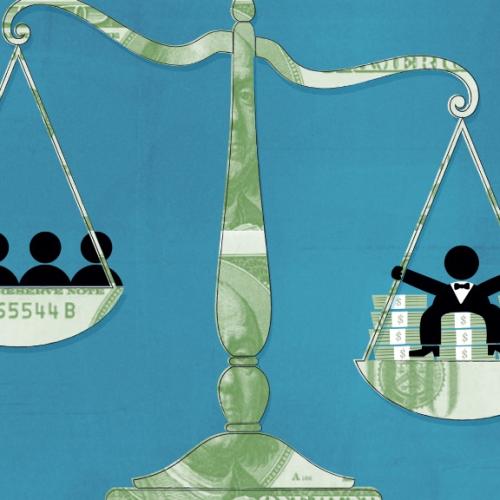
A US senator on Wednesday released a report that detailed how private equity firms have ruined hospitals in his home state and across the country. The report from Sen. Chris Murphy (D-Conn.) documented what happened when three Connecticut hospitals—Waterbury Hospital, Rockville General, and Manchester Memorial—were bought by Prospect Medical Holdings, a private equity-backed healthcare firm. Ramona, an operating room assistant at Waterbury Hospital cited in the report, explained how Prospect went to extreme lengths to avoid spending money. She explained to Murphy that Prospect at one point stopped paying vendors, which resulted in supplies eventually growing "so scarce patients were sometimes left on the operating table while staff scrambled" to find the necessary equipment. Staff members eventually started buying supplies themselves, with some even going so far as to buy food for their patients to ensure that they did not go hungry. Prospect didn't just skimp on buying supplies for the hospitals but also on maintaining the buildings themselves. A unit secretary at Waterbury Hospital named Carmen told Murphy's staff of two instances where the ceiling at the building literally fell down due to years of neglect. Murphy's report also emphasized that the story of private equity stripping hospitals for parts is not unique to his state. "The story of these three Connecticut hospitals is playing out in healthcare systems all over the country," it said.
Note: According to this Guardian article, "More and more people, especially the relatively poor, may live almost their entire lives in systems owned by one or another private equity firm: financiers are their landlords, their electricity providers, their ride to work, their employers, their doctors, their debt collectors." For more along these lines, read our concise summaries of news articles on health and financial system corruption.
As I approach India's first Garbage Cafe on a cloudy and foggy winter day in early 2025, the smell of hot samosas immediately makes the place feel cosy. Inside, people are sitting on wooden benches holding steel plates filled with steaming meals, some chatting, others eating quietly. Every day, hungry people arrive at this cafe in Ambikapur, a city in the state of Chhattisgarh in central India, in the hope of getting a hot meal. But they don't pay for their food with money – instead, they hand over bundles of plastic such as old carrier bags, food wrappers and water bottles. People can trade a kilogram (2.2lb) of plastic waste for a full meal that includes rice, two vegetable curries, dal, roti, salad and pickles, says Vinod Kumar Patel, who runs the cafe on behalf of the Ambikapur Municipal Corporation (AMC), the public body which manages the city's infrastructure. Every morning, [Rashmi Mondal] sets out early on the streets of Ambikapur in a search for discarded plastic – anything from old food wrappers to plastic bottles. For her, collecting such detritus is a means of survival. "I've been doing this work for years," Mondal says, looking at the small pile of plastic she has gathered. Previously, Mondal used to sell the plastic she collected to local scrap dealers for just 10 Indian rupees (£0.09/$0.12) per kilogram – barely enough to survive on. "But now, I can get food for my family in exchange for the plastic I collect. It makes all the difference in our lives."
Note: Explore more positive stories like this on reimagining the economy.
Food forest projects have been taking root in multiple U.S. cities. In Atlanta, Boston, Denver, Philadelphia, Seattle and elsewhere, groups have partnered with local communities to cultivate layers of edible plants on public parkland, in empty lots and along roadsides. Their champions say that in addition to food, these forests offer a host of climate and environmental benefits. “It’s the most hopeful form of land management that I’ve heard about,” said Lincoln Smith, founder of Forested, a 10-acre experimental forest garden in Bowie, Maryland. Just down the road from a private golf course, beyond a gate made of rough-hewn branches and chicken wire, lies a dense thicket of trees. A rustic fence, obscured by greenery, keeps deer from gorging on the smorgasbord of nuts, berries, and other fruits and edible plants growing in Smith’s forest garden. The food forest’s benefits can also be gauged by the number of nonhuman visitors. Small butterflies and moths fluttered among the greenery, while birds chirped from inside thick treetops. Bumblebees and honeybees swarmed an anise hyssop, crawling all over the plant’s lavender stalks. Beyond increasing people’s access to fresh food and nature, and serving as wildlife habitats, these forest ecosystems can sequester carbon and help improve water quality. “You can see photos of this place from when it was a cornfield and know that runoff has been drastically reduced and carbon is being accumulated in the soil,” Smith said.
Note: Explore more positive stories like this on healing the Earth and reimagining the economy.
An interview that I conducted in 2020 with Brad Edwards, a lawyer for Epstein’s victims, has always haunted me. It’s about a conversation Edwards had with Epstein’s bodyguard of five years, Igor Zinoviev, who warned him to back off because of Epstein’s shadowy connections to the U.S. government. “[Zinoviev said] ‘You don't know who you're messing with and you need to be really careful. You are on Jeffrey's radar and somebody that Jeffrey pays a lot of attention to, which is not good, you don't want to be on Jeffrey's radar,’” Edwards told me for Broken: Jeffrey Epstein, the podcast series I hosted and reported. “And I said, ‘Well, give me some examples. I mean, who am I messing with?’” Edwards recalled. “And that's when he looked across the table and whispered three letters, ‘C-I-A.’” One of Zinoviev’s first assignments during Epstein’s brief 2008 detention — just 13 months of overnights at the Palm Beach County jail with so-called work release — was to visit CIA headquarters in Langley, Virginia. There, he says, he attended classes for a week as the only private citizen in the room. At the end, the director or assistant director — Zinoviev couldn’t remember — handed him a book with a handwritten note inside. He was told not to read it and to deliver it directly to Epstein in jail. Edwards later wrote about this encounter in his own book, Relentless Pursuit: My Fight for the Victims of Jeffrey Epstein. Epstein’s usefulness to high-ranking officials might also explain why a Freedom of Information Act request of his calendar by The Wall Street Journal revealed multiple meetings with former CIA director Bill Burns when he was Deputy Secretary of State.
Note: This piece was published on Tara Palmeri's Substack. Palmeri is an investigative journalist and former ABC News White House correspondent. US attorney Alexander Acosta was once told Epstein "belonged to intelligence, and to leave it alone." Read our comprehensive Substack investigation covering the connection between Epstein’s child sex trafficking ring and intelligence agency sexual blackmail operations.
Bernadette Spofforth [was] detained for 36 hours in July 2024. Three girls had just been murdered in Southport, England, at a Taylor Swift-themed dance party. But Spofforth was not under suspicion for the crime. Instead, horrified, and in the fog of a developing tragedy, she’d reposted on X another user’s content blaming newly arrived migrants for the ghastly crime — clarifying in her retweet, “If this is true.” Hours later she realized she may have received bad information and deleted the post — but it had already been seen thousands of times. The murders resulted in widespread civil unrest in the UK, where mass migration is a central issue for citizens. Four police vehicles arrived at her home days later. Spofforth, 56, a successful businesswoman from Chester, was placed under arrest. Her story is one repeated almost hourly in the UK, where data suggests over 30 people a day are arrested for speech crimes, about 12,000 a year, under laws written well before the age of social media that make crimes of sending “grossly offensive” messages or sharing content of an “indecent, obscene or menacing character.” Social media continues to be flooded with videos of British cops banging on doors in the middle of the night and hauling parents off to jail—all over mean Facebook posts. On Tuesday, the US State Department’s annual Human Rights Report slammed British authorities’ “serious restrictions on freedom of expression.”
Note: For more along these lines, read our concise summaries of news articles on government corruption and censorship.
Important Note: Explore our full index to key excerpts of revealing major media news articles on several dozen engaging topics. And don't miss amazing excerpts from 20 of the most revealing news articles ever published.