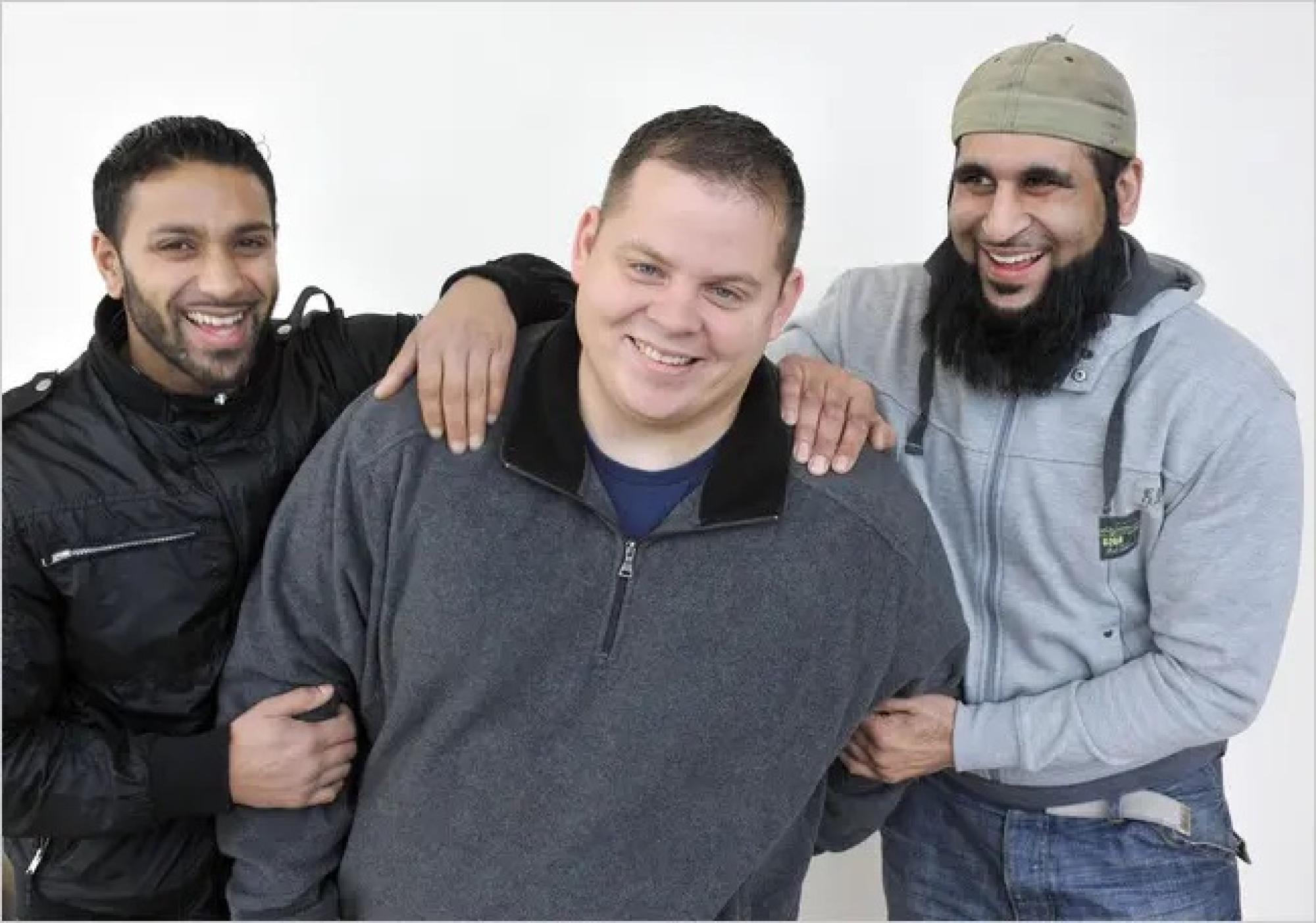
Highly controversial since it opened in 2002, Guantanamo prison was set up by President George Bush in the aftermath of the 9/11 attacks to house suspected terrorists". Why would a former Guantanamo Bay prison guard track down two of his former captives - two British men - and agree to fly to London to meet them? The last time Ruhal Ahmed met Brandon Neely, he was "behind bars, behind a cage and [Brandon] was on the other side". The location had been Camp X-Ray - the high-security detention camp run by the US in Guantanamo Bay. Mr Ahmed, originally from Tipton in the West Midlands, was among several hundred foreign terror suspects held at the centre. Mr Neely was one of his guards. Mr Neely, 29, ... left the US military in 2005 to become a police officer and was still struggling to come to terms with his time as a guard at Guantanamo. He felt anger at a number of incidents of abuse he says he witnessed, and guilt over one in particular. "The news would always try to make Guantanamo into this great place," he says, "like 'they [prisoners] were treated so great'. No it wasn't. You know here I was basically just putting innocent people in cages." This led to a spontaneous decision last year to reach out to his former prisoners. [Shafiq Rasul:] "At first I couldn't believe it. Getting a message from an ex-guard saying that what happened to us in Guantanamo was wrong was surprising more than anything." To Mr Neely's astonishment he received a reply and the pair began an exchange of e-mails. It was at this point that the BBC asked if both sides would be prepared to meet in person. They agreed. Each say they had genuinely found some sort of closure from meeting. The sense of relief in all their faces speaks volumes, and they leave the meeting closer to one another.
Latest
Latest News
Each news summary is created according to strict standards. Here's how we do it.
Each summary is created using a consistent editorial procedure. The target length is approximately 16 lines of 11-point Arial text in a 650-pixel-wide column. Up to 25% of a summary may be set in bold to emphasize the most important ideas. Summaries are composed of verbatim excerpts presented in the same sequence as they appear in the original news source, with very minor editorial additions. Where material has been omitted between excerpts, the omission is indicated with ellipses (...). Any words added by an editor for clarity or context appear in [brackets]. Our original news editor was Fred Burks. Tod Fletcher edited most summaries from 2007 through 2014, and Mark Bailey has served as news editor since 2014.