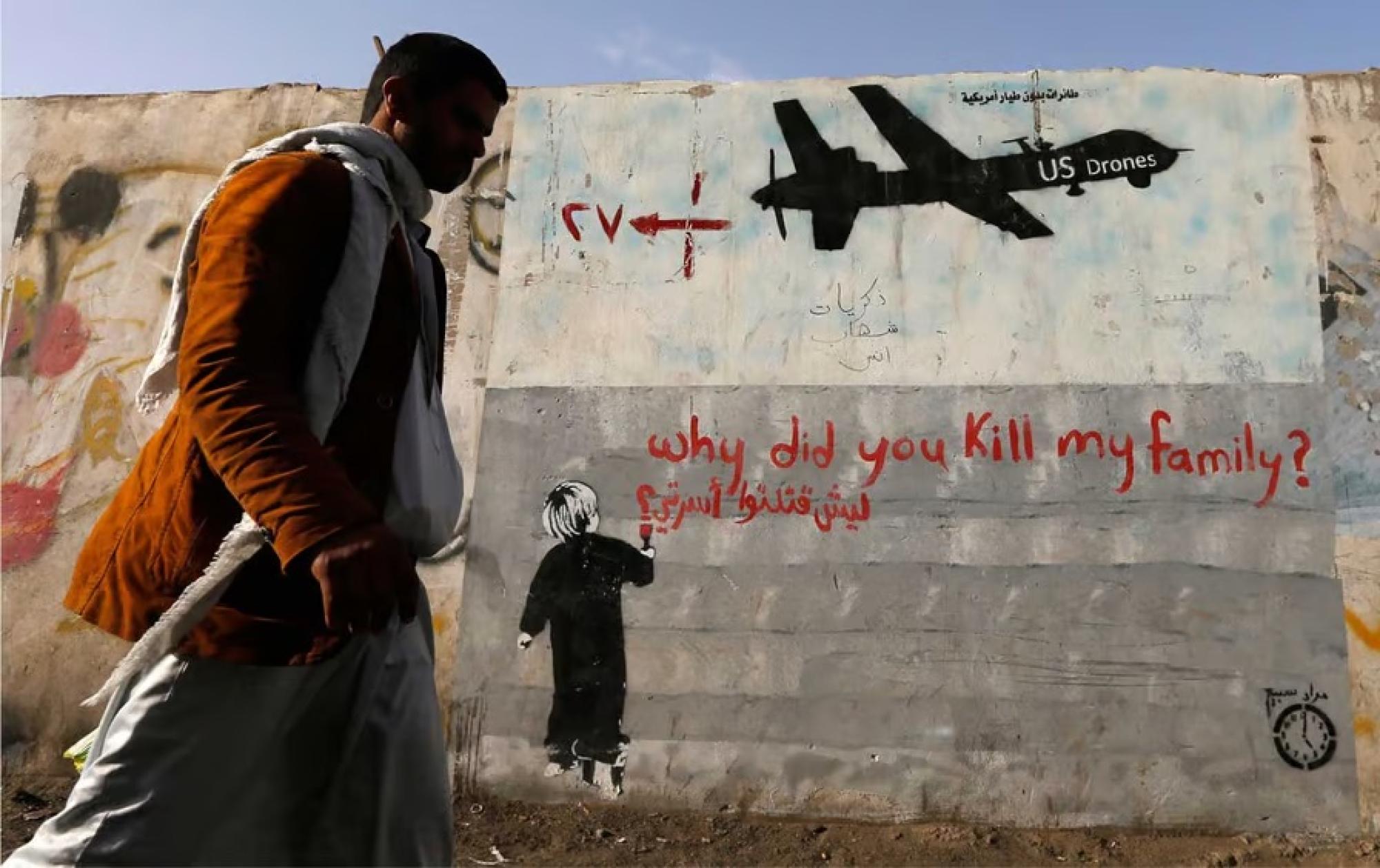
The day after the U.S. government began routinely bombing faraway places, the lead editorial in the New York Times expressed some gratification. Nearly four weeks had passed since 9/11 ... and America had finally stepped up its "counterattack against terrorism" by launching airstrikes on al-Qaeda training camps and Taliban military targets in Afghanistan. The Project on Defense Alternatives concluded that American air strikes had killed more than 1,000 [Afghan] civilians during the last three months of 2001. By mid-spring 2002, the Guardian reported, "as many as 20,000 Afghans may have lost their lives as an indirect consequence of the U.S. intervention." Under the "war on terror" rubric, open-ended warfare was well underway " "as if terror were a state and not a technique," as Joan Didion wrote in 2003. "We had seen, most importantly, the insistent use of September 11 to justify the reconception of America's correct role in the world as one of initiating and waging virtually perpetual war." Unlike those killed on 9/11, the Iraqi dead were routinely off the American media radar screen, as were the psychological traumas suffered by Iraqis and the decimation of their country's infrastructure. For the White House, the Pentagon, and Congress, the war on terror offered a political license to kill and displace people on a large scale in at least eight countries. The resulting carnage often included civilians. The dead and maimed had no names or faces that reached those who signed the orders and appropriated the funds.
Latest
Latest News
Each news summary is created according to strict standards. Here's how we do it.
Each summary is created using a consistent editorial procedure. The target length is approximately 16 lines of 11-point Arial text in a 650-pixel-wide column. Up to 25% of a summary may be set in bold to emphasize the most important ideas. Summaries are composed of verbatim excerpts presented in the same sequence as they appear in the original news source, with very minor editorial additions. Where material has been omitted between excerpts, the omission is indicated with ellipses (...). Any words added by an editor for clarity or context appear in [brackets]. Our original news editor was Fred Burks. Tod Fletcher edited most summaries from 2007 through 2014, and Mark Bailey has served as news editor since 2014.