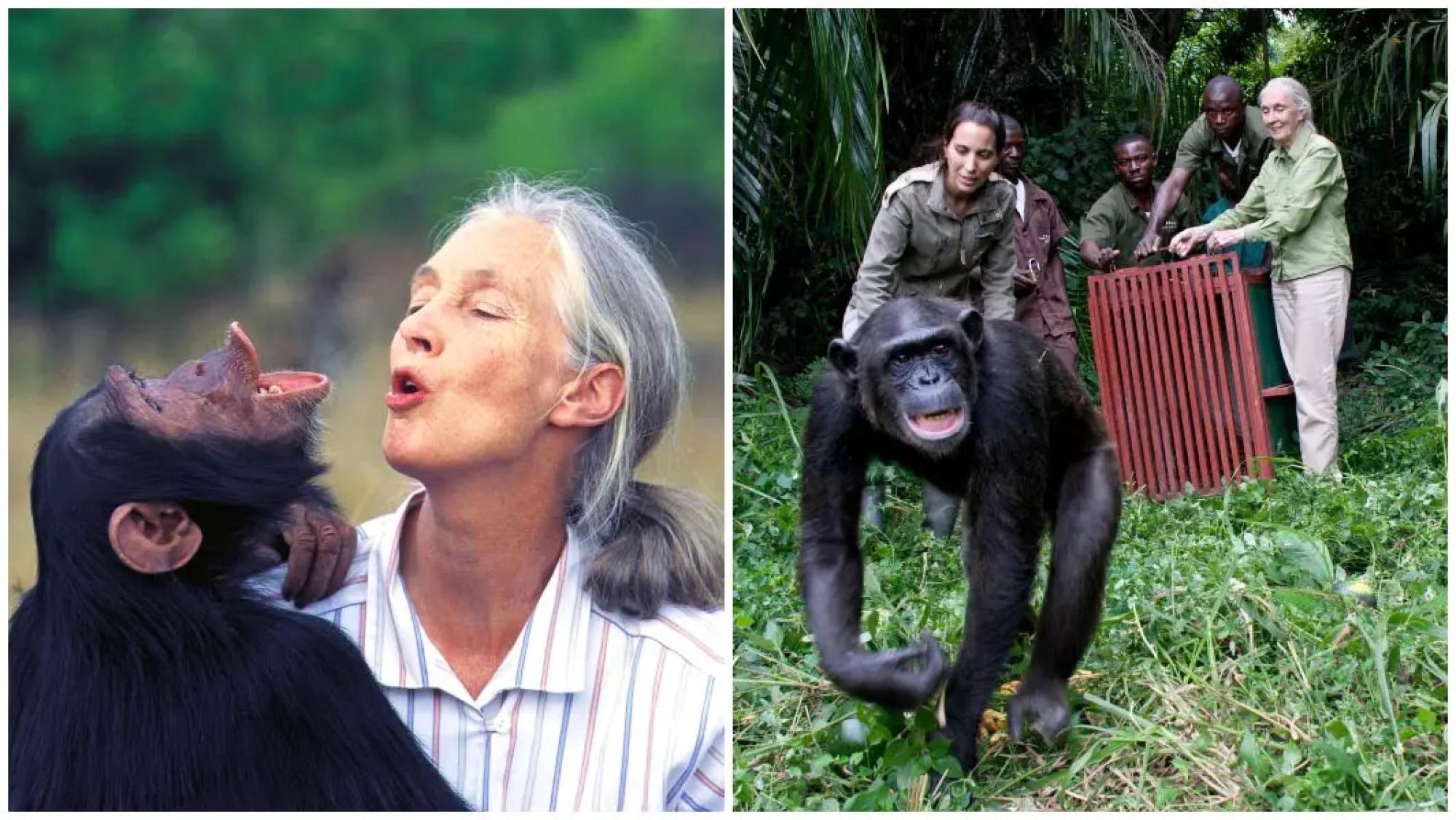
In 1986, [Dr. Jane Goodall] attended a conference in Chicago with researchers studying chimps in six areas of Africa, and the reports of environmental devastation shocked Goodall. Her activism evolved quickly, from chimps, to their habitat to human welfare, and how animal rights and the future of the planet are inherently interconnected. Some of her decisions have been deemed controversial: her friendship with for US Secretary of State James Baker, her work with Conoco ... oil company to build a chimpanzee sanctuary, hard conversations with the National Institutes of Health regarding their medical research and testing practices on chimpanzees and visiting their labs. I lost a lot of friends because of going into the labs, sitting down and talking to the people, organizing a conference to bring in the lab people, the scientists and also the animal welfare people ..."There were a lot of animal rights people who refused to speak to me " they said, 'Wow can you sit down with these evil people and have a cup of tea with them?' I was totally and completely flabbergasted. If you don't talk to people, how can expect them to change?" When speaking to the NIH, "I didn't stand there and accuse them of being cruel monsters. I showed slides and some film of the Gombe chimpanzees and talked about their lives, and then showed some slides of the chimps in the small cages and said, 'You know, it's like putting a person in a prison like that,'" said Goodall. "Many of the scientists said, 'We really have never thought about this in this way' a lot of them were actually crying." She stands by all of it because it produces results. It took decades, but the NIH phased out medical testing and research on chimpanzees. Conoco built the chimpanzee sanctuary, the Tchimpounga Chimpanzee Rehabilitation Center, saving all of the starving chimpanzees in the Brazzaville Zoo in the Republic of Congo. In this age of cancel culture and unprecedented political polarity, Goodall's pragmatism, and insistence that arguing does not change minds but appealing to people's hearts and to their better nature is what produces progress distinguishes her from contemporary activists.
Latest
Latest News
Each news summary is created according to strict standards. Here's how we do it.
Each summary is created using a consistent editorial procedure. The target length is approximately 16 lines of 11-point Arial text in a 650-pixel-wide column. Up to 25% of a summary may be set in bold to emphasize the most important ideas. Summaries are composed of verbatim excerpts presented in the same sequence as they appear in the original news source, with very minor editorial additions. Where material has been omitted between excerpts, the omission is indicated with ellipses (...). Any words added by an editor for clarity or context appear in [brackets]. Our original news editor was Fred Burks. Tod Fletcher edited most summaries from 2007 through 2014, and Mark Bailey has served as news editor since 2014.