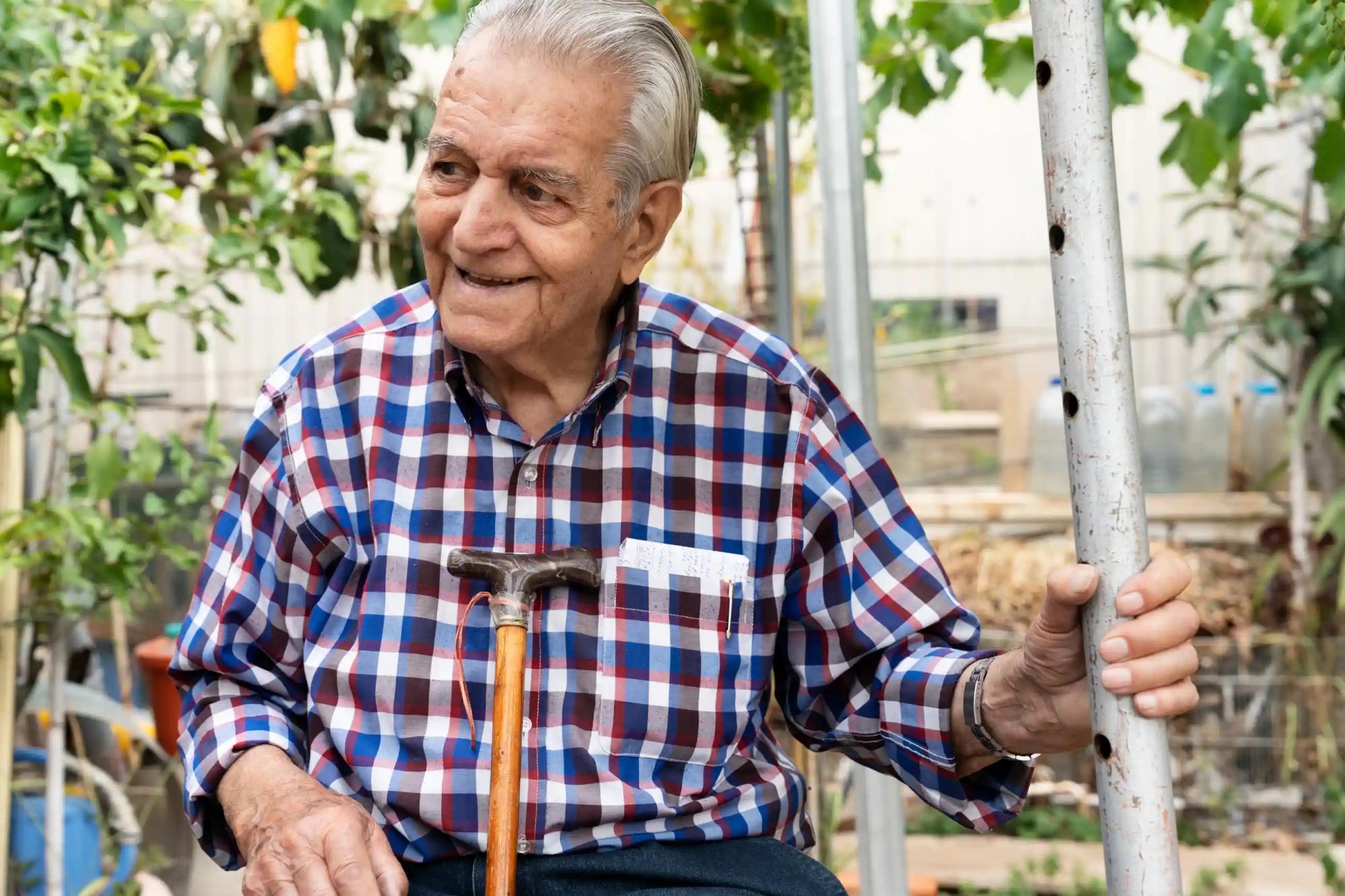
When Joan Carulla Figueres turned the roof terrace of his Barcelona apartment into a garden, it was out of nostalgia for his rural origins. Sixty-five years later, the ecological concepts he has long followed have become commonplace, and he is acclaimed as a pioneer of organic farming. Carulla, who celebrated his 100th birthday this year, is credited with creating the city's first roof garden. However, his "allotment in the sky" boasts far more than the usual tomato plants and pots of geraniums. It is home to more than 40 fruit trees, vines that produce 100kg (220lbs) of grapes a year, olives, peaches, figs, garlic, aubergines and even potatoes. He is passionate about potatoes. His approach to agriculture is what today we call organic, but Carulla insists he is not doing anything new and that poor farmers have always practised organic farming out of necessity. "My grandparents had little land and no money for fertiliser," he says. "They used animal and vegetable waste and straw. We lived a frugal life. We didn't go hungry, we just lived." Like his forebears, Carulla makes compost from everything, including old magazines and thin wooden fruit boxes. "There's almost nothing we don't use, everything decomposes eventually." If the war made him a vegetarian, it also made him a pacifist. He was 15 when Juneda was bombed and strafed by fascist warplanes. Carulla speaks with sorrow of the 117 people killed in the village and how the reprisals carried out by both sides at the end of the war broke his father's spirit and drove his mother to an early grave. "She was one of the war's silent victims," he says. "I think she died from pain and suffering." He also talks about how at the age of 10 he had an epiphany when he vowed to become un generador de amor (someone who generates love). "I don't know where this phrase came from, but I decided that what I had to do was to create love in everyone, universal love."
Latest
Latest News
Each news summary is created according to strict standards. Here's how we do it.
Each summary is created using a consistent editorial procedure. The target length is approximately 16 lines of 11-point Arial text in a 650-pixel-wide column. Up to 25% of a summary may be set in bold to emphasize the most important ideas. Summaries are composed of verbatim excerpts presented in the same sequence as they appear in the original news source, with very minor editorial additions. Where material has been omitted between excerpts, the omission is indicated with ellipses (...). Any words added by an editor for clarity or context appear in [brackets]. Our original news editor was Fred Burks. Tod Fletcher edited most summaries from 2007 through 2014, and Mark Bailey has served as news editor since 2014.