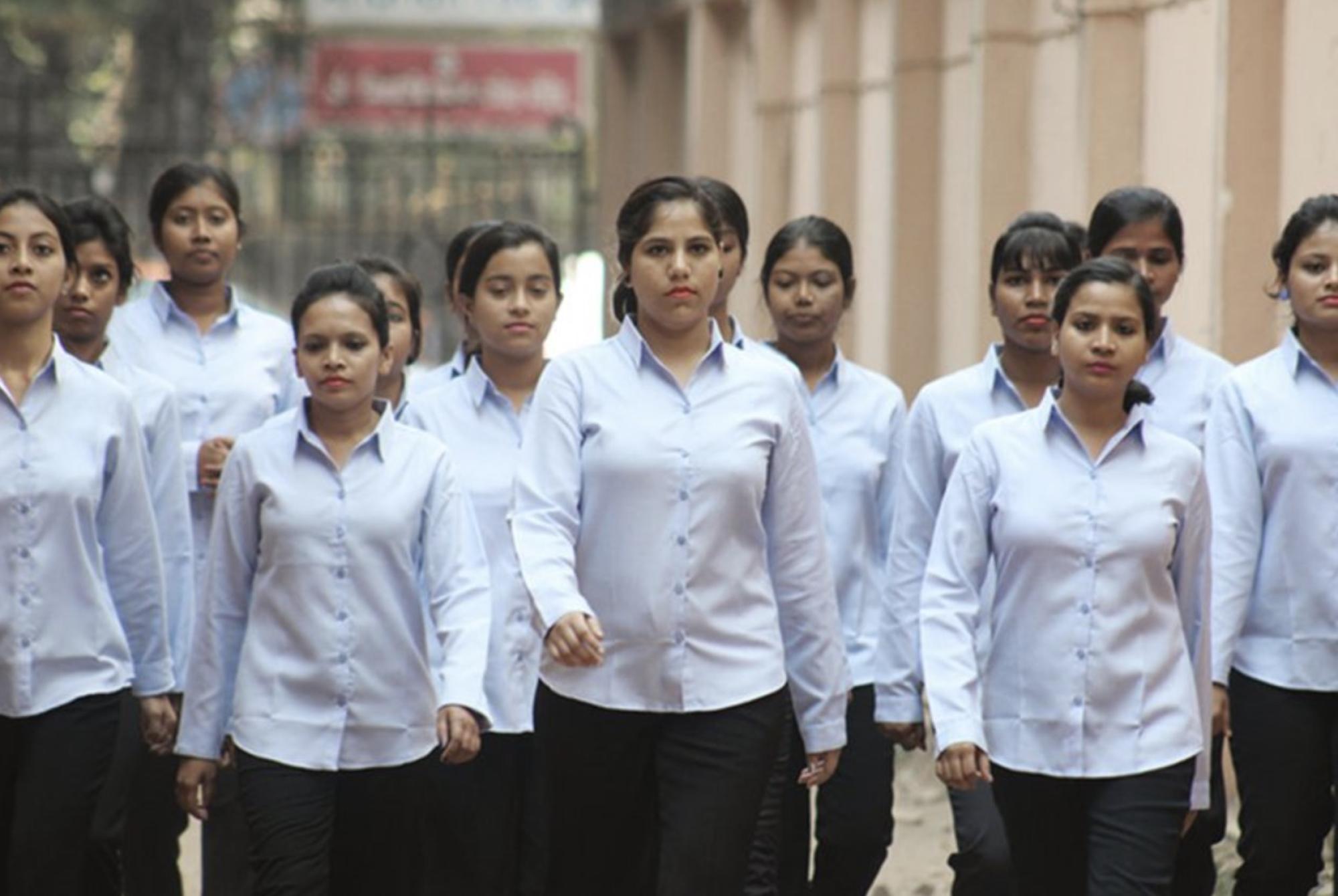
School for Justice empowers girls who have been victims of child trafficking by helping them attain degrees and jobs through which they can defend other trafficking victims. The school collaborates with local NGOs to identify trafficking survivors and helps them gain admission to universities to pursue law, social work and journalism degrees. Along the way, School for Justice provides the girls with an array of supports, and after completion of their studies, assists them in obtaining internships and jobs at law firms. "All the girls are very eager to pursue their education, especially law, and we give them all kinds of support for pursuing their studies and further internships and jobs," says Rishi Kant, one of the founders of Shaktivahini, the Delhi-based NGO that runs the program. Some become attorneys or paralegals, while others train to become police officers or journalists focused on human trafficking. Along the way, School for Justice helps them cover expenses for hostels, food, medical needs, traveling, internet charges and English communication classes. The program also runs trainings and workshops. Even as it works with trafficking victims specifically, the School for Justice is striving to ignite a broader conversation about the realities of child prostitution. "We should create awareness [among] not only girls, but also adolescent boys, about sex being a part of their life and to not treat it as a commodity available in the market," says Tapoti Bhowmick, senior program coordinator at the anti-trafficking NGO Sanlaap.
Latest
Latest News
Each news summary is created according to strict standards. Here's how we do it.
Each summary is created using a consistent editorial procedure. The target length is approximately 16 lines of 11-point Arial text in a 650-pixel-wide column. Up to 25% of a summary may be set in bold to emphasize the most important ideas. Summaries are composed of verbatim excerpts presented in the same sequence as they appear in the original news source, with very minor editorial additions. Where material has been omitted between excerpts, the omission is indicated with ellipses (...). Any words added by an editor for clarity or context appear in [brackets]. Our original news editor was Fred Burks. Tod Fletcher edited most summaries from 2007 through 2014, and Mark Bailey has served as news editor since 2014.