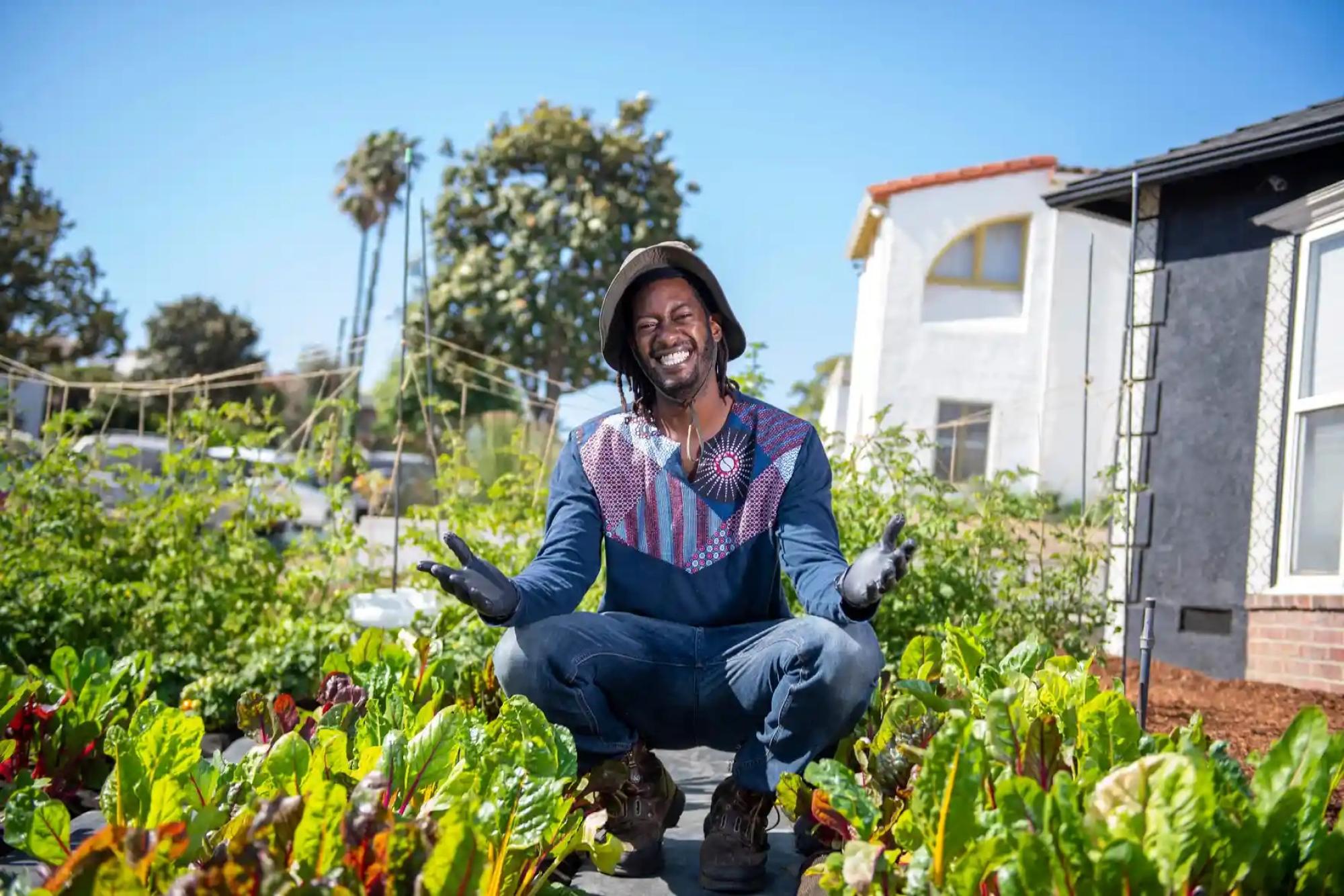
In South Los Angeles, Crop Swap LA volunteers and staffers harvested bags of freshly picked produce from the front yard of a residence. "Everything we're growing is nutrient-dense and the food remains in the neighborhood," says Jamiah Hargins, who founded Crop Swap LA in 2018 as a small monthly swap of surplus produce. After spending years in finance and consulting, Hargins decided to create a local food distribution system to address the fact that his neighborhood was a food desert, meaning most residents have little access to healthy food. It's now one of many Bipoc-led groups across the US that are reclaiming their agricultural heritage and redefining the local food movement by growing on traditional farms and unconventional spaces such as yards, medians and vacant lots as a way to increase food security and health in their own communities. There are similar groups run by communities of color across the US. After the Chicora-Cherokee community in North Charleston, South Carolina, was left without a grocery store for more than 10 years, Fresh Future Farm stepped in. Founded in 2014, the non-profit transformed a vacant lot into a flourishing urban farm that grows bananas, sugarcane, meyer lemons, satsuma oranges, collard greens, okra and tomatoes, among other crops. Two years later, it opened a sliding scale grocery store on the same property " the first one in the area in 11 years. The non-profit also teaches home gardening classes, which is inspiring a new crop of home growers.
Latest
Latest News
Each news summary is created according to strict standards. Here's how we do it.
Each summary is created using a consistent editorial procedure. The target length is approximately 16 lines of 11-point Arial text in a 650-pixel-wide column. Up to 25% of a summary may be set in bold to emphasize the most important ideas. Summaries are composed of verbatim excerpts presented in the same sequence as they appear in the original news source, with very minor editorial additions. Where material has been omitted between excerpts, the omission is indicated with ellipses (...). Any words added by an editor for clarity or context appear in [brackets]. Our original news editor was Fred Burks. Tod Fletcher edited most summaries from 2007 through 2014, and Mark Bailey has served as news editor since 2014.