















Media Articles
Below are key excerpts of revealing news articles from reliable news media sources. If any link fails to function, a paywall blocks full access, or the article is no longer available, try these digital tools.
For further exploration, delve into our comprehensive Information Centers.

Live streaming of child sex abuse via webcams is an emerging threat, experts have warned, amid a doubling of reported indecent images. The Child Exploitation and Online Protection Centre said children were being "abused to order". Offenders targeted vulnerable families overseas, paying them to facilitate child abuse, according to its report. CEOP said those carrying out abuse used a "hidden internet" to disguise their identity and avoid detection. The child protection body - part of Home Office's Serious Organised Crime Agency - said it received 8,000 reports of indecent images of children being shared last year. It said live streaming emerged in 2012 as a means of producing and distributing images. "We're seeing cases where they're effectively being abused to order for paying customers," chief executive Peter Davies told the BBC. He said some of those exploiting children via the internet were in the UK. An estimated 50,000 UK web users are involved in distributing abuse images. Children were forced to engage in sexual activity on live webcams in exchange for payment to the family or organised crime gangs. Tech-savvy paedophiles have turned to networks specifically designed to conceal the identity and location of their users. Using a variety of technological tricks, so-called "dark nets" - Tor, I2P, Freenet and many others - hide the giveaway identifiers while allowing people to go on using the web.
Note: For more on sexual abuse scandals, see the deeply revealing reports from reliable major media sources available here.
Of all the oddities of the U.S. health care system, one stands out: we spend far more on health care per person than other industrialized nations yet have no better health outcomes. Understanding why isnt easy. A 2012 paper by the Commonwealth Fund found that among 13 industrialized countries studied, the U.S. has the highest rate of obesity, which is usually a factor in higher health care costs. Yet, the U.S. ranks far behind many other countries in our rates of citizens who smoke or are over 55, two other strong indicators of increased spending. So why is our health care spending more than 17% of our gross domestic product, far more than any other country? A central reason U.S. health care spending is so high is that hospitals and doctors charge more for their services and theres little transparency about why. There is no uniformity to the system, in which public and private insurers have separate, unrelated contracts with hospitals and doctors. The result is a tangled, confusing and largely secretive collection of forces driving health care prices higher and higher. This isnt possible in many other countries either because governments set prices for health care services or broker negotiations between coalitions of insurers and providers. Known as all-payer rate setting, insurers in these systems band together to negotiate as groups. In contrast, U.S. insurers closely guard the secrecy of their contracted prices with health care providers and negotiate individually. This is why a hospital hosting five patients for knee replacements might get paid five different amounts for the surgeries.
Note: For more on corporate corruption, see the deeply revealing reports from reliable major media sources available here.
Can we make ourselves happier? According to studies from all over the globe collated by the World Happiness Database in Rotterdam, we can. But the path to happiness may not be where we are looking for it. Prof Ruut Veenhoven, Director of the Database and Emeritus professor of social conditions for human happiness at the Erasmus University in Rotterdam, says his own study found a slight negative correlation between the number of times people in a study spontaneously mentioned "goals" and their happiness. "Though it is generally assumed that you need goals to lead a happy life, evidence is mixed. The reason seems to be that unhappy people are more aware of their goals, because they seek to change their life for the better." Although there is some positive correlation between seeing meaning in life and being happy, studies suggest this is not a necessary condition for happiness. In fact, studies suggest leading an active life has the strongest correlation with happiness. "In order to lead a happy life, a rewarding life, you need to be active," says Veenhoven. "So involvement is more important to happiness than knowing the why, why we are here. Research has shown that we can make ourselves happier because happiness does change over time and these changes are not just a matter of better circumstances but of better dealing with life. Elderly people tend to be wiser, and for that reason, happier." Studies collated by the database say you tend to be happier if you: *Are in a long-term relationship *Are actively engaged in politics *Are active in work and in your free time *Go out for dinner *Have close friendships.
Note: For a treasure trove of great news articles which will inspire you to make a difference, click here.
Peter Doshi ... is one of the most influential voices in medical research today. Dr. Doshis renown comes not from solving the puzzles of cancer or discovering the next blockbuster drug, but from pushing the worlds biggest pharmaceutical companies to open their records to outsiders. Together with a band of far-flung researchers and activists, he is trying to unearth data from clinical trials complex studies that last for years and often involve thousands of patients across many countries and make it public. The current system, the activists say, is one in which the meager details of clinical trials published in medical journals, often by authors with financial ties to the companies whose drugs they are writing about, is insufficient to the point of being misleading. For years, researchers have talked about the problem of publication bias, or selectively publishing results of trials. Concern about such bias gathered force in the 1990s and early 2000s, when researchers documented how, time and again, positive results were published while negative ones were not. Taken together, studies have shown that results of only about half of clinical trials make their way into medical journals. In 2009, Dr. Doshi and his colleagues set out to answer a simple question about the anti-flu drug Tamiflu: Does it work? Resolving that question has been far harder than they ever envisioned, and, four years later, there is still no definitive answer.
Note: If the public is going to be taking these drugs, shouldn't all safety studies be publicly available? What are the drug companies hiding? For more on corruption in the pharmaceutical industry, see the deeply revealing reports from reliable major media sources available here.
Faced with a $19 billion fine for polluting Ecuadors rainforest, Chevron Corp. has done a remarkable job of turning the tables on its foes. The lawyers who sued Chevron in Ecuador, winning that eye-popping judgment, have come under non-stop attack from the oil company. Chevron has hauled them into court in New York, accusing them of fraud and extortion. The company has gone after Ecuadors judicial system as well, claiming judges there conspired with the other side. That aggressive strategy has worked wonders, putting Chevrons opponents on the defensive and convincing many people that the Ecuador suit is a sham. And you can trace much of that strategy back to a 2008 memo by San Franciscos master of crisis communications, Sam Singer. In October of 2008, he sent Chevron spokesman Kent Robertson a four-page memo outlining steps the company could take to change public perceptions of the Ecuador lawsuit. Singer recommended going on the offensive. The company should portray Ecuadors court system as corrupt, with collusion between judges and the plaintiffs in the lawsuit. Pointing out the leftward tilt of Ecuadoran President Rafael Correa wouldnt hurt. And Singer recommended counter attacks on the plaintiffs and their legal team, particularly lead lawyer Steven Donziger. Bear in mind that the memo was written more than two years before the Ecuadoran judge presiding over the lawsuit ruled against Chevron, in February of 2011. Some of Singers recommendations didnt fly. For example, he suggested portraying Ecuador as the next major threat to America. But the company took much of his advice to heart.
Former FBI supervisor John Morris thought he had left his sordid relationship with James "Whitey" Bulger back in Boston along with the envelopes of money, the cases of expensive wine, the home-cooked meals he had prepared for the accused mob boss. Then the phone rang one night. It was 1995 and Bulger had become a fugitive from justice. It was Bulger on the phone. And he was livid. A Boston newspaper had reported that Bulger was a longtime FBI informant, and Bulger wanted Morris to have the story retracted. "He said if he was going to jail ... I was going with him." Morris testified in the trial of Bulger, 83, who is accused of a string of crimes, including 19 murders. Testimony during the trial has stated Bulger ran a criminal enterprise with the help of corrupt FBI agents [John] Connolly and Morris, and that Bulger was an FBI informant concerning his criminal rivals. Morris' testimony put a spotlight on a staggering amount of corruption in the Boston FBI field office that included cash bribes and tip-offs to wiretaps. Connolly's relationship with Bulger extended into the Massachusetts State House, Morris testified. His friendship with Bulger's brother, then Senate President William Bulger, [could] land him a job as the Boston police commissioner upon his retirement from the bureau. Connolly's behavior did not raise any eyebrows with the Special Agents in Charge of the Boston FBI field office, Morris told the court. In fact it was quite the opposite. FBI bosses sought Connolly's friendship, Morris testified. "He had tremendous access across the board to everything including sports events, political figures," Morris testified.
Note: For more on major corruption within the FBI and other intelligence services, see the deeply revealing reports from reliable major media sources available here.
The Army is blocking all access to The Guardian newspaper's reports about the National Security Agency's sweeping collection of data about Americans' email and phone communications, an Army spokesman said Thursday. The Monterey (Calif.) Herald reported that employees at the Presidio of Monterey, an Army public affairs base about 100 miles south of San Francisco, were unable to gain access to The Guardian's articles on former NSA contractor Edward Snowden and his professed leaks of classified information about the intelligence programs. Late Thursday, an Army spokesman told The Herald by email that the newspaper's NSA reports were, in fact, being blocked across the entire Army. He wrote that it's routine for the Defense Department to take "network hygiene" action to prevent disclosure of classified information, The Herald reported. "We make every effort to balance the need to preserve information access with operational security," the newspaper quoted the spokesman as saying. "However there are strict policies and directives in place regarding protecting and handling classified information."
Note: To read the full story in the Monterey Herald, click here. For the Guardian's coverage of this, click here. Does the military have the right to censor its members' access to information?
Four Central Intelligence Agency officers were embedded with the New York Police Department in the decade after Sept. 11, 2001, including one official who helped conduct surveillance operations in the United States, according to a newly disclosed C.I.A. inspector generals report. That officer believed there were no limitations on his activities, the report said, because he was on an unpaid leave of absence, and thus exempt from the prohibition against domestic spying by members of the C.I.A. Another embedded C.I.A. analyst who was on its payroll said he was given unfiltered police reports that included information unrelated to foreign intelligence, the C.I.A. report said. The once-classified review, completed by the C.I.A. inspector general in December 2011, found that the four agency analysts more than had previously been known were assigned at various times to provide direct assistance to the local police. The report also raised a series of concerns about the relationship between the two organizations. The C.I.A. inspector general, David B. Buckley, found that the collaboration was fraught with irregular personnel practices, that it lacked formal documentation in some important instances, and that there was inadequate direction and control by agency supervisors. The declassification of the executive summary, in response to a Freedom of Information Act suit, comes ... comes amid lawsuits against the Police Department alleging unconstitutional surveillance of Muslim communities and mosques in New Jersey and New York.
Note: For more on the realities of intelligence agency operations, see the deeply revealing reports from reliable major media sources available here.
Volunteering is a simple way to help others, but its also a powerful way to help yourself. Beyond the good feelings youll get from donating your time, and the potential to develop new, meaningful relationships with people in your community, volunteering has a significant impact on your physical health, including a boost to your heart health. New research from Carnegie Mellon University, scheduled to be published in the journal Psychology and Aging, followed more than 1,000 adults between the ages of 51 and 91. Those who volunteered for at least 200 hours a year were 40 percent less likely to develop high blood pressure than those who did not. Research shows volunteering can cut your overall mortality risk by 47 percent, may lower your risk of depression and anxiety, and even boost your psychological well-being. The type of volunteer work appeared to be irrelevant. Rather, it was the amount of time spent doing it that mattered. The benefits are particularly pronounced among older adults, a population that tends to slow down once retirement hits. Social interaction, and the stress relief it can provide, is likely one major reason why volunteering has a beneficial effect on blood pressure, as its a well-known fact that stress elevates blood pressure. Blood pressure aside, volunteering is not only a boon for your heart health. Its likely that one reason volunteering is so beneficial is simply because it keeps you active and on your feet. Instead of resigning yourself to your couch, choosing to volunteer adds many hours of non-exercise activity to your life a key to optimal health.
Note: For a treasure trove of great news articles which will inspire you to make a difference, click here.
Did you know that the United States, Canada, Britain, Australia, and New Zealand participate together in an electronic eavesdropping cooperative called "The Five Eyes Alliance"? Or that Britain "has secretly gained access to the network of cables which carry the world's phone calls and internet traffic and has started to process vast streams of sensitive personal information which it is sharing with its American partner, the National Security Agency"? One key innovation has been GCHQ's ability to tap into and store huge volumes of data drawn from fibre-optic cables for up to 30 days so that it can be sifted and analysed. GCHQ and the NSA are consequently able to access and process vast quantities of communications between entirely innocent people, as well as targeted suspects. This includes recordings of phone calls, the content of email messages, entries on Facebook and the history of any internet user's access to websites - all of which is deemed legal, even though the warrant system was supposed to limit interception to a specified range of targets. Say you're the NSA. By law, there are certain sorts of spying you're not lawfully allowed to do on Americans. (And agency rules constraining you too.) But wait. Allied countries have different laws and surveillance rules. Put bluntly, intelligence agencies have an incentive to make themselves complicit in foreign governments spying on their own citizens.
Note: For more along these lines, see concise summaries of deeply revealing news articles on intelligence agency corruption and the disappearance of privacy from reliable major media sources.
A cadre of six government and non-government experts who served the National Transportation Safety Board when that independent federal agency investigated the explosion of a Boeing 747 off the coast of Long Island in July 1996 ... are the protagonists of a new documentary, "TWA Flight 800". After four years of investigation, the NTSB claimed the cause of Flight 800's explosion was a mechanical defect, but the new documentary, written and directed by journalist Kristina Borjesson, claims the FBI, NTSB and other government agencies may have covered up that the plane was brought down by a missile strike. Participants in the film have called on the NTSB to reopen the case based on altered physical evidence, suppressed data, and unexamined testimony from hundreds of eyewitnesses. [The] book Attention All Passengers: The Airlines Dangerous Descentand How to Reclaim Our Skies ... published last year ... thanked the brave men and women who are Federal Aviation Administration, Transportation Security Administration, and airline whistleblowers. These whistleblowers confirmed such problems as defective airline maintenance outsourcing, FAA oversight failures, TSA waste, and many other important findings. After watching the documentary, I believe there are enough smoking guns to warrant an unbiased reexamination. Last week one major news site was in near hysterics about the documentary, employing the term conspiracy ten times. Kristina Borjesson ... wasnt surprised, noting that reexamining hot topics discredits previous reporting.
Note: Kristina Borjesson is a long-time supporter of WantToKnow.info who has written a great piece on Flight 800, which we have posted at this link. She's also the editor of what may be the best book ever on media corruption and manipulation, Into the Buzzsaw. You can find an excellent two-page summary of the book at this link. For the engaging trailer to this film, click here.
The peculiar circumstances of journalist Michael Hastings' death in Los Angeles last week have unleashed a wave of conspiracy theories. Now there's another theory to contribute to the paranoia: According to a prominent security analyst, technology exists that could [have] allowed someone to hack his car. Former U.S. National Coordinator for Security, Infrastructure Protection, and Counter-terrorism Richard Clarke [said] that what is known about the single-vehicle crash is "consistent with a car cyber attack." Clarke said, "There is reason to believe that intelligence agencies for major powers" -- including the United States -- know how to remotely seize control of a car. "It's relatively easy to hack your way into the control system of a car, and to do such things as cause acceleration when the driver doesn't want acceleration, to throw on the brakes when the driver doesn't want the brakes on, to launch an air bag," Clarke told The Huffington Post. Hastings was driving a 2013 Mercedes C250 coupe when he crashed into a tree on Highland Ave. in Los Angeles at approximately 4:30 am on June 18. Video posted online showed the car in flames, and one neighbor told a local news crew she heard a sound like an explosion. Another eyewitness said the car's engine had been thrown 50 to 60 yards from the car. There were no other vehicles involved in the accident. The fire was so all-consuming that it took the Los Angeles County coroner's office two days to identify Hastings' body, but Clarke said a cyber attack on the vehicle would have been nearly impossible to trace "even if the dozen or so computers on board hadn't melted."
Note: For a video of a DARPA specialist talking about how any computerized function of a car can be taken over, click here. This news article shows how a university test proved a car's onboard computer can be hacked. For an excellent video presenting powerful evidence that Hastings' death was anything but suicide, click here. For a Fox News video showing other evidence of premeditated murder, click here. In this video, a good friend states he had just received an email from Hastings that he had a story on the CIA that would be the biggest story yet. A later email then said he was worried as he was now under FBI investigation.
[Barrett] Brown is not a household name like Edward Snowden or Bradley Manning. But after helping expose a dirty tricks plot, he faces jail. Brown made a splash in February 2011 by helping to uncover "Team Themis", a project by intelligence contractors retained by Bank of America to demolish the hacker society known as Anonymous. The Team Themis story began in late 2010, when Julian Assange warned WikiLeaks would release documents outlining an "ecosystem of corruption [that] could take down a bank or two." Bank of America went into damage-control mode and, as the New York Times reported, assembled "a team of 15 to 20 top Bank of America officials scouring thousands of documents in the event that they become public." Days later, Bank of America retained the well-connected law firm of Hunton & Williams [which] "proposed various schemes to attack" WikiLeaks. Its partners suggested creating false documents and fake personas to damage progressive organizations. The tech companies' emails which Anonymous hacked and Barrett Brown helped publicize listed planned tactics: "Feed[ing] the fuel between the feuding groups. Disinformation. Create messages around actions to sabotage or discredit the opposing organization. Submit fake documents and then call out the error." Brown [has] been cooling his heels in a jail outside Dallas ... awaiting two separate trials that could put him on ice for more than 100 years. In contrast to the FBI's aggressive pursuit of Brown, no probe of the Team Themis project was launched despite a call from 17 US House representatives to investigate a possible conspiracy to violate federal laws.
Note: With the wide focus on the privatized national security state by the leaks from Edward Snowden, there is renewed interest in Brown's plight and the campaign for justice in his case. For more on this and to support Barret Brown, click here. For more on intelligence agency corruption, see the deeply revealing reports from reliable major media sources available here.
In March, the head of the Centers for Disease Control issued an alarm, echoed by virtually every health authority in the world, that antibiotic-resistant bacteria threaten to return humans to the days when ordinary infections routinely killed and maimed. Yet the United States continues to use at least 70 percent of its antibiotics on livestock. Millions of pounds of antibiotics are routinely administered at low doses to large numbers of animals living in crowded conditions ... to speed their growth and prevent possible infections, creating ideal conditions for bacteria to become resistant. At the same time, drug-resistant infections acquired in hospitals kill 70,000 people a year. The problem is so dire that the Obama administration is paying drug companies to develop new antibiotics, and some groups want to test them directly on sick people to speed approval. While many physicians try to limit antibiotic use on sick patients to slow the spread of resistance, livestock growers can buy antibiotics over the counter at a feed store. "Many hospitals have implemented antimicrobial stewardship programs, in which every milligram of antibiotic use is scrutinized," said Dr. Tom Newman, a professor of epidemiology and biostatistics at UCSF. About once a month, Brad Spellberg, an infectious disease researcher at Harbor-UCLA Medical Center, said he sees patients with abdominal or urinary tract E. coli infections that resist all oral antibiotics. Doctors are down to "one or two last-ditch IVs," or intravenous administration of antibiotics against some bacteria.
Note: For more on important health issues, see the deeply revealing reports from reliable major media sources available here.
Camp Kesem, which gets its name from the Hebrew word for "magic," is a transformative experience for most of the campers, who spend a week between Woodside and La Honda, amid the redwoods of the Santa Cruz Mountains. "A lot of them resist it before they come," said camp director Heather Paul, "and then they get here and find out it's not a cancer camp." Unlike other camps, which often forbid phone calls to and from parents, Camp Kesem has a hotline specifically for that purpose. "For a lot of them, the homesickness can be intense," Paul said, "especially if the parent was recently diagnosed." There had long been camps for children suffering from cancer and other life-threatening diseases, but until Stanford University's Hillel organization started Camp Kesem 13 years ago, there was almost no place for kids from families stricken with the disease to turn when they needed a break from watching their parents' suffering. "Kesem is a little haven where everyone understands and supports each other," said 15-year-old Juliane Bombosch, of San Bruno, whose mother was diagnosed with stage 4 breast cancer. Juliane this year is attending her fourth Kesem, and among the 120 campers and 75 counselors -- all undergraduate volunteers from Stanford -- are many who keep coming back until they exceed the age limit. There are 37 Kesems nationwide, with another five expected to be available next year, but because cancer is expensive, the camps remain free of charge -- and fundraising is a constant challenge.
Note: For a treasure trove of great news articles which will inspire you to make a difference, click here.
Britain's spy agency GCHQ has secretly gained access to the network of cables which carry the world's phone calls and internet traffic and has started to process vast streams of sensitive personal information which it is sharing with its American partner, the National Security Agency (NSA). The sheer scale of the agency's ambition is reflected in the titles of its two principal components: Mastering the Internet and Global Telecoms Exploitation, aimed at scooping up as much online and telephone traffic as possible. This is all being carried out without any form of public acknowledgement or debate. One key innovation has been GCHQ's ability to tap into and store huge volumes of data drawn from fibre-optic cables for up to 30 days so that it can be sifted and analysed. GCHQ and the NSA are consequently able to access and process vast quantities of communications between entirely innocent people, as well as targeted suspects. This includes recordings of phone calls, the content of email messages, entries on Facebook and the history of any internet user's access to websites all of which is deemed legal, even though the warrant system was supposed to limit interception to a specified range of targets. The existence of the programme has been disclosed in documents shown to the Guardian by the NSA whistleblower Edward Snowden. Britain's technical capacity to tap into the cables that carry the world's communications ... has made GCHQ an intelligence superpower. A total of 850,000 NSA employees and US private contractors with top secret clearance had access to GCHQ databases.
Note: For solid evidence spy agencies targeted even top politicians, click here. For more on intelligence agency corruption, see the deeply revealing reports from reliable major media sources available here.
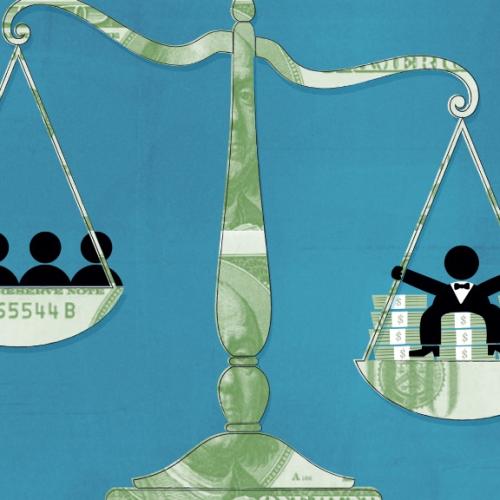
JEFFREY BROWN: Does the amount of wealth you have affect the kind of person you are? NewsHour economics correspondent PAUL SOLMAN: In California, you're supposed to stop for a pedestrian at a crosswalk. And, in a recent study, some 90 percent of drivers did, except for those driving luxury cars. They were almost as likely to run the intersection as wait for the person to cross the street. PAUL PIFF, University of California, Berkeley: Drivers of those BMWs, those Porsches, those Mercedes were anywhere from three to four times more likely to break the law, than drivers of less expensive, low-status cars. WOMAN: Oh, by the way, there's candy there. It's actually for children for another study, but you're welcome to take a few pieces if you want to. [Other] WOMAN: Thank you. PAUL SOLMAN: That's the script an experimenter recited to every subject. And the results? PAUL PIFF: Wealthier participants took two times as much candy from children as did poor participants. PAUL SOLMAN: So, experimental evidence that rich people are more likely to break the law while driving, help themselves to candy meant for children, cheat in a game of chance, also to lie during negotiations and endorse unethical behavior, including stealing at work. The academic paper that resulted made headlines everywhere, the Wall Street Journal article leading with the question, "Ready the Pitchforks?" PAUL SOLMAN: Psychology professor Dacher Keltner is Paul Piff's [co-author]. DACHER KELTNER: We publish these studies in relatively obscure scientific journals, and literally the next day we're getting hundreds of e-mails from around the world, and a lot quite hostile.
Note: Don't miss the fascinating video at the link above, which is also available here. Note that it is not about rich people being unethical, it's about human behavior. People tend to become more unethical the more money they have. For more on income inequality, see the deeply revealing reports from reliable major media sources available here.
Russ Tice, a former intelligence analyst and Bush-era NSA whistleblower, claimed Wednesday that the intelligence community has ordered surveillance on a wide range of groups and individuals, including high-ranking military officials, lawmakers and diplomats. They went after and I know this because I had my hands literally on the paperwork for these sort of things they went after high-ranking military officers. They went after members of Congress, both Senate and the House, especially on the intelligence committees and on the armed services committees," [said] Tice. But they went after other ones, too. They went after lawyers and law firms. They went after judges. One of the judges is now sitting on the Supreme Court. Two are former FISA court judges. They went after State Department officials. They went after people in the executive service that were part of the White House. Then Tice dropped the bombshell about Obama. "In summer of 2004, one of the papers that I held in my hand was to wiretap a bunch of numbers associated with a 40-something-year-old wannabe senator for Illinois ... thats the president of the United States now. FBI whistleblower Sibel Edmonds and Tice agreed that such wide-ranging surveillance of officials could provide the intelligence agencies with unthinkable power to blackmail their opponents. I was worried that the intelligence community now has sway over what is going on, Tice said. Tice first blew the whistle on ... domestic spying across multiple agencies in 2005.
Note: Listen to Tice's shocking revelations in this interview. For more along these lines, see concise summaries of deeply revealing news articles about corruption in government and throughout intelligence agencies.
Drug companies face accusations of secretly colluding with pharmacists to overcharge the NHS millions of pounds, following an undercover investigation by The Telegraph. Pharmaceutical firms appear to have rigged the market in so-called "specials" prescription drugs that are largely not covered by national NHS price regulations. The prices of more than 20,000 drugs could have been artificially inflated, with backhanders paid to chemists who agreed to sell them. Representatives of some companies agreed to invoice chemists for drugs at up to double their actual cost. Chemists would then send inflated invoices to the NHS, allowing them to pocket the difference. Tens of thousands of the "special" drugs are not on the nationally controlled NHS price list and so costs can be manipulated by drug companies. Sales representatives for drug firms were secretly recorded by this newspaper offering to provide apparently falsified invoices allowing chemists to bill the NHS for sums far greater than they would spend. Another firm offered to pay an annual fee to chemists who agreed to offer its prescription drugs. Hundreds of millions of pounds of taxpayers money are feared to have been wasted in recent years due to the practice. The undercover investigation was launched after this newspaper was approached by a whistle-blower who alleged widespread malpractice. Undercover reporters posed as investors hoping to set up a chain of chemists.
Note: Watch the incriminating videos of these undercover deals at the link above. For more on pharmaceutical corruption, see the deeply revealing reports from reliable major media sources available here.
As part of its "Food With Integrity" program, Chipotle this week posted information on its website identifying which items on its menu contain genetically modified ingredients. The chain posted a chart noting that 12 out of 25 ingredients, including its rice, barbacoa, chips, chicken, vegetable fajitas, steak and flour tortillas (except in certain restaurants) use either genetically modified corn or soybean oil, the vast majority of which is derived from GM soybeans. The chain said that those ingredients are "currently unavoidable" but that it is "working hard" to eliminate them. This move comes on the heels of Ben & Jerry's announcement that all of its flavors will be GM ingredient free by the end of the year and Whole Foods pledge to phase out all foods with GM ingredients by 2018. Although GM crops ... are considered safe by federal authorities and are legal to plant and sell, some independent studies have linked them to health and environmental problems. The announcements happen amid a flurry of state bills to require mandatory labeling of food with GM ingredients. In more GM news, this afternoon the U.S. Senate passed a bipartisan amendment to require labeling of GM salmon as part of a 2014 Agriculture Appropriations bill. Overseas, where the labeling question is largely over, the GM debate rages over expanding GM crop planting approvals in the European Union. Asked [whether UK Prime Minister David] Cameron would eat GM foods or allow his children to eat them, the spokesman steadfastly declined to answer.
Note: Much of Europe labels their food for GMOs, which are even banned in many areas. Read an MSN article on the banning of GM foods from all restaurants and food in the UK's parliament at this link. For a treasure trove of great news articles which will inspire you to make a difference, click here.
Important Note: Explore our full index to key excerpts of revealing major media news articles on several dozen engaging topics. And don't miss amazing excerpts from 20 of the most revealing news articles ever published.