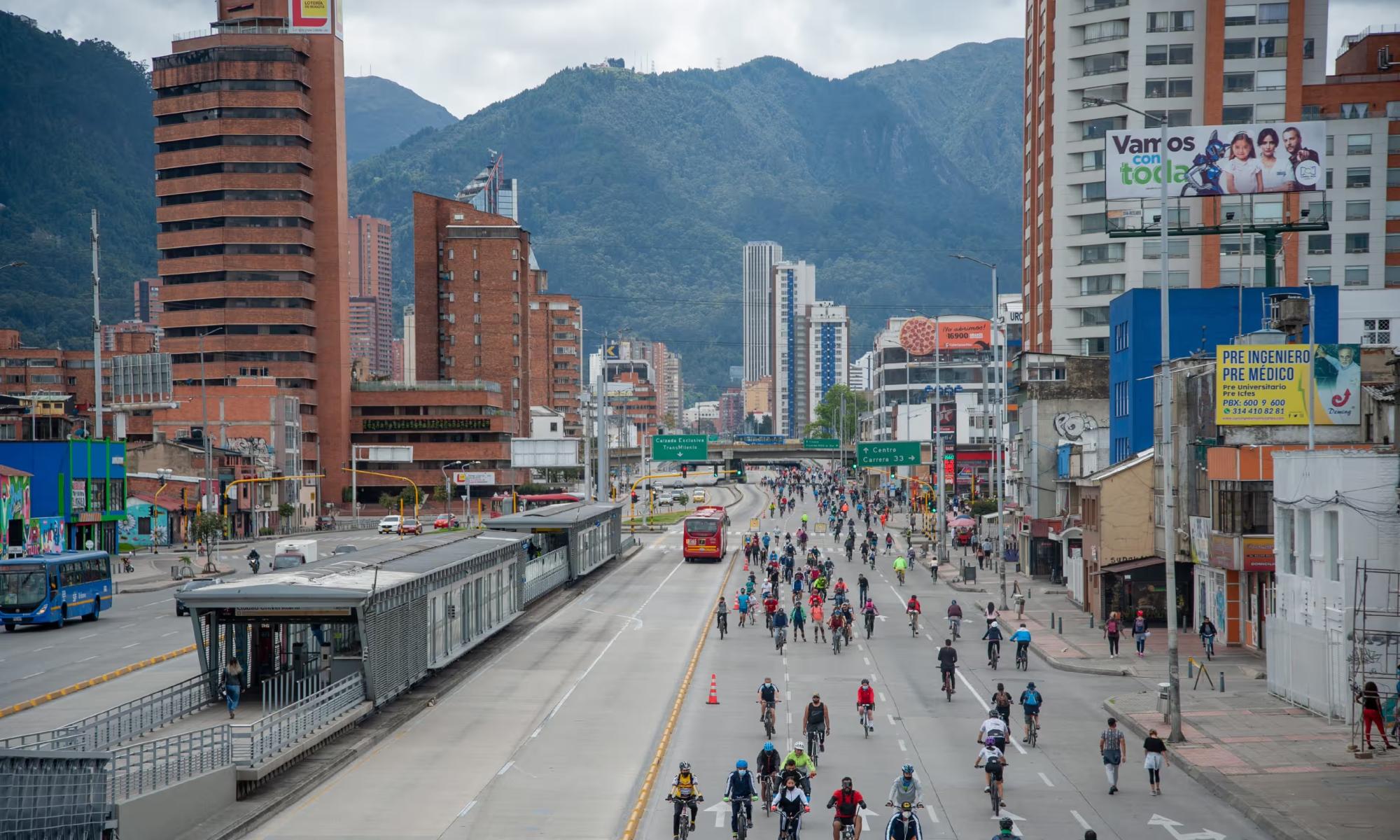
Once a week the citizens of Bogotá take back the streets of their city. Every Sunday, between 7am and 2pm, many of the biggest roads are shut to cars and left open to bikes, skates and feet. "Ciclovía is really cool because there is a lot more space for us," says seven-year-old Oliver Rojas, who is out cycling with his parents and is baffled to hear that this innovative scheme does not exist in the rest of the world. The weekly event was born out of a one-day protest in 1974 against cars taking over the world's streets. It now covers 127 km (79 miles) of streets in the city and, on average, 1.5 million Bogotanos use the Ciclovía every Sunday. It has spread to most other Colombian cities and has been copied by mayors across the world, from Buenos Aires to Bengaluru, who hope the initiative can help get people in shape, improve mental health, reduce car usage and help fight climate change in the way that it has in Colombia. Part of the attraction is the fun and the family-friendly atmosphere. Bogotá's cycleways are punctuated with aerobics classes, people selling fresh juices, and the sound of salsa. On a regular weekday, the level of PM 2.5 particles on the main road through Bogotá ... is dangerously high at 65 µg/m3. During Ciclovía, however, that number falls to 5 µg/m3 on the same stretch of road 13 times less and in line with the WHO's recommendations for the tiny, harmful particles. Noise levels are seven times lower.
Latest
Latest News
Each news summary is created according to strict standards. Here's how we do it.
Each summary is created using a consistent editorial procedure. The target length is approximately 16 lines of 11-point Arial text in a 650-pixel-wide column. Up to 25% of a summary may be set in bold to emphasize the most important ideas. Summaries are composed of verbatim excerpts presented in the same sequence as they appear in the original news source, with very minor editorial additions. Where material has been omitted between excerpts, the omission is indicated with ellipses (...). Any words added by an editor for clarity or context appear in [brackets]. Our original news editor was Fred Burks. Tod Fletcher edited most summaries from 2007 through 2014, and Mark Bailey has served as news editor since 2014.