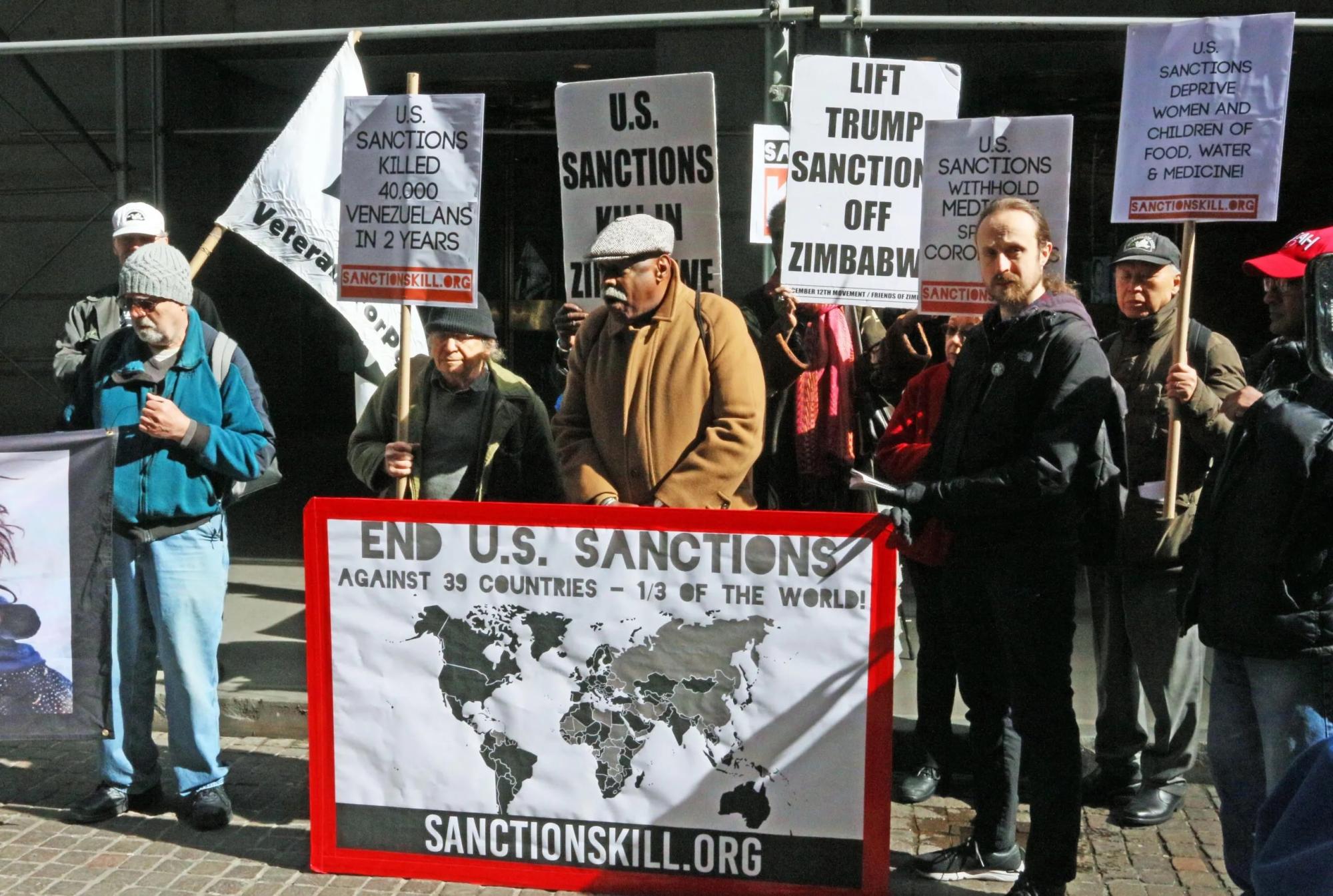
According to the Global Sanctions Database, the United States, European Union, and UN have sanctioned 25% of the countries in the world. The United States by itself sanctioned 40% of these countries, sanctions that are unilateral because they do not have the assent of a UN Security Council resolution. In the 1960s, only 8% of the world's countries were under sanctions. This inflation of sanctions demonstrates that it has become normal for the powerful North Atlantic states to wage wars without having to fire a bullet. As US President Woodrow Wilson said in 1919 at the formation of the League of Nations, sanctions are 'something more tremendous than war'. The cruellest formulation of Wilson's statement was made by Madeleine Albright, then the US ambassador to the UN, regarding the US sanctions against Iraq in the 1990s. From 1990 to 1996, sanctions ... resulted in the excess deaths of over 500,000 children under the age of five. The number of people who die because of sanctions is greater than the number of battle-related casualties (106,000 deaths per year) 'and similar to some estimates in the total death toll of wars including civilian casualties (around half a million deaths per year)'. The most vulnerable population groups, as you would expect, are children under five and older people. Deaths of children under five years 'represented 51% of total deaths caused by sanctions over the 1970"2021 period'.
Latest
Latest News
Each news summary is created according to strict standards. Here's how we do it.
Each summary is created using a consistent editorial procedure. The target length is approximately 16 lines of 11-point Arial text in a 650-pixel-wide column. Up to 25% of a summary may be set in bold to emphasize the most important ideas. Summaries are composed of verbatim excerpts presented in the same sequence as they appear in the original news source, with very minor editorial additions. Where material has been omitted between excerpts, the omission is indicated with ellipses (...). Any words added by an editor for clarity or context appear in [brackets]. Our original news editor was Fred Burks. Tod Fletcher edited most summaries from 2007 through 2014, and Mark Bailey has served as news editor since 2014.