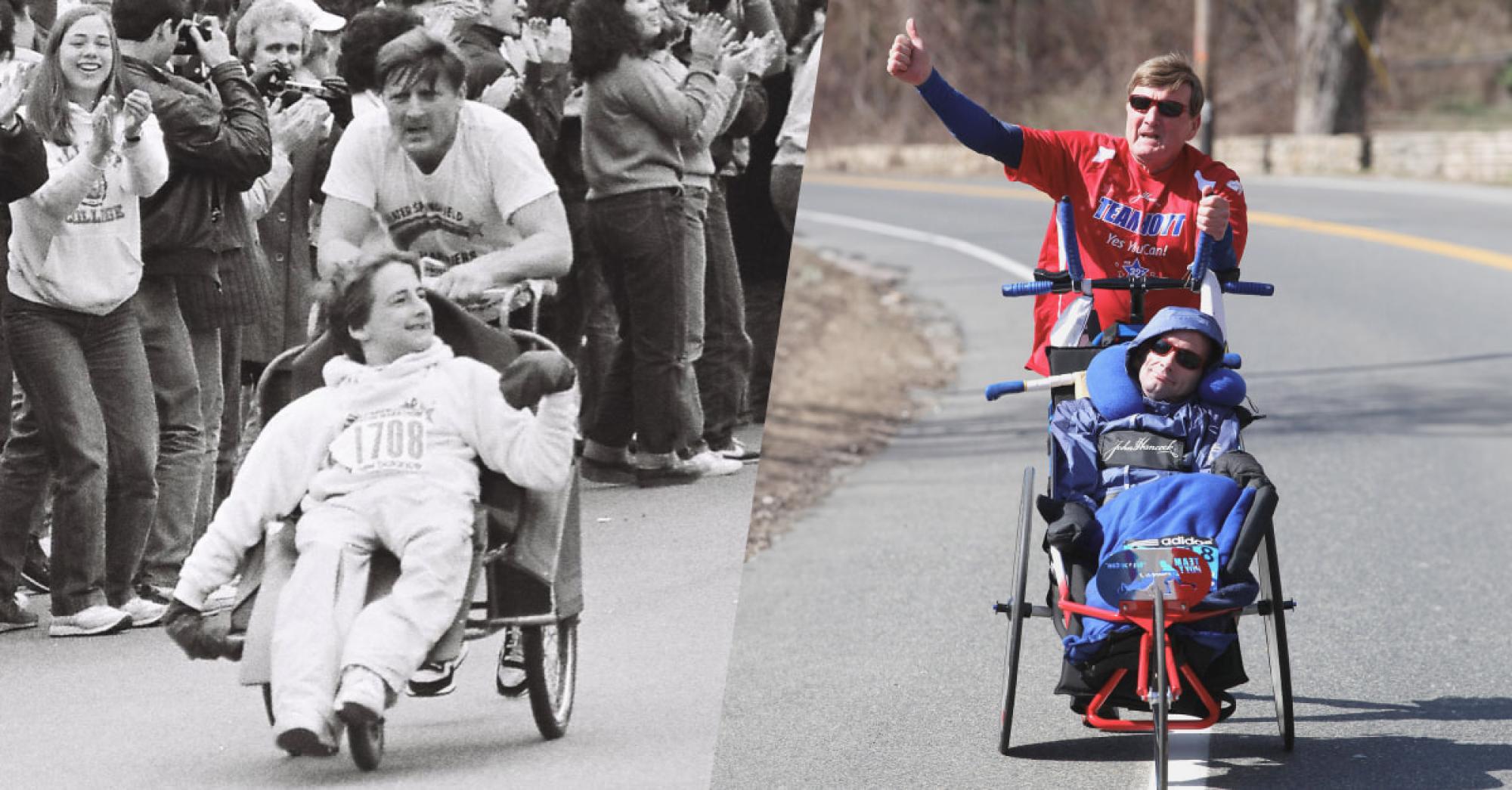
By his own assessment, Dick Hoyt wasn't in racing shape the first time his teenage son Rick, a quadriplegic with cerebral palsy, asked if they could participate in a 5-mile fund-raising race father pushing son in a wheelchair. "I said, 'Yeah, let's go down there and try it.' I had no idea what would happen, and nobody else did, either," Mr. Hoyt later recalled. "Most people expected us to go down to the corner and come back, but we ended up doing the whole thing." From those first racing steps, the two became legends in running circles and inspirational worldwide as they participated in more than 1,000 competitions, including dozens of marathons and multiple triathlons. Mr. Hoyt ... was 80 when he died of heart failure Wednesday. Though Mr. Hoyt and Rick posted a best time of 2:40:47 in the Marine Corps Marathon " a pace many marathoners will never touch running alone " the teaming of father and son was, for both, more important than all else. "When we're out there," Mr. Hoyt told the Globe in 1990, "there's nothing I feel I can't do with Rick." "Dick started this whole movement of duos, and Team Hoyt inspired thousands of people around the world," said longtime Boston Marathon race director Dave McGillivray. "He helped open the door to people believing in themselves, and the walls of intimidation crumbled." Most runners would be too intimidated to even try what Mr. Hoyt did over and over again " push a wheelchair carrying a boy, who became a grown man, up and down hills for 26.2 miles.
Latest
Latest News
Each news summary is created according to strict standards. Here's how we do it.
Each summary is created using a consistent editorial procedure. The target length is approximately 16 lines of 11-point Arial text in a 650-pixel-wide column. Up to 25% of a summary may be set in bold to emphasize the most important ideas. Summaries are composed of verbatim excerpts presented in the same sequence as they appear in the original news source, with very minor editorial additions. Where material has been omitted between excerpts, the omission is indicated with ellipses (...). Any words added by an editor for clarity or context appear in [brackets]. Our original news editor was Fred Burks. Tod Fletcher edited most summaries from 2007 through 2014, and Mark Bailey has served as news editor since 2014.