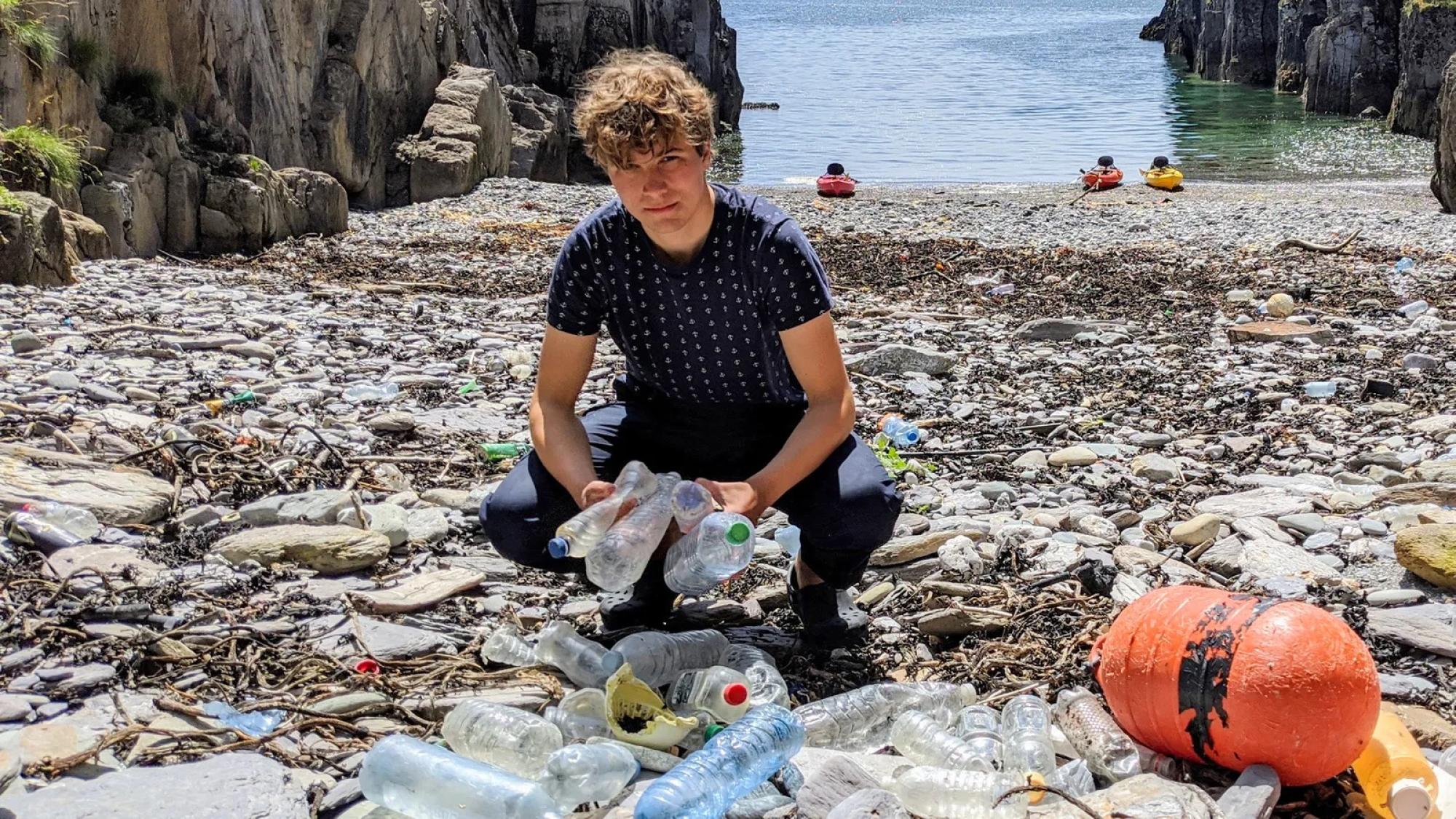
Huge amounts of plastic ends up rivers and oceans every year, harming the environment and potentially also human health. But what if we could pull it out of water with the power of magnets? [Chemistry student] Ferreira became determined to find a solution to remove microplastics from water. He started by designing his own spectrometer, a scientific instrument that uses ultraviolet light to measure the density of microplastics in solutions. I could see there were a lot of microplastics in the water and they weren't just coming from big plastic breaking down in the sea," he says. It was on his local beach that Ferreira came up with a solution that could extract microplastics from water. "I found some oil spill residue with loads of plastic attached to it," he says. "I realised that oil could be used to attract plastic." Ferreira mixed vegetable oil with iron oxide powder to create a magnetic liquid, also known as ferrofluid. He then blended in microplastics from a wide range of everyday items, including plastic bottles, paint and car tyres, and water from the washing machine. After the microplastics attached themselves to the ferrofluid, Ferreira used a magnet to remove the solution and leave behind only water. Following 5,000 tests, Ferreira's method was 87% effective at extracting microplastics from water. Ferreira is currently in the process of designing a device which uses the magnetic extraction method to capture microplastics as water flows past it. The device will be small enough to fit inside waterpipes to continuously extract plastic fragments.
Latest
Latest News
Each news summary is created according to strict standards. Here's how we do it.
Each summary is created using a consistent editorial procedure. The target length is approximately 16 lines of 11-point Arial text in a 650-pixel-wide column. Up to 25% of a summary may be set in bold to emphasize the most important ideas. Summaries are composed of verbatim excerpts presented in the same sequence as they appear in the original news source, with very minor editorial additions. Where material has been omitted between excerpts, the omission is indicated with ellipses (...). Any words added by an editor for clarity or context appear in [brackets]. Our original news editor was Fred Burks. Tod Fletcher edited most summaries from 2007 through 2014, and Mark Bailey has served as news editor since 2014.