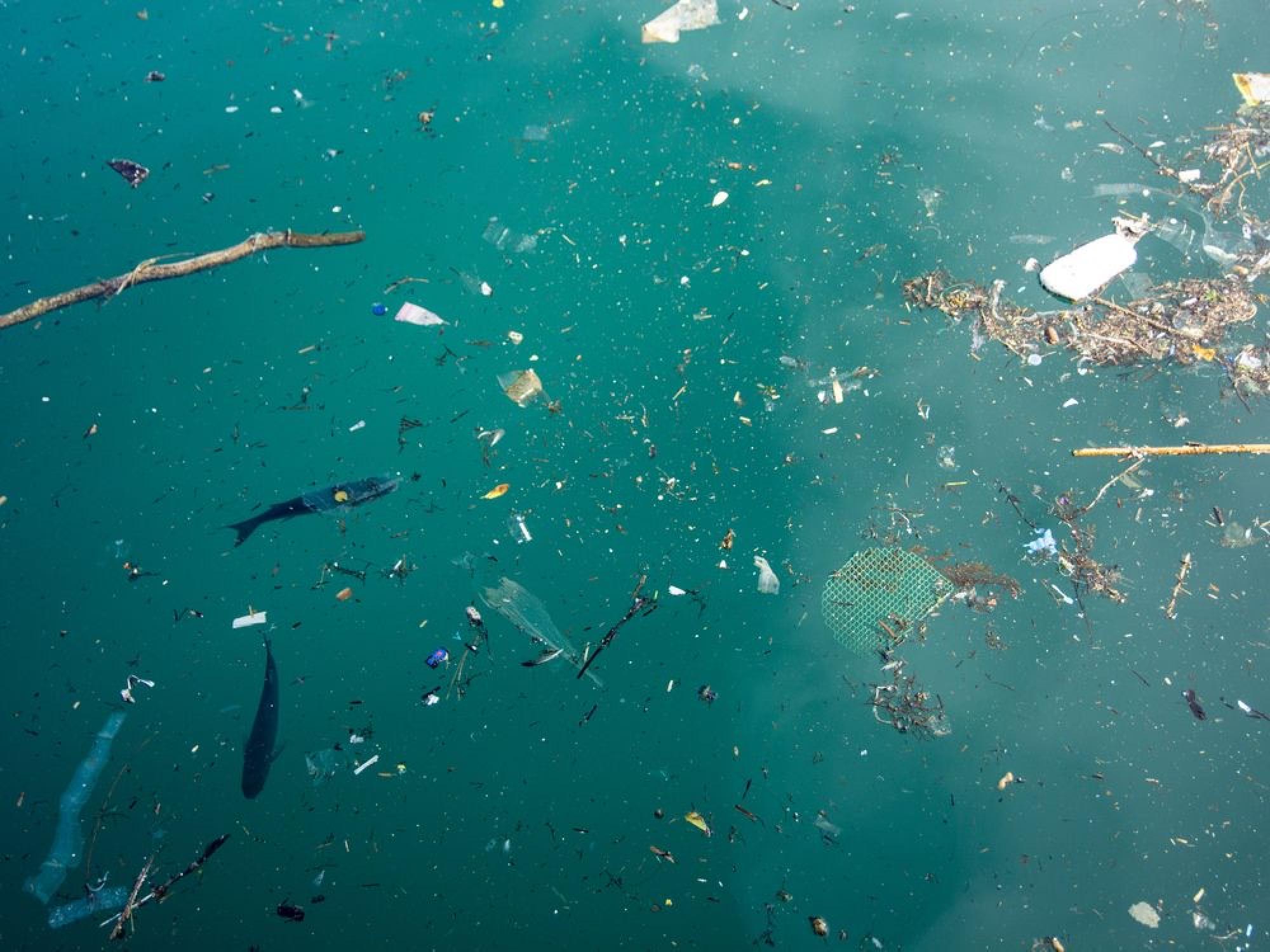
For millennia, humans have used dried natural sponges to clean up, to paint and as vessels to consume fluids like water or honey. Whether synthetic or natural, sponges are great at ensnaring tiny particles in their many pores. And, as scientists around the world are beginning to show, sponges' cavity-filled forms mean they could provide a solution to one of our era's biggest scourges: microplastic pollution. In August, researchers in China published a study describing their development of a synthetic sponge that makes short work of microscopic plastic debris. In tests, the researchers show that when a specially prepared plastic-filled solution is pushed through one of their sponges, the sponge can remove both microplastics and even smaller nanoplastics from the liquid. Optimal conditions allowed the researchers to remove as much as 90 percent of the microplastics. The plastic-gobbling sponges are made mostly from starch and gelatin. Looking a bit like large white marshmallows, the biodegradable sponges are so light that balancing one atop a flower leaves the plant's petals upright and unyielding, which the researchers suggest ought to make them cheap and easy to transport. The sponges, if ever produced at an industrial scale ... could be used in wastewater treatment plants to filter microplastics out of the water or in food production facilities to decontaminate water. It would also be possible to use microplastic-trapping sponges like this in washing machines.
Latest
Latest News
Each news summary is created according to strict standards. Here's how we do it.
Each summary is created using a consistent editorial procedure. The target length is approximately 16 lines of 11-point Arial text in a 650-pixel-wide column. Up to 25% of a summary may be set in bold to emphasize the most important ideas. Summaries are composed of verbatim excerpts presented in the same sequence as they appear in the original news source, with very minor editorial additions. Where material has been omitted between excerpts, the omission is indicated with ellipses (...). Any words added by an editor for clarity or context appear in [brackets]. Our original news editor was Fred Burks. Tod Fletcher edited most summaries from 2007 through 2014, and Mark Bailey has served as news editor since 2014.