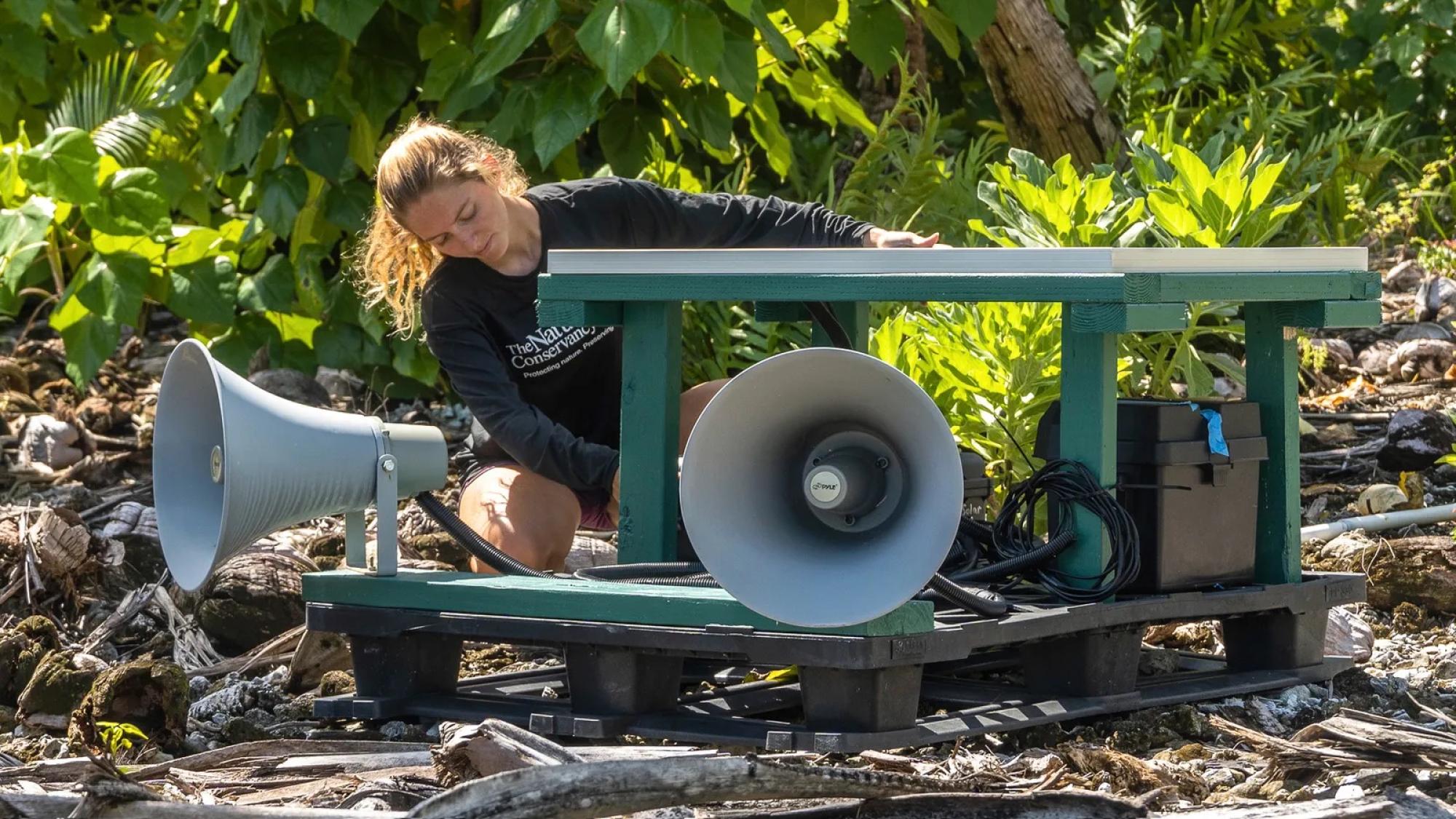
Beyond human hearing, a cacophony of natural clicks, whistles and hums pass all around us, linking billions of living beings in networks of sound. Mother whales whisper to their young so predators can't hear them. Bees emit unique buzzing signals to distinguish threats from specific predators. Turtle embryos synchronise their collective moment of birth by making sounds through their shells. And unknown fish species buzz to one another in the depths " their very identities one of nature's countless sonic mysteries. What if tapping into these sounds could allow us to not only to learn more about the natural world, but actually help to begin healing it? An emerging appreciation for the biological importance of sound has led to new strategies for environmental conservation. From microscopic larvae lost at sea to birds that travel hundreds of miles from home, conservationists are now starting to use the sounds of nature to guide them back to where they belong. "Sound is so important," says Cheryl Tipp, curator of wildlife and environmental sound at the British Library. "In the natural world, it's used in mating displays, in territorial disputes, as alarm signals." For humans trying to support nature, meanwhile, sound can be used to identify new species, monitor populations and assess the health of ecosystems, she says. There is now a growing interest in the use of sound to accelerate habitat restoration itself, by coaxing certain species to certain locations using their very own sounds.
Latest
Latest News
Each news summary is created according to strict standards. Here's how we do it.
Each summary is created using a consistent editorial procedure. The target length is approximately 16 lines of 11-point Arial text in a 650-pixel-wide column. Up to 25% of a summary may be set in bold to emphasize the most important ideas. Summaries are composed of verbatim excerpts presented in the same sequence as they appear in the original news source, with very minor editorial additions. Where material has been omitted between excerpts, the omission is indicated with ellipses (...). Any words added by an editor for clarity or context appear in [brackets]. Our original news editor was Fred Burks. Tod Fletcher edited most summaries from 2007 through 2014, and Mark Bailey has served as news editor since 2014.