




















Media Articles
Below are key excerpts of revealing news articles from reliable news media sources. If any link fails to function, a paywall blocks full access, or the article is no longer available, try these digital tools.
For further exploration, delve into our comprehensive Information Centers.

A major new study published in Nature Health has found a strong connection between environmental exposure to agricultural pesticides and an increased risk of cancer. Pesticides are commonly found in food, water, and the surrounding environment, often as complex mixtures rather than single substances. This has made their health effects difficult to measure. Most previous research has focused on individual chemicals in controlled settings, which does not reflect how people are exposed in real life. By combining environmental monitoring, national cancer registry data, and biological research, scientists from the IRD, Institut Pasteur, University of Toulouse, and the National Institute of Neoplastic Diseases (INEN) in Peru provide new insight into how pesticide exposure may contribute to the development of certain cancers. Peru ... includes regions with intensive agriculture, diverse climates and ecosystems, and significant social and geographic inequalities. "We first modeled the dispersion of pesticides in the environment over a six-year period, from 2014 to 2019, which allowed us to create a high-resolution map and identify areas with the highest risk of exposure," explains Jorge Honles, PhD in epidemiology at the University of Toulouse. The team then compared these exposure maps with health data from more than 150,000 cancer patients recorded between 2007 and 2020. Regions with higher environmental pesticide exposure also had higher rates of certain cancers. In these areas, the likelihood of developing cancer was about 150% greater on average. The research also highlights how pesticide exposure may affect the body long before cancer is diagnosed. Molecular studies conducted at the Institut Pasteur, led by Pascal Pineau, show that pesticides can interfere with processes that maintain normal cell function and identity. These disruptions occur early and may accumulate over time without obvious symptoms. Vulnerable populations, including Indigenous and rural communities, may face the greatest risks.
Note: This landmark study demonstrates a significant link between pesticide exposure on a national scale and biological changes that increase the risk of cancer. Our Substack, "The Pesticide Crisis Reveals The Dark Side of Science. We Have The Solutions to Regenerate," uncovers the scope of the widespread conspiracy to poison our food, air, and along with the powerful remedies and solutions to this crisis. For more along these lines, read our concise summaries of news articles on food system corruption and toxic chemicals.
The Modern Ag Alliance, launched by Bayer in 2024, enables the company to lobby and campaign through an entity that looks like a coalition of farm organizations, not a single giant chemical corporation. MAA represents itself as a “diverse coalition, founded by Bayer, that today represents more than 110 agricultural organizations.” But public records suggest it functions as a front group for Bayer’s interests. Tax records reveal that a Bayer vice president sits on the board of directors, and nearly all of its budget has gone to a public relations firm that also works for Bayer. Bayer itself describes the MAA as a key part of its lobbying. The company has portrayed the MAA – whose tagline is “Pesticides power America’s ag” – as its strategy for “fighting back” against glyphosate concerns and lawsuits. MAA is a 501(c)(4) nonprofit organization, a structure that allows it to raise unlimited funds for advocacy or lobbying while keeping donors secret. Disclosed members of the Modern Ag Alliance include large agribusiness trade groups, and national and state commodity crop growers’ groups. Many of these groups have financial relationships with Bayer and other pesticide firms, via sponsorships, partnerships or direct funding, though these ties are often opaque. The MAA lobbies for legislation that ... would make it harder for Americans to use state-law failure-to-warn claims to sue pesticide manufacturers for cancer and other injuries.
Note: Our Substack, "The Pesticide Crisis Reveals The Dark Side of Science. We Have The Solutions to Regenerate," uncovers the scope of Bayer/Monsanto's media propaganda machine and the widespread conspiracy to poison our food, air, and along with the powerful remedies and solutions to this crisis. For more along these lines, read our concise summaries of news articles on corporate corruption and toxic chemicals.
The single biggest predictor of how happy you are at any given moment isn’t your income, your relationship status, your health, your career, or the city you live in. It’s whether your mind is focused on what you’re doing right now or wandering somewhere else. That’s the whole finding. Present equals happy. Absent equals unhappy. Everything else is details. In 2010, Harvard psychologists Matthew Killingsworth and Daniel Gilbert published a paper in the journal Science with a title that sounds like a Buddhist proverb: “A Wandering Mind Is an Unhappy Mind.” They developed an iPhone app that pinged 2,250 people at random intervals throughout the day, asking three questions: What are you doing? What are you thinking about? How happy are you? People’s minds wandered from what they were doing 46.9 percent of the time. And when their minds wandered, they were consistently less happy than when they were focused on whatever was in front of them. This held true regardless of the activity. What you’re thinking about matters more than twice as much as what you’re doing. You could have the perfect life — the career, the partner, the health, the house — and spend most of it mentally somewhere else, and the somewhere else would make you miserable. We don’t struggle with presence during peak experiences. Nobody’s mind wanders during their wedding or the birth of their child or the moment they land the job they wanted. Those moments are vivid enough to command attention. They handle presence for you. The problem is that peak experiences make up maybe two percent of your life. The other ninety-eight percent ... is ordinary, and your capacity to be present during ordinary moments determines the quality of your entire existence. That’s where happiness actually lives. In the ninety-eight percent. In the ability to be present in an ordinary moment without wishing it were something else.
Note: Explore more positive stories like this in our comprehensive inspiring news articles archive focused on solutions and bridging divides.
Peter Thiel has gone from reclusive billionaire to high-profile political overlord. Hundreds of emails show that that journey was encouraged and facilitated by ... Jeffrey Epstein. Among the millions of Epstein-related documents released by the Department of Justice so far are hundreds of email exchanges between Epstein and Thiel that show the deep, symbiotic friendship between the two men. In return for Epstein’s favors and tax advice, Thiel provided investment insights and served as something of a reputational shield. When Thiel expressed a growing interest in geopolitics, Epstein encouraged his curiosity, setting up meetings with officials and political power players at home and abroad. After Thiel became part of the 2016 Trump campaign, Epstein urged him to grow his influence within Trumpworld and advised him on how to do it. As with his friendship with former Trump mastermind Steve Bannon, Epstein’s emails with Thiel show the late billionaire’s knack for ingratiating himself with the powerful and influential, particularly those who might have sway in the White House of his former “closest friend,” Trump. Thiel and Epstein exchanged constant emails, regularly met and talked on the phone, collaborated on business ventures, and discussed everything from politics and science to investment possibilities — as in one now-notorious email exchange about Brexit, in which Epstein seemed to revel in the “return to tribalism” and “collapse” that it heralded.
Note: Watch a 7-min video of WTK Director Amber Yang and Joe Martino from Collective Evolution discussing the links between Epstein, Thiel, Palantir, the Rothschild banking family, and intelligence agency operations. Don't miss part one and part two of our investigations into the Epstein files so far. For more along these lines, read our concise summaries of news articles on Jeffrey Epstein.
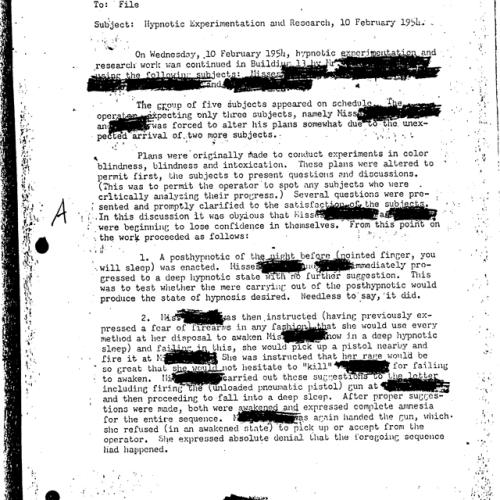
Korean prisoners of war in the 1950s were subjected to early MK-ULTRA experiments while in American custody, according to recently declassified CIA documents which confirm these experiments for the first time. The only reporting that previously referenced Koreans being used as guinea pigs for these experiments was journalist John Marks’s landmark 1979 book, The Search for the “Manchurian Candidate.” Using CIA documents, Marks traced the now-infamous MK-ULTRA project to its start, when it was known as Project Bluebird. In the book, Marks describes how, in October 1950, 25 unnamed North Korean POWs were chosen as the first test subjects to receive “advanced” interrogation techniques, with the overt goal of “controlling an individual to the point where he will do our bidding against his will and even against such fundamental laws of nature as self-preservation.” The declassified documents, which the National Security Archive released between December 2024 and April 2025, are available through a special collection titled “CIA and the Behavioral Sciences: Mind Control, Drug Experiments and MK-ULTRA.” [A] memo includes detailed plans for interrogation teams trained to utilize the polygraph, various drugs, and hypnotism “for personality control purposes.” In a later memo from February 2, 1951, there are inquiries into acquiring six “hypospray” devices: experimental instruments designed to covertly inject sedatives through the skin via “jet injection.”
Note: Read a timeline of known incidents of human experimentation. For more along these lines, read our concise summaries of news articles on intelligence agency corruption and mind control.
An Air Force veteran who agreed to testify before Congress about secret government UFO programs died just months before the hearings of an accidental drug overdose. Matthew James Sullivan, 39, died at his home in Falls Church, Va., on May 12, 2024 from a lethal mix of alcohol, alprazolam, cyclobenzaprine and imipramine, according to the Northern District Office of the Chief Medical Examiner. The mysterious death is of “grave concern” to Rep. Eric Burlison (R-Mo.), who referred the matter for investigation to the FBI due to “implications for national security,” according to a letter obtained by The Post. “Mr. Sullivan’s death was a local Virginia medical examiner case, and the manner and circumstances of his of death raise substantial questions, as he was preparing to provide testimony to Congress,” the April 16 letter addressed to FBI Director Kash Patel read. “The sudden and suspicious circumstances surrounding his death raise significant concerns about potential foul play and the safety of other individuals involved in this matter.” The FBI indicated in a statement that Sullivan’s death could be under investigation along with the dozen other missing or dead US scientists. Sullivan earned a Bronze Star for valor in Operation Enduring Freedom and later worked for the Air Force Intelligence Agency, National Air and Space Intelligence Center, and the National Security Agency.
Note: Don't miss our new video UFO Disclosure Explained: New Solutions for Humanity w/ Daniel Sheehan and Amber Yang. For more along these lines, read our concise summaries of news articles on UFOs. Then explore the comprehensive resources provided in our UFO Information Center.
A new study suggests a common weed killer may be linked to the mysterious global rise of young colorectal cancer. The first-of-its kind study published Tuesday in the journal Nature Medicine, suggests that picloram — a herbicide used globally to kill woody plants and shrubs while keeping grasses intact — could explain the rising incidence of colon and rectal cancer cases in people under 50. [Senior study author Jose] Seoane's team found that certain "fingerprints" appeared in the DNA of young colorectal cancer tumors they studied, and those fingerprints were linked back to exposures, including: Smoking; Poor diets, lacking fresh vegetables, beans, nuts and other "Mediterranean" staples; Obesity; Educational attainment (which is also linked to poorer diets); and finally, the weed killer picloram. His team checked to see if this same pattern persisted across populations, comparing the incidence of young colorectal cancer in seven US states, including California, Connecticut, Georgia, Iowa, New Mexico, Utah, and Washington, to the level of county-wide pesticide use. The strongest pesticide signal of all tied to higher rates of young colon cancer was for picloram. (In second place was glyphosate.) Picloram, which was developed in the 1960s, was one of many herbicides used in the "agents" the US Military used to clear forest during the Vietnam War. It works by disrupting the way plant hormones normally function, and can persist in the soil for years.
Note: Our Substack, "The Pesticide Crisis Reveals The Dark Side of Science. We Have The Solutions to Regenerate," uncovers the scope of the widespread conspiracy to poison our food, air, and along with the powerful remedies and solutions to this crisis. For more along these lines, read our concise summaries of news articles on health and toxic chemicals.
Your neighbors’ Ring cameras film your walk to the car. Your car’s sensors, cameras and microphones record your speed, how you drive, where you’re going, who’s with you, what you say, and biological metrics such as facial expression, weight and heart rate. Your car may also collect text messages and contacts from your connected smartphone. Meanwhile, your phone continuously senses and records your communications, info about your health, what apps you’re using, and tracks your location. As you enter [a] store, its surveillance cameras identify your face and track your movements through the aisles. If you then use Apple or Google Pay to make your purchase, your phone tracks what you bought and how much you paid. All this data quickly becomes commercially available, bought and sold by data brokers. Aggregated and analyzed by artificial intelligence, the data reveals detailed, sensitive information about you that can be used to predict and manipulate your behavior, including what you buy, feel, think and do. Companies unilaterally collect data from most of your activities. This “surveillance capitalism” is often unrelated to the services device manufacturers, apps and stores are providing you. The U.S. government ... now purchases massive quantities of your information from commercial data brokers. Disclosure of documents allegedly hacked from Homeland Security reveal a massive surveillance web that has all Americans in its scope.
Note: For more along these lines, read our concise summaries of news articles on AI and the disappearance of privacy.
[Veteran journalist Katrina Manson's] new book, “Project Maven: A Marine Colonel, His Team, and the Dawn of AI Warfare,” is an ... account of the ongoing reconfiguration of the U.S. armed forces for a new technological era. “Project Maven” is structured as an intellectual and professional biography of Drew Cukor, a Marine Corps intelligence officer largely responsible for ... this military transformation. Cukor insists that Maven was never supposed to be a weapon. He frequently defends the project as nothing more than an integrated data platform ... for a world made better and safer by A.I. warfare. In 2018, Google employees staged a massive walkout to protest the company’s work on a primitive iteration of the project. In the aftermath of the Google fiasco, Cukor turns to Palantir (in addition to Microsoft and Amazon) to make Maven a reality. NATO now has its own Maven contract with Palantir, and that prompted ten member nations to pursue one, too. The Maven Smart System has become a global surveillance apparatus—it can keep track of forty-nine thousand airfields all over the world—but its current work is hardly limited to intelligence provision and analysis. A “single click,” [journalist Katrina] Manson reports, “could send coordinates through a tactical data link to a specific weapons platform so that it could fire at the target.” The entire process, from target identification to target destruction, is four clicks. Officials told Manson that Maven was “accelerating operations and ‘enabling lethality’ at combat headquarters around the world.” Maven is only one part of the A.I. tool kit. Manson uncovers evidence of two clandestine killer-robot programs, one aerial and the other aquatic, which are being developed in haste. For the first time, the Pentagon’s proposed budget contained a line item for comprehensively self-directing systems. A machine can shoot, Manson reports, up to “ten times faster than an assassin.”
Note: For more, read our concise summaries of news articles on AI and military corruption.
The human brain remains deeply mysterious. Scientists have mapped its synapses and neurons in extraordinary detail, yet ... the felt experience of being you still defies efforts at a full explanation. However, researchers do have one fascinating window into that inner world: near-death experiences, or NDEs. As the name suggests, near-death experiences are altered states of consciousness reported by upwards of one-fifth of people who experience a life-threatening medical emergency. Some common traits of NDEs have emerged over nearly 50 years of research: intense emotions of peace and joy, out-of-body experiences (OBEs), encounters with dead relatives, altered perceptions of time, and elevated lucidity, among others. These accounts from people who’ve nearly died appear to contradict what scientists expect to occur in the brain as its regions begin to shut down one by one. In a new qualitative study published in the journal Psychology of Consciousness: Theory, Research, and Practice, [researcher Nicole] Lindsay and her colleagues reveal details of how individuals’ dreams changed drastically following an NDE. A participant named Basil said he could confidently recall one dream every week or two, but after his near-death experience, that recall became a nightly occurrence. Others reported that dreams become intensely vivid after an NDE and that the separation between dreaming and waking was much more ambiguous than it was before.
Note: For more inspiring and credible material on this topic, read our Substack investigations: How Consciousness Research Can Help Heal a Divided World and Insights from Near-Death Experiences Remind Us of Who We Are and What Unites Us. Explore more positive stories like this on near-death experiences.
Beneath the surface of the Strait of Hormuz and the surrounding Gulf lies a biological sanctuary. The region is home to around 7,000 dugongs and fewer than 100 Arabian humpback whales—a nonmigratory population that cannot leave these waters. Naval mines, residual military activity, and congested shipping lanes mean the strait remains a high-risk environment—not just for vessels but also for the ecosystems beneath them. Underwater explosions and military sonar don’t just scare whales, they can physically blind them, leading to stranding and death. The Arabian humpback whale, unlike its cousins in the Atlantic, does not migrate. For them, the Gulf is not a corridor but home, a permanent habitat. Olivier Adam, a researcher at Sorbonne University Abu Dhabi, says that the Gulf’s resident cetaceans—better known as marine mammals—have limited options: Either abandon their habitat or remain and endure prolonged exposure to noise. In the case of Arabian humpback whales, relocation is not realistic, as they are one of the only populations that do not migrate between feeding and breeding areas. “These baleen whales have no way to escape,” he says. Whales rely on sound for nearly every essential function: feeding, navigation, reproduction, and social interaction. When that acoustic environment is disrupted, the effects are immediate. In shallow coastal zones, where biodiversity is concentrated, even small disruptions can cascade through the ecosystem.
Note: Read more about the decimation of populations of whales and dolphins over the last decade resulting from the year-round, full-spectrum military practices carried out in the oceans. For more along these lines, read our concise summaries of news articles on war and marine mammals.
The disappearance of a rocket scientist has taken a chilling new turn after it emerged she holds a one-of-a-kind patent tied to advanced US launch systems. Monica Jacinto Reza, 60, was last seen hiking in the rugged San Gabriel Wilderness area in the Angeles National Forest on June 22 last year. Reports ... indicated that a man walking about 30ft ahead of Reza on the trail to the Waterman Mountain summit turned around moments later and discovered she had vanished without a trace. Records show she is the only surviving co-creator of a 2010 patent filed with Dallis Ann Hardwick, who died of cancer in 2014, for a specialized metal designed to resist burning while remaining incredibly strong under extreme heat. She was also credited as a co-inventor of Mondaloy, a nickel-based superalloy later used in key components of advanced propulsion systems developed through US Air Force and NASA-backed research programs. Reza spent decades working at Rocketdyne, later part of Aerojet Rocketdyne, a major aerospace contractor involved in government propulsion programs, while retired US Major General William Neil McCasland, who oversaw related Air Force research portfolios, also went missing in June 2025. Reza and McCasland are among nine recent cases involving scientists with ties to aerospace, defense or nuclear research whose deaths or disappearances have drawn public attention.
Note: Hacked emails released by Wikileaks show Tom DeLonge assuring former White House chief of staff John Podesta in 2016 that the missing astronautical engineer General McCasland was involved in a project related to extraterrestrial material, having previously led the Wright Patterson Air Force Base lab where the Roswell incident materials were reportedly taken. McCasland had been working with DeLonge and helped assemble his advisory team.
When he walked out of prison after 28 years, the first thing Allen Burnett did was drive to the ocean. “I just stood there for a minute,” he recalls. “I wanted to feel the air.” Sentenced to life without the possibility of parole, he believed he would die behind bars. At California State Prison ... Burnett eventually earned a college degree with magna cum laude honors thanks to a pioneering in-prison education program through Cal State, and he found mentorship with other prisoners. Governor Gavin Newsom commuted his sentence. Today Burnett is the co-founder and executive director of Prism Way, a Los Angeles nonprofit that trains formerly incarcerated people to become peer support specialists. The work draws directly on the peer-counseling culture Burnett experienced during his own incarceration. The mission is clear: turn lived experience into healing. The California Model, inspired in part by Norway’s prison system, emphasizes trauma-informed staffing, education and rehabilitation that mirrors life outside. Peer support is a key component. In 2022, the California Department of Corrections and Rehabilitation began training incarcerated people to become peer support specialists. These mentors help fellow inmates cope with trauma and addiction, bridging gaps that formal treatment sometimes cannot. Early results of peer counseling have been promising. In the Twin Towers Correctional Facility in downtown Los Angeles, it coincided with a sharp drop in self-harm.
Note: Explore more positive stories like this in our comprehensive repairing criminal justice.
Children regularly survive near-death experiences, or NDEs, just like anyone else. But a new study published in the journal Psychology of Consciousness: Theory, Research, and Practice notes that very few researchers actually speak with this critical age group, despite the special insights it offers for experts exploring human consciousness. In their review, the authors noticed that children reported some similar “core features,” including tunnels, bright lights, and out-of-body sensations. They interviewed seven children who survived cardiac arrest in a pediatric intensive care unit (PICU) using arts- and play-based approaches, rather than the more direct questions used in most adult-based NDE interviews. Strikingly, however, the children’s self-reported NDE experiences did not include every hallmark found in adult descriptions of NDEs. For example, there are no life reviews or messages from loved ones present in children’s descriptions. Culture and religion also played little to no role in their responses, leading the authors to assert that a child’s NDE may be more “raw” ... than adult NDEs, and should be considered extremely valuable data for future research. Unlocking the secrets of NDEs could help us understand consciousness, but scientists need more data. Thankfully, as resuscitation techniques become ever more advanced, it’s likely that more and more people will experience these events instead of simply dying before they can share what happened to them.
Note: Our Substack investigation, How Consciousness Research Can Help Heal a Divided World, features fascinating examples and credible, scientific investigations into past-life memories in children. Explore more positive stories like this on near-death experiences.
One of the most intriguing secrets of Operation Epic Fury is how, using an “exquisite” piece of classified technology, the CIA succeeded in finding the injured airman in Iran by detecting his heartbeat, the tiniest evidence of human life concealed in a narrow crevice up a 7,000ft mountain ridge. The technology that led to the airman’s rescue by Seal Team Six commandos has been outed as a CIA “tool” called Ghost Murmur. It was reportedly developed as a highly classified “blue skies” invention by Lockheed Martin’s Skunk Works, the famous laboratory where young, brilliant scientists and engineers devote their time to finding solutions to impossible concepts. John Ratcliffe, the CIA director, hinted at the new technology in a press conference this week. “We deployed both human assets and exquisite technologies that no other intelligence service in the world possess to a daunting challenge, comparable to hunting for a single grain of sand in the middle of a desert,” Ratcliffe said. On the face of it, a futuristic magnetic sensing device ... pinpointed the missing colonel’s heartbeat across a 40-mile stretch of land. Ghost Murmur, as described, would appear to push the boundaries of physics beyond even the most exceptional human brain or computer. Intelligence sources would not confirm or deny the existence of Ghost Murmur. But reportedly the “CIA tool” relies on what is called quantum magnetometry, which can find signals of human hearts, aided by artificial intelligence to separate out all the other noises getting in the way.
Note: While it's unclear whether the Ghost Murmur tool was actually responsible for rescuing the injured soldier, this technology is not out of the realm of possibility. Since the 1960s, the CIA had already developed poison weapons capable of causing heart attacks remotely. Learn more about real-life exotic weapon technologies used by militaries around the world. For more along these lines, read our concise summaries of news articles on AI and intelligence agency corruption.
A NASA scientist mysteriously died without any cause of death listed or autopsy — sparking questions about whether he was part of a pattern of deaths tied to the US space and nuclear program. Michael Hicks, who worked on a myriad of NASA space science missions, died in July 2023 at the age of 59 and worked at California’s Jet Propulsion Laboratory (JPL) from 1998 to 2022. He assisted on the DART Project, the Near Earth Asteroid Tracking Project, the Dawn Mission, and the NASA Deep Space 1 Mission. He joins eight other scientists or top officials who have died or disappeared recently. Monica Reza, JPL’s former director of the Materials Processing Group, disappeared in June 2025 while hiking and has still not been found. Retired Air Force Gen. William Neil McCasland also disappeared in February, walking out of his home in Albuquerque, New Mexico, without his prescription glasses or phone. JPL astrophysicist Carl Grillmair was murdered on his front porch in February, and Frank Maiwald, another JPL scientist, died in July 2024 without explanation. Maiwald was a longtime co-worker of Hicks. Two nuclear workers at the Los Alamos National Laboratory vanished from their homes in 2025 under mysterious circumstances. Boston fusion energy researcher Nuno Loureiro was killed at his home in December 2025. Lastly, pharmaceutical researcher Jason Thomas was found dead in a Massachusetts lake last month after also disappearing several months earlier.
Note: Hacked emails released by Wikileaks show Tom DeLonge assuring former White House chief of staff John Podesta in 2016 that the missing astronautical engineer General McCasland was involved in a project related to extraterrestrial material, having previously led the Wright Patterson Air Force Base lab where the Roswell incident materials were reportedly taken. McCasland had been working with DeLonge and helped assemble his advisory team.
A series of deaths and disappearances among scientists in the United States has raised alarm, as some of the cases are both puzzling and high-profile. Among the missing is a retired Air Force general, with several other scientists having professional ties to him. The long list recently grew to nine with the death of Michael David Hicks, a research scientist at NASA's Jet Propulsion Laboratory (JPL), who passed away on July 30, 2023, at the age of 59. The cause of death was never made public, and no record of an autopsy could be found. Hicks worked at JPL from 1998 to 2022 and was credited with publishing over 80 scientific papers. He contributed to multiple teams that helped NASA understand the physical properties of comets and asteroids. Whether there is a connection between these cases remains unclear. However, the Bernalillo County Sheriff’s Department in New Mexico told Newsweek that it is investigating the disappearance of retired Air Force General William “Neil” McCasland. Two of the missing scientists, McCasland and Monica Reza, “had a close professional connection” and vanished within eight months of each other, according to The New York Post, which described Reza as a “rocket scientist.” Some of the deaths appear unrelated. Four of the eight other scientists simply disappeared under mysterious circumstances. While these cases have been widely reported across multiple media outlets, authorities have not indicated any confirmed connection.
Note: Hacked emails released by Wikileaks show Tom DeLonge assuring former White House chief of staff John Podesta in 2016 that the missing astronautical engineer General McCasland was involved in a project related to extraterrestrial material, having previously led the Wright Patterson Air Force Base lab where the Roswell incident materials were reportedly taken. McCasland had been working with DeLonge and helped assemble his advisory team.
With all of his appeals exhausted, Charles “Sonny” Burton had already chosen the last meal he would have before being put to death by nitrogen gas at Alabama’s Holman correctional facility. His fate was in the hands of Kay Ivey, Alabama’s governor and a staunch supporter of capital punishment who has presided over more than 25 executions – more than any other Alabama governor since the death penalty was reinstated in 1976. But on the morning of 10 March, just two days before Sonny was to be put to death, Ivey commuted his sentence to life without parole. No new court ruling or legal evidence had come out, but the governor was forced to respond to an unusually diverse coalition [that] made the case that executing a 75-year-old man who didn’t pull the trigger – while the man who did died in prison with a life sentence – was simply wrong. Burton had been on death row since 1992 for the killing of Doug Battle during a robbery at a Talladega AutoZone. Derrick DeBruce, the man who fired the weapon, had his sentence reduced to life without parole in 2014 after winning a federal appeal. That meant that of the six people who took part in the robbery, Burton alone was facing execution. Schulz’s clemency petition cited precedents from Texas, Oklahoma and Arkansas – states where Republican governors who supported the death penalty had refused to execute inmates who played a lesser role in a killing than a co-defendant who got a lighter sentence.
Note: More than half of all wrongful criminal convictions are caused by government misconduct. For more along these lines, read our concise summaries of news articles on judicial system corruption and repairing criminal justice.
“Multiple young men” were allegedly drugged and raped at Jeffrey Epstein’s Zorro Ranch, according to an explosive new report that detailed harrowing accusations from murder to babies snatched from mothers at the pedophile’s New Mexico house of horrors. “A man actually claims that he met Jeffrey Epstein [and] was brought to the ranch, he was drugged,” US Rep. Melanie Stansbury (D-NM) told “60 Minutes Australia” in a Sunday segment, the Sun reported. “He describes in detail a scene in which multiple young men were raped at the ranch in front of him after he was drugged,” said Stansbury, a leading advocate for Epstein victims. It’s unclear how Stansbury learned the excrutiating details of the alleged abuse, but her claims come as her state is in the thick of an extensive investigation into Zorro Ranch — the first probe of its kind since the millionaire financier killed himself in 2019 in a Manhattan jail cell after being arrested on sex-trafficking charges. The probe was sparked in part by anonymous 2019 allegations that Epstein and Maxwell choked women to death during “rough fetish sex” and buried them on the ranch — accusations that resurfaced with the release earlier this year of the tranche of files from the FBI’s investigation into the disgraced financier. Zorro Ranch was never fully searched after the federal government ordered New Mexico authorities to “stand down” in 2019 because there was no “probable cause” to search the ranch.
Note: In an interview with The Daily Mail, New Mexico State Representative Andrea Romero spoke on the recent announcement of a “Truth Commission” to investigate sexual and medical crimes at Zorro Ranch: "we have people coming forward saying they were drugged, had sex organs and sperm harvested from their bodies, and woke up around medical equipment not knowing where they were or what happened to them." Read more in our Substack, "Epstein Files Pt. 2: Beyond Sex Trafficking—Zorro Ranch and a Darker Scientific Agenda," where we explore Epstein's deep ties to the scientific elite and their active exploration into eugenics, designer babies, human cloning, social engineering, and other ethically questionable human experimentation practices.
In Kargi, a remote desert village in the far north of Kenya, cancers of the digestive tract plague the population at unusually high rates. The disease most often attacks the esophagus, though stomach cancer is also common. Some patients think it’s a punishment from God. The evidence on the ground suggests it’s more likely from a multinational oil company. In the 1980s, foreign work crews dressed like astronauts descended on the village of Kargi and the surrounding Chalbi Desert to drill for oil. They spent five unsuccessful years boring nearly a dozen wells thousands of feet into the ground. The men were from Amoco, an American oil company now owned by BP. To mark their presence was a dry white substance scattered on the ground, close to the water wells used by residents and their livestock. The substance the company left behind contained heavy metals and known carcinogens. When locals discovered the flaky substance around the wells, many believed it was natural salt and started using it to cook their food. The water was contaminated. High levels of carcinogenic toxic chemicals, namely nitrates, had seeped into surrounding boreholes and wells — the only water supply in the desert. Animals began dying in the thousands. And people started getting cancer. By the early 2000s, the cancer rate in the community was three times the national average. No official cleanup has ever been done. The community has lost hope in getting answers.
Note: For more along these lines, read our concise summaries of news articles on corporate corruption and toxic chemicals.
Important Note: Explore our full index to key excerpts of revealing major media news articles on several dozen engaging topics. And don't miss amazing excerpts from 20 of the most revealing news articles ever published.