


























Big Tech News Articles

OpenAI this week quietly deleted language expressly prohibiting the use of its technology for military purposes. Up until January 10, OpenAI’s “usage policies” page included a ban on “activity that has high risk of physical harm, including,” specifically, “weapons development” and “military and warfare.” That plainly worded prohibition against military applications would seemingly rule out any official, and extremely lucrative, use by the Department of Defense or any other state military. The new policy retains an injunction not to “use our service to harm yourself or others” and gives “develop or use weapons” as an example, but the blanket ban on “military and warfare” use has vanished. OpenAI spokesperson Niko ... Felix [said] that OpenAI wanted to pursue certain “national security use cases that align with our mission,” citing a plan to create “cybersecurity tools” with DARPA, and that “the goal with our policy update is to provide clarity and the ability to have these discussions.” The real-world consequences of the policy are unclear. Last year, The Intercept reported that OpenAI was unwilling to say whether it would enforce its own clear “military and warfare” ban in the face of increasing interest from the Pentagon and U.S. intelligence community. “Given the use of AI systems in the targeting of civilians in Gaza, it’s a notable moment to make the decision to remove the words ‘military and warfare’ from OpenAI’s permissible use policy,” said [former AI policy analyst] Sarah Myers West.
Note: Learn more about emerging warfare technology in our comprehensive Military-Intelligence Corruption Information Center. For more, see concise summaries of deeply revealing news articles on corporate corruption from reliable major media sources.
Leading up to the August Republican presidential primary debate ... An RNC official told Google via email that the debate would be streaming exclusively on the upstart video platform Rumble. The August 23 debate was broadcast on Fox News and streamed on Fox Nation, which requires a subscription, while Rumble was the only one to stream it for free. On the day of and during the debate, however, potential viewers who searched Google for “GOP debate stream” were returned links to YouTube, Fox News, and news articles about the debate, according to screen recordings. Rumble was nowhere on the first page. For Rumble, which is currently in discovery in an antitrust lawsuit against Google in California, this is a case of Google suppressing its competitors in favor of its own product, YouTube. YouTube is owned by Google, and it has regularly been the subject of anticompetitive allegations from rivals, who charge that Google unfairly and illegally favors YouTube in its search algorithm. Google, in fact, is in the middle of a landmark antitrust trial, charged with anticompetitive practices by the Department of Justice. The company would not have been required by antitrust law to promote [Rumble's] link. It would, however, be barred from suppressing the competitor’s link from organic results. The fact that Rumble’s link did not appear on the first page even though it was the most relevant link the search could return means either the search engine failed at its task or the link was suppressed.
Note: For more along these lines, see concise summaries of deeply revealing news articles on corporate corruption and media manipulation from reliable sources.
The EARN IT Act [is] a bill designed to confront the explosion of child sexual abuse material (CSAM) online. EARN IT would help address what is, disturbingly, a common experience for young users: routine exposure to predatory targeting, grooming, sexual violence, prostitution/sex trafficking, hardcore pornography and more. A New York Times investigation revealed that 70 million CSAM images were reported to the National Center for Missing and Exploited Children (NCMEC) in 2019–up from 600,000 in 2008–an "almost unfathomable" increase in criminality. The EARN IT Act restores privacy to victims of child sexual abuse material and allows them to sueâ€those who cause them harm online, under federal civil law and state criminal and civil law. It also creates a new commission to issue guidelines to limit sex trafficking, grooming and sexual exploitationâ€online. CSAM still exists because tech platforms have no incentive to prevent or eliminate it, because Section 230 of the Communications Decency Act (passed in 1996, before social media existed) gives them near-blanket immunity from liability. While some in the technology sector [are] claiming EARN IT is a threat to encryption and user privacy, the reality is that encryption can coexist with better business practices for online child safety. We can increase security and privacy while refraining from a privacy-absolutism that unintentionally allows sexual predators to run rampant online.
Note: To understand the scope of child sex abuse worldwide, learn about other major cover-ups in revealing news articles on sexual abuse scandals from reliable major media sources.
Ties between Silicon Valley and the Pentagon are deeper than previously known, according to thousands of previously unreported subcontracts published Wednesday. The subcontracts were obtained through open records requests by accountability nonprofit Tech Inquiry. They show that tech giants including Google, Amazon, and Microsoft have secured more than 5,000 agreements with agencies including the Department of Defense, Immigrations and Customs Enforcement, the Drug Enforcement Agency, and the FBI. Tech workers in recent years have pressured their employers to drop contracts with law enforcement and the military. Google workers revolted in 2018 after Gizmodo revealed that Google was building artificial intelligence for drone targeting through a subcontract with the Pentagon after some employees quit in protest, Google agreed not to renew the contract. Employees at Amazon and Microsoft have petitioned both companies to drop their contracts with ICE and the military. Neither company has. The newly-surfaced subcontracts ... show that the companies' connections to the Pentagon run deeper than many employees were previously aware. Tech Inquiry's research was led by Jack Poulson, a former Google researcher. "Often the high-level contract description between tech companies and the military looks very vanilla," Poulson [said]. "But only when you look at the details ... do you see the workings of how the customization from a tech company would actually be involved."
Note: For more along these lines, see concise summaries of deeply revealing news articles on corruption in government and in the corporate world from reliable major media sources.
Frances Haugen spent 15 years working for some of the largest social media companies in the world including Google, Pinterest, and until May, Facebook. Haugen quit Facebook on her own accord and left with thousands of pages of internal research and communications that she shared with the Securities and Exchange Commission. 60 Minutes obtained the documents from a Congressional source. On Sunday, in her first interview, Haugen told 60 Minutes correspondent Scott Pelley about what she called "systemic" problems with the platform's ranking algorithm that led to the amplification of "angry content" and divisiveness. Evidence of that, she said, is in the company's own internal research. Haugen said Facebook changed its algorithm in 2018 to promote "what it calls meaningful social interactions" through "engagement-based rankings." She explained that content that gets engaged with – such as reactions, comments, and shares – gets wider distribution. "Political parties have been quoted, in Facebook's own research, saying, we know you changed how you pick out the content that goes in the home feed," said Haugen. "And now if we don't publish angry, hateful, polarizing, divisive content, crickets." "We have no independent transparency mechanisms," Haugen [said]. "Facebook ... picks metrics that are in its own benefit. And the consequence is they can say we get 94% of hate speech and then their internal documents say we get 3% to 5% of hate speech. We can't govern that."
Note: For more along these lines, see concise summaries of deeply revealing news articles on media manipulation from reliable sources.
Jeff Bezos’ Washington Post is facing a scathing new class-action lawsuit accusing it of using surveillance pricing to gouge loyal readers – in a case that attorneys believe could rack up millions in damages. Since the mid-2010s, WaPo has “covertly harvested” subscriber data, using “deeply personal information” to determine how much they could squeeze out of each loyal reader, according to the suit, which was filed Thursday in the Superior Court of the District of Columbia. Readers largely expected their personal data would be used for “mutually beneficial purposes” like “relevant advertisements” – and did not consent to their personal information being used to hike prices on their subscriptions, the suit alleged. After billionaire Bezos bought WaPo in 2013 for $250 million, the paper started heavily investing in technology and digital subscriptions, the suit noted. “The more loyal a reader became, the more data The Post could gather to estimate how much more that person might tolerate paying at renewal,” the complaint said. “Rather than rewarding loyalty, The Post’s system converted subscribers’ engagement into leverage against them.” The suit also alleged WaPo might be collecting extra information from subscribers’ use of “affiliates” – including Amazon, Bezos’ e-commerce giant. Last year, the publication was forced to reveal it was engaging in surveillance pricing techniques because of a 2025 New York disclosure law.
Note: Read more about the rise of AI surveillance pricing. For more along these lines, read our concise summaries of news articles on Big Tech and mass media.
AI is projected to generate nearly unfathomable amounts of revenue. Any mention of AI tends to be accompanied by warnings that deeper jobs cuts across many more industries are coming for us all. Jensen Huang, CEO of chip giant Nvidia, said in 2025: “Every job will be affected, and immediately. It is unquestionable. You’re not going to lose your job to an AI, but you’re going to lose your job to someone who uses AI.” Increasingly, people young and old flock to a new gold rush in Silicon Valley to toil away on AI-fueled startups. If AI’s worst-case scenario for tech jobs plays out ... that’s still nowhere near the apocalyptic future of labor that many fear. “Is it, in fact, going to destroy all of the jobs?” Naidu asked. “I’m not convinced. Even take software. Software is only about 4 to 6% of GDP. So it’s a lot, but it’s not like the whole economy can be replaced by Claude Code.” Convincing people that AI will replace human workers in droves is a clever marketing tactic. Not only does it stoke rabid investor speculation, but it distracts from a more realistic application of AI: to surveil and micromanage employees to squeeze yet more productivity out of them, all the while pressuring them to feel grateful that they have any kind of work. Gig workers, the people who pick you up in Ubers and deliver your food on platforms like DoorDash, have already been the guinea pigs for this kind of algorithmic management, and labor experts predict it will spread.
Note: For more along these lines, read our concise summaries of news articles on AI and media manipulation.
For decades, Congress has tried and failed to give Americans control over their own personal data: the right to see it, correct it, and delete it at will. This inaction has left Americans with no recourse against misuse of their own data, while the data broker industry quietly continues to collect and sell the personal information of millions, operating in a largely unchecked gray market. Now, two new bills, the SECURE Data Act and the GUARD Financial Data Act, offer the latest test of whether Washington can step up and finally pull data brokers out of the shadows and into the reach of the law. Efforts to prevent the SECURE Data Act — or any federal protections — from being enacted are currently on full display. Exacerbating the situation and further endangering consumers, there is an entire category of companies that have deliberately avoided being classified as data brokers in an effort to skirt even the patchwork of state-level regulations. Unlike traditional data brokers, massive data aggregators don’t sell your name and address to the highest bidder. Instead, they operate quietly, harvesting your data from across the internet, then assembling it into risk scores, behavioral profiles, and assessments of your creditworthiness. These opaque calculations increasingly govern your real-world outcomes, including whether you’re approved for a mortgage, the interest rates on your auto loan, and what services or products are marketed to you.
Note: For more along these lines, read our concise summaries of news articles on Big Tech and the disappearance of privacy.
Former Meta employee Sarah Wynn-Williams [was] silenced by Meta’s legal threats to bankrupt her if she spoke. Wynn-Williams has written a book, Careless People, about her time at Meta (then Facebook), where she was an early director of global public policy. But Meta does not like the book. It has done everything in its power to stop it, including seeking an emergency arbitration order that prevents Wynn-Williams from promoting the book, and threatening punitive damages. These serve both to punish Wynn-Williams for writing it, and to send a warning to any future critic. A certain kind of libertarian responds by saying that Meta is not “censoring” Wynn-Williams, because only governments can censor. A certain kind of lawyer may say she brought this on herself by signing a contract agreeing not to criticise Meta. Private censorship is real and, in the time we live in, often more impactful than the public kind. Not all contractual provisions are, or should be, enforceable. You cannot write an enforceable contract to sell a child, to bind someone never to marry or to give up other fundamental rights. Why should the right to speak critically be any different? A contract in which someone agrees never to criticise their employer should be void and unenforceable. That is why we need legislation that makes clear a simple principle: that the free-speech right to criticise your employer is important, fundamental and cannot be sold.
Note: Meta whistleblower Sarah Wynn-Williams once told US senators that the company targeted teenage girls with beauty and weight-loss advertisements during moments of heightened vulnerability such as after deleting a selfie. According to her testimony, Meta could detect when users were feeling "worthless," "helpless," or like a "failure," and then make that information available to advertisers. For more along these lines, read about a new nonprofit called Psst, which is designed to make it safer for Big Tech whistleblowers to report wrongdoing without immediately exposing themselves to retaliation.
The former chief investigations counsel for the House Oversight Committee has been helping to prepare Bill Gates, the billionaire co-founder of Microsoft, to testify privately in the panel’s Jeffrey Epstein investigation on Wednesday. Representative James R. Comer of Kentucky, the Republican chairman of the committee, formally requested in March that Mr. Gates appear before the committee for a transcribed interview. His request came after files released by the Justice Department showed that Mr. Gates met with Mr. Epstein, the convicted sex offender, multiple times and that his closest advisers were in frequent contact with the disgraced financier until 2019, the year of his death in prison. In preparing for the deposition, Mr. Gates has turned to Jake Greenberg, who until December was spearheading the oversight panel’s Epstein inquiry in his role as the committee’s top investigative official. Mr. Gates’s close relationship with Mr. Epstein has roiled his foundation, which has authorized an outside review of its ties to Mr. Epstein. Representative Suhas Subramanyam, Democrat of Virginia, said in an interview that he wanted to know what Mr. Gates “knew of Epstein’s crimes, and the nature and extent of their relationship.” He added, “Epstein was known for befriending and even blackmailing rich and powerful men, and I want to know if Gates was one of them.” Mr. Gates has sought out powerful inside players to help him weather the scrutiny. He hired John Moran, a former lawyer for the Justice Department, who helped him secure an agreement with the committee for him to appear off camera, The Wall Street Journal reported.
Note: Don't miss part one and part two of our investigations into the Epstein files so far. For more along these lines, read our concise summaries of news articles on Big Tech and Jeffrey Epstein.
Some of the largest data-collecting companies in the United States—including major AI vendors, data brokers, defense contractors, and dating apps—rely on deceptive methods to keep consumers from opting out of the sale and sharing of their personal information. Researchers at [the Electronic Privacy Information Center] audited the opt-out processes of 38 major data companies and documented at least eight distinct categories of manipulative design: Opt-out forms that don't actually let users opt out of the sale of their data. Links that are buried in fine print and missing from homepages. Consumers routed through multiple separate forms to complete a single request. And requirements that users create accounts or pay for subscriptions before opting out at all, among others. Major companies offering large language models, such as Google, Meta, and OpenAI, fail to clearly link their opt-out forms from their homepages or privacy policies, according to the report, and several require consumers to submit multiple separate forms to complete a single request. OpenAI's form, when a consumer finds it, does not offer a way to opt out of the sale or transfer of personal data. What it offers instead is an option to “remove personal information from ChatGPT responses,” which EPIC says is a filter on the chatbot's output, not the removal of any underlying data. Researchers found that the people-search brokers they audited—Spokeo, Whitepages, and National Public Data—do not offer consumers a way to opt out of the sale or transfer of their data at all. Instead, the companies offer a process for removing individual listings by URL, one at a time, with no commitment to stop selling that same person's information in the future.
Note: The owner of a data broker company once bragged about having highly detailed personal information on nearly all internet users. For more along these lines, read our concise summaries of news articles on Big Tech and the disappearance of privacy.
On Thursday, a U.S. Army Special Forces soldier who was involved in the raid to capture Nicolás Maduro in Venezuela was arrested on charges that he used classified information to make more than $400,000 by betting on the operation before it happened. In the hours before the U.S. attacked Iran, hundreds of anonymous bets over $1,000 were placed on the U.S. striking Iran by the next day, which the New York Times said suggested that some users might’ve “seen the strike coming.” Prediction markets, such as industry leaders Polymarket and Kalshi, have exploded in popularity. They create or exacerbate an array of problems, but at the Media and Democracy Project, or MAD, we believe they have the potential to severely harm the way news is reported, perceived, and engaged with. Suppose that prediction markets achieve their claims of providing better forecasts than other methods. Casino journalism [would still be] bad for journalism and the public. Most of the “propositions” offered on these markets are based on news reports; reporters provide the raw material on which these bets are made. In effect, traders on prediction markets are betting on the content of news stories. An Israeli journalist recently received death threats over his refusal to rewrite his report on an Iranian missile strike, on which $23 million of prediction market “investments” were riding. As the markets become larger, and their use in news increases, the incentive for market manipulation will also grow.
Note: For more along these lines, read our concise summaries of news articles on military corruption and Big Tech.
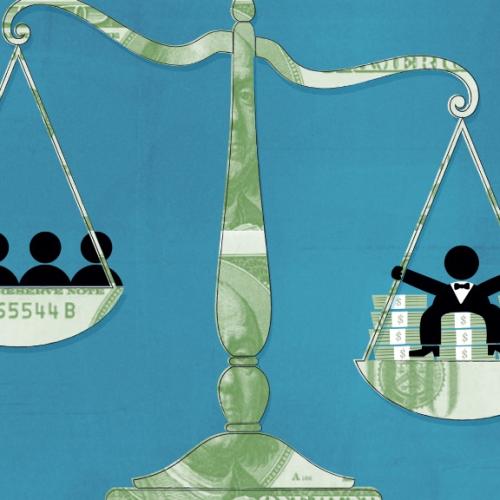
Trump loyalist and CIA contractor Larry Ellison’s purchase of CNN appears imminent, and marks the latest venture into media for the world’s second-richest individual. The world’s seven richest individuals are all now powerful media barons, controlling what the world sees, reads, and hears, marking a new chapter in oligarchical control over society and striking another blow at a free, independent press and diversity of opinion. In September, President Trump signed an executive order approving a proposal to force through the sale of social media platform TikTok to an American consortium led by Ellison-owned tech company, Oracle. Under the planned arrangement, Oracle will oversee the platform’s security and operations, giving the world’s second-richest man effective control over the platform that more than 60% of Americans under thirty years of age use for news and entertainment. No other period in history has seen such a rapid and overwhelming buy up of our means of communications by the billionaire class – a fact that raises tough questions about freedom of speech and diversity of opinion. Today, the world’s seven richest individuals are all major media barons, giving them extraordinary control over our media and public square, allowing them to set agendas, and suppress forms of speech they do not approve of. This includes criticisms of them and their holdings, the economic system we live under, and the actions of ... governments.
Note: For more along these lines, read our concise summaries of news articles on financial inequality and media manipulation.
Those who have kept track of the rise of the Thielverse, which includes figures such as Peter Thiel, Elon Musk and JD Vance, have understood that an agenda to usher in a unique form of authoritarianism has been slowly introduced into the mainstream political atmosphere. “I think now it’s quite clear that this is the PayPal Mafia’s moment. These particular figures have had an extremely significant influence on US government policy since January, including the extreme distribution of AI throughout the US government,” [investigative journalist Whitney] Webb explains. It’s clear that the architects of mass surveillance and the military industrial complex are beginning to coalesce in unprecedented ways within the Trump administration and Webb emphasizes that now is the time to pay attention and push back against these new forces. If they have their way, all commercial technology will be completely folded into the national security state — acting blatantly as the new infrastructure for techno-authoritarian rule. The underlying idea behind this new system is “pre-crime,” or the use of mass surveillance to designate people criminals before they’ve committed any crime. Webb warns that the Trump administration and its benefactors will demonize segments of the population to turn civilians against each other, all in pursuit of building out this elaborate system of control right under our noses.
Note: Read about Peter Thiel's involvement in the military origins of Facebook. For more along these lines, read our concise summaries of news articles on Big Tech and the disappearance of privacy.
In July, US group Delta Air Lines revealed that approximately 3 percent of its domestic fare pricing is determined using artificial intelligence (AI) – although it has not elaborated on how this happens. The company said it aims to increase this figure to 20 percent by the end of this year. According to former Federal Trade Commission Chair Lina Khan ... some companies are able to use your personal data to predict what they know as your “pain point” – the maximum amount you’re willing to spend. In January, the US’s Federal Trade Commission (FTC), which regulates fair competition, reported on a surveillance pricing study it carried out in July 2024. It found that companies can collect data directly through account registrations, email sign-ups and online purchases in order to do this. Additionally, web pixels installed by intermediaries track digital signals including your IP address, device type, browser information, language preferences and “granular” website interactions such as mouse movements, scrolling patterns and video viewing behaviour. This is known as “surveillance pricing”. The FTC Surveillance Pricing report lists several ways in which consumers can protect their data. These include using private browsers to do your online shopping, opting out of consumer tracking where possible, clearing the cookies in your history or using virtual private networks (VPNs) to shield your data from being collected.
Note: For more along these lines, read our concise summaries of news articles on Big Tech and the disappearance of privacy.
Mark Zuckerberg is said to have started work on Koolau Ranch, his sprawling 1,400-acre compound on the Hawaiian island of Kauai, as far back as 2014. It is set to include a shelter, complete with its own energy and food supplies, though the carpenters and electricians working on the site were banned from talking about it. Asked last year if he was creating a doomsday bunker, the Facebook founder gave a flat "no". The underground space spanning some 5,000 square feet is, he explained, "just like a little shelter, it's like a basement". Other tech leaders ... appear to have been busy buying up chunks of land with underground spaces, ripe for conversion into multi-million pound luxury bunkers. Reid Hoffman, the co-founder of LinkedIn, has talked about "apocalypse insurance". So, could they really be preparing for war, the effects of climate change, or some other catastrophic event the rest of us have yet to know about? The advancement of artificial intelligence (AI) has only added to that list of potential existential woes. Ilya Sutskever, chief scientist and a co-founder of Open AI, is reported to be one of them. Mr Sutskever was becoming increasingly convinced that computer scientists were on the brink of developing artificial general intelligence (AGI). In a meeting, Mr Sutskever suggested to colleagues that they should dig an underground shelter for the company's top scientists before such a powerful technology was released on the world.
Note: Read how some doomsday preppers are rejecting isolating bunkers in favor of community building and mutual aid. For more along these lines, read our concise summaries of news articles on financial inequality.
Powerful tools that collect and aggregate data, enable facial recognition, and increase surveillance have become a bedrock of American policing over the past two decades. In collaboration with private technology companies, law enforcement agencies at all levels have experimented with how to implement these tools and created a large consumer market for them. Against this backdrop, it is essential to understand the role of the tech industry in both increasing the reach of local law enforcement and enabling mass deportations by the Trump administration. ICE is, for example, one of the largest customers for Clearview AI, a facial recognition company that has scraped more than 30 billion faces from internet sources. Data brokers, including one owned jointly by several airline companies, are actively selling data to ICE and other federal agencies. One of the most troubling recent developments in police data is that it captures information about all people. This “dragnet” approach to data collection is designed to give law enforcement maximum access to the entire population, transforming all personal information into potential evidence. Increasingly, law enforcement agencies are opting to purchase this data rather than collect it themselves, exploiting a loophole in Fourth Amendment legal protections. Some police departments have begun pressuring people into providing DNA samples at routine traffic stops, an attempt to expand their databases.
Note: For more along these lines, read our concise summaries of news articles on Big Tech and the disappearance of privacy.
AI could mean fewer body bags on the battlefield — but that's exactly what terrifies the godfather of AI. Geoffrey Hinton, the computer scientist known as the "godfather of AI," said the rise of killer robots won't make wars safer. It will make conflicts easier to start by lowering the human and political cost of fighting. Hinton said ... that "lethal autonomous weapons, that is weapons that decide by themselves who to kill or maim, are a big advantage if a rich country wants to invade a poor country." "The thing that stops rich countries invading poor countries is their citizens coming back in body bags," he said. "If you have lethal autonomous weapons, instead of dead people coming back, you'll get dead robots coming back." That shift could embolden governments to start wars — and enrich defense contractors in the process, he said. Hinton also said AI is already reshaping the battlefield. "It's fairly clear it's already transformed warfare," he said, pointing to Ukraine as an example. "A $500 drone can now destroy a multimillion-dollar tank." Traditional hardware is beginning to look outdated, he added. "Fighter jets with people in them are a silly idea now," Hinton said. "If you can have AI in them, AIs can withstand much bigger accelerations — and you don't have to worry so much about loss of life." One Ukrainian soldier who works with drones and uncrewed systems [said] in a February report that "what we're doing in Ukraine will define warfare for the next decade."
Note: As law expert Dr. Salah Sharief put it, "The detached nature of drone warfare has anonymized and dehumanized the enemy, greatly diminishing the necessary psychological barriers of killing." For more, read our concise summaries of news articles on AI and warfare technology.
“Ice is just around the corner,” my friend said, looking up from his phone. A day earlier, I had met with foreign correspondents at the United Nations to explain the AI surveillance architecture that Immigration and Customs Enforcement (Ice) is using across the United States. The law enforcement agency uses targeting technologies which one of my past employers, Palantir Technologies, has both pioneered and proliferated. Technology like Palantir’s plays a major role in world events, from wars in Iran, Gaza and Ukraine to the detainment of immigrants and dissident students in the United States. Known as intelligence, surveillance, target acquisition and reconnaissance (Istar) systems, these tools, built by several companies, allow users to track, detain and, in the context of war, kill people at scale with the help of AI. They deliver targets to operators by combining immense amounts of publicly and privately sourced data to detect patterns, and are particularly helpful in projects of mass surveillance, forced migration and urban warfare. Also known as “AI kill chains”, they pull us all into a web of invisible tracking mechanisms that we are just beginning to comprehend, yet are starting to experience viscerally in the US as Ice wields these systems near our homes, churches, parks and schools. The dragnets powered by Istar technology trap more than migrants and combatants ... in their wake. They appear to violate first and fourth amendment rights.
Note: Read how Palantir helped the NSA and its allies spy on the entire planet. Learn more about emerging warfare technology in our comprehensive Military-Intelligence Corruption Information Center. For more, read our concise summaries of news articles on AI and Big Tech.
Health practitioners are becoming increasingly uneasy about the medical community making widespread use of error-prone generative AI tools. In their May 2024 research paper introducing a healthcare AI model, dubbed Med-Gemini, Google researchers showed off the AI analyzing brain scans from the radiology lab for various conditions. It identified an "old left basilar ganglia infarct," referring to a purported part of the brain — "basilar ganglia" — that simply doesn't exist in the human body. Board-certified neurologist Bryan Moore flagged the issue ... highlighting that Google fixed its blog post about the AI — but failed to revise the research paper itself. The AI likely conflated the basal ganglia, an area of the brain that's associated with motor movements and habit formation, and the basilar artery, a major blood vessel at the base of the brainstem. Google blamed the incident on a simple misspelling of "basal ganglia." It's an embarrassing reveal that underlines persistent and impactful shortcomings of the tech. In Google's search results, this can lead to headaches for users during their research and fact-checking efforts. But in a hospital setting, those kinds of slip-ups could have devastating consequences. While Google's faux pas more than likely didn't result in any danger to human patients, it sets a worrying precedent, experts argue. In a medical context, AI hallucinations could easily lead to confusion and potentially even put lives at risk.
Note: For more along these lines, read our concise summaries of news articles on AI and corruption in science.
Important Note: Explore our full index to revealing excerpts of key major media news articles on several dozen engaging topics. And don't miss amazing excerpts from 20 of the most revealing news articles ever published.