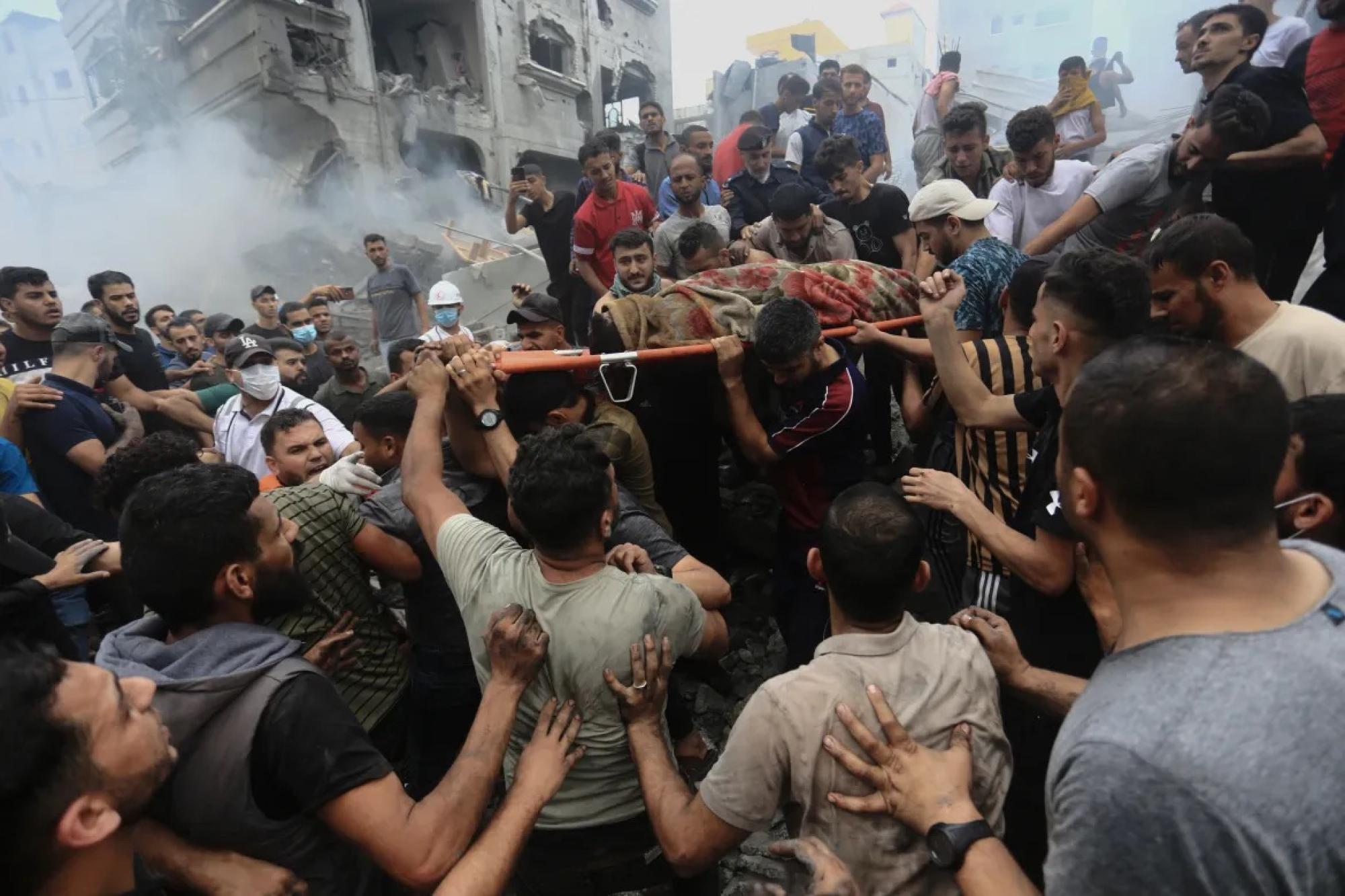
Israel has cast the deaths of civilians in the Gaza Strip as a regrettable but unavoidable part of modern conflict, pointing to the heavy human toll from military campaigns the United States itself once waged in Iraq and Syria. But ... experts say that even a conservative reading of the casualty figures reported from Gaza shows that the pace of death during Israel's campaign has few precedents in this century. People are being killed in Gaza more quickly, they say, than in even the deadliest moments of U.S.-led attacks in Iraq, Syria and Afghanistan, which were themselves widely criticized by human rights groups. Civilian casualties are notoriously hard to calculate, and officials in the Hamas-run Gaza Strip do not separate the deaths of civilians and combatants. Researchers point instead to the roughly 10,000 women and children reported killed in Gaza as an approximate though conservative " measure of civilian deaths in the territory. More women and children have been reported killed in Gaza in less than two months than the roughly 7,700 civilians documented as killed by U.S. forces and their international allies in the entire first year of the invasion of Iraq in 2003. And the number of women and children reported killed in Gaza since the Israeli campaign began last month has already started to approach the roughly 12,400 civilians documented to have been killed by the United States and its allies in Afghanistan during nearly 20 years of war.
Latest
Latest News
Each news summary is created according to strict standards. Here's how we do it.
Each summary is created using a consistent editorial procedure. The target length is approximately 16 lines of 11-point Arial text in a 650-pixel-wide column. Up to 25% of a summary may be set in bold to emphasize the most important ideas. Summaries are composed of verbatim excerpts presented in the same sequence as they appear in the original news source, with very minor editorial additions. Where material has been omitted between excerpts, the omission is indicated with ellipses (...). Any words added by an editor for clarity or context appear in [brackets]. Our original news editor was Fred Burks. Tod Fletcher edited most summaries from 2007 through 2014, and Mark Bailey has served as news editor since 2014.