




















Search 14,300 Media Articles
A US-based human rights group has accused the Egyptian government of using torture and false confessions in a high-profile anti-terrorism case. Twenty-two alleged members of an unknown Islamist group, the Victorious Sect, were accused of planning attacks on tourism sites and gas pipelines. Human Rights Watch says its research suggests the security forces may have fabricated the group's name. It reports claims the case was used to justify renewing emergency laws. The BBC's Ian Pannell in Cairo says this is just the latest in a run of accusations by human rights organisations against Egypt's police and state security apparatus. The authorities' claims made headlines in April 2006 when they said they had smashed a previously unheard-of terrorist group plotting a series of attacks against soft targets including tourists and Coptic Christian clerics. "Beyond coerced confessions, there appears to be no compelling evidence to support the government's dramatic claims," HRW says. "Indeed, it appears that SSI (state security investigations) may have fabricated the allegations made against at least some and possibly all of them," its report says. Detainees quoted by HRW said they had been beaten and kicked by their interrogators, and some were given electric shocks on their bodies, including their genitals. A spokesperson for the organisation said the case was not unusual, but was part of a pattern of detention and torture by the Egyptian security services in order to obtain false confessions. The "Victorious Sect" arrests came to light shortly before Egypt renewed its enduring and controversial emergency laws, which give sweeping powers of detention to the security forces.
The CIA made videotapes in 2002 of its officers administering harsh interrogation techniques to two al-Qaeda suspects but destroyed the tapes three years later, CIA Director Michael V. Hayden said. Captured on tape were interrogations of Abu Zubaydah ... and a second high-level al-Qaeda member who was not identified. Zubaydah [was] subjected to "waterboarding" ... while in CIA custody. All the tapes were destroyed in November 2005 on the order of Jose A. Rodriguez Jr., then the CIA's director of clandestine operations. The destruction came after the Justice Department had told a federal judge in the case of al-Qaeda operative Zacarias Moussaoui that the CIA did not possess videotapes of a specific set of interrogations sought by his attorneys. The startling disclosures came on the same day that House and Senate negotiators reached an agreement on legislation that would prohibit the use of waterboarding and other harsh interrogation tactics by the CIA. The measure ... would effectively set a government-wide standard for legal interrogations by explicitly outlawing the use of [waterboarding], forced nudity, hooding, military dogs and other harsh tactics against prisoners by any U.S. intelligence agency. Civil liberties advocates denounced the CIA's decision to destroy the tapes. Jameel Jaffer, a national security lawyer at the American Civil Liberties Union, said the tapes were destroyed at a time when a federal court had ordered the CIA to comply with a Freedom of Information Act request by the ACLU seeking records related to interrogations. "The CIA appears to have deliberately destroyed evidence that would have allowed its agents to be held accountable for the torture of prisoners," Jaffer said. "They are tapes that should have been released to the courts and Congress, but the CIA apparently believes that its agents are above the law."
For three decades Vice President Dick Cheney conducted a secretive, behind-closed-doors campaign to give the president virtually unlimited wartime power. Finally, in the aftermath of 9/11, the Justice Department and the White House made a number of controversial legal decisions. Orchestrated by Cheney and his lawyer David Addington, the department interpreted executive power in an expansive and extraordinary way, granting President George W. Bush the power to detain, interrogate, torture, wiretap and spy -- without congressional approval or judicial review. "The vice president believes that Congress has very few powers to actually constrain the president and the executive branch," former Justice Department attorney Marty Lederman tells Frontline. "He believes the president should have the final word -- indeed the only word -- on all matters within the executive branch." After Sept. 11, Cheney and Addington were determined to implement their vision -- in secret. The vice president and his counsel found an ally in John Yoo, a lawyer at the Justice Department's extraordinarily powerful Office of Legal Counsel. In concert with Addington, Yoo wrote memoranda authorizing the president to act with unparalleled authority. "There were extravagant and unnecessary claims of presidential power that were wildly overbroad to the tasks at hand," [former Assistant Attorney General Jack L. Goldsmith] says. As the White House and Congress continue to face off over executive privilege, the terrorist surveillance program, and the firing of U.S. attorneys, Frontline tells the story of what's formed the views of the man behind what some view as the most ambitious project to reshape the power of the president in American history.
Note: To watch this revealing Frontline video, click here.
More than 260 doctors from around the world have launched an unprecedented attack on the American medical establishment for its failure to condemn unethical practices by medical practitioners at the Guantanamo Bay prison camp in Cuba. In a letter to The Lancet, the doctors from 16 countries, including Britain and America, say the failure of the US regulatory authorities to act is "damaging the reputation of US military medicine". They compare the actions of the military doctors, whom they accuse of being involved in the force-feeding of prisoners at Guantanamo Bay and of turning a blind eye to evidence of torture in Iraq and elsewhere, to those of the South African security police involved in the death of the anti-apartheid activist Steve Biko 30 years ago. The group highlighted the force-feeding of prisoners at Guantanamo Bay last year and suggested the physicians involved should be referred to their professional bodies for breaching internationally accepted ethical guidelines. The doctors wrote: "No healthcare worker in the War on Terror has been charged or convicted of any significant offence despite numerous instances documented including fraudulent record-keeping on detainees who have died as a result of failed interrogations ... The attitude of the US military establishment appears to be one of 'See no evil, hear no evil, speak no evil'." The US introduced the policy of force-feeding, in which prisoners are strapped to a chair and a tube is forced down the throat into the stomach, after more than 100 prisoners went on hunger strike in 2005. "Fundamental to doctors' responsibilities in attending a hunger striker is the recognition that prisoners have a right to refuse treatment," the doctors wrote.
BLITZER: Let's check in with Jack Cafferty right now. JACK CAFFERTY, CNN ANCHOR: The House just passed President Bush's bill to redefine the treatment of detainees, and the Senate's expected to do the same thing tomorrow. Buried deep inside this legislation is a provision that will pardon President Bush and all the members of his administration of any possible crimes connected with the torture and mistreatment of detainees dated all the way back to September 11, 2001. At least President Nixon had Gerald Ford to do his dirty work. President Bush is trying to pardon himself. Under the War Crimes Act, violations of the Geneva Conventions are felonies. In some cases, punishable by death. When the Supreme Court ruled the Geneva Conventions applied to al Qaeda and Taliban detainees, President Bush and his boys were suddenly in big trouble. They had been working these prisoners over pretty good. In an effort to avoid possible prosecution, they're trying to cram this bill through Congress before the end of the week when Congress adjourns. The reason there's such a rush to do this, if the Democrats get control of the House in November, well, this kind of legislation probably wouldn't pass. You want to know the real disgrace of what these people are about to do or are in the process of doing? Senator Bill Frist and Congressman Dennis Hastert and their Republican stooges apparently don't see anything wrong with this. I really do wonder sometimes what we're becoming in this country. The question is this: Should Congress pass a bill giving retroactive immunity to President Bush for possible war crimes?
Note: To watch a video clip of this broadcast, click here.
ONE of Hitlers top intelligence officers, who ordered the murders of more than 100 British secret agents in concentration camps, was spared execution as a war criminal and selected to work for MI6. Newly opened papers contain startling evidence that...British Intelligence turned Horst Kopkow, faked his death and used him to fight the Cold War. The Atkins documents have been corroborated by newly declassified secret papers in the British and American National Archives. Britain has denied that it engaged in the dark arts used by the Americans, whose employment of Nazis to catch Communists has been well-documented. British intelligence sources pointed out that Kopkow was not in the league of the butcher of Lyons, a reference to Klaus Barbie, the most notorious war criminal employed by the Americans. The Kopkow case is uniquely chilling because the MI6 men who spared him were colleagues and handlers of his victims. Among those whose torture and death he sanctioned were men and women of the SOE and MI6 agents.
A voluminous Senate report documenting the C.I.A.s use of torture in secret prisons set for release days later could lead to riots, attacks on American embassies and the killing of American hostages overseas, James R. Clapper Jr., the director of national intelligence, told members of the Senate Intelligence Committee during a conference call in December 2014, citing a classified assessment. This episode is omitted from a new film treatment of the labyrinthine saga involving the Senate report making a rare case of real life sometimes being more dramatic than the Hollywood portrayal. But the film, The Report ... is the first effort at a popular recounting of the tumultuous events surrounding the congressional investigation into the C.I.A. program and the inquirys conclusions, which found that the agencys brutal interrogation methods sometimes including torture produced little or no intelligence of value. The senators believed that the intelligence assessment Clapper was quoting flagrantly distorted what the Senate report had said, predicting dire consequences from the release of information that wasnt even in the report. In their anger, they decided to push ahead and release the report. Only the 528-page executive summary of the 6,000-page volume has been made public. Yet it is the closest thing to date to a public accounting for the C.I.A. interrogation program, the first time in history the government authorized the use of methods the United States had long considered to be illegal torture.
Note: Read an article titled, "10 Craziest Things in the Senate Report on Torture". For more along these lines, see concise summaries of deeply revealing news articles on intelligence agency corruption from reliable major media sources.
I was captured when I was in my 20s and brought to Guantanamo Bay in 2004, after more than two years in secret prisons. I have been imprisoned here without charges since then. I am now 43. Thirteen years ago, your country brought me here because of accusations about who I was. Confessions were beaten out of me in those secret prisons. I tried, but I am no longer trying to fight against those accusations from the past. What I am asking today is, how long is my punishment going to continue? Your president says there will be no more transfers from here. Am I going to die here? If I have committed crimes against the law, charge me. In 15 years, I have never been charged, and the worst things the government has said about me were extracted by force. The judge in my habeas case decided years ago that I had been subjected to physical and psychological abuse during my interrogations, and statements the government has wanted to use against me are not reliable. Even if I were cleared, it would not matter. There are men here who have been cleared for years who are sitting in prison next to me. Detainees here, all Muslim, have never had rights equal to other human beings. Even when we first won the right to challenge our detention, in the end, it became meaningless. It is hard for me to ... believe that laws will not be bent again to allow the government to win. But this week, I am joining a group of detainees here, all of us who have been held without charges for years, to try again to ask the courts for protection.
Note: The above was written by Sharqawi Al Hajj, a Yemeni citizen detained at Guantanamo Bay. For more along these lines, see the "10 Craziest Things in the Senate Report on Torture". For more, see concise summaries of deeply revealing news articles on corruption in government and in the intelligence community.
Tasers have been misused or linked to accusations of torture or corporal punishment in U.S. prisons and jails. Reuters identified 104 deaths involving Tasers behind bars, nearly all since 2000 10 percent of a larger universe of more than 1,000 fatal law enforcement encounters in which the weapons were used. Of the 104 inmates who died, just two were armed. A third were in handcuffs or other restraints when stunned. In more than two-thirds of the 70 cases in which Reuters was able to gather full details, the inmate already was immobilized when shocked. Tasers have high potential for abuse behind bars, said U.S. Justice Department consultant Steve Martin, a former general counsel for the Texas Department of Corrections who has inspected more than 500 U.S. prisons and jails. When you inflict pain, serious pain, for the singular purpose of inflicting pain ... it meets the definition of the legal standard of excessive force, but its also torturous. San Bernardino County paid $2.8 million this year to nearly 40 current and former inmates to settle a series of lawsuits that included allegations Tasers were regularly used for torture at the countys West Valley Detention Center. The suits alleged an array of abuses at the 3,347-bed jail ... including guards stunning inmates in the genitals. Inmate John Hanson testified he was shocked nearly five times a day from February to March 2014 in surprise attacks as he delivered meals to inmates. Deputies were truly enjoying the control and affliction of pain, he said.
Note: For lots more, see the entire Reuters series on Tasers on this webpage. For more along these lines, see concise summaries of deeply revealing news articles on prison system corruption and non-lethal weapons.
Mike Beck, a National Security Agency counterintelligence officer, could always bang out 60 words a minute. But in early 2006, Beck struggled to move his fingers at their usual typing speed. Soon after, a brain scan showed why: Beck had Parkinson's disease, the second-most-common neurodegenerative disorder in the United States. He was only 46 - unusually young for Parkinson's. No one in his family had ever had it. Then, in an unsettling coincidence, he learned that an NSA colleague a man he'd spent a pivotal week in 1996 with in a hostile country had also just been diagnosed with Parkinson's. Eventually, Beck read a classified intelligence report that convinced him that he and his co-worker on the trip were likely the victims of a covert attack that led to their illnesses - and that has prompted a highly unusual workers' compensation claim. Beck believes that while he and his colleague were sleeping in their hotel rooms, the hostile country, which he cannot name for security reasons, deployed a high-powered microwave weapon against them, damaging their nervous systems. For the last four years, Beck, 57, has been trying to persuade the Labor Department to award him 75 percent of his salary, or about $110,000 a year. But the Labor Department won't approve Beck's request without solid evidence that he was targeted. In Beck's case short of obtaining proof from the hostile nation's spy service he'd need the endorsement of the NSA, which has refused to provide it.
Note: To learn about how electromagnetic weapons can be used to torture anyone without legal recourse, listen to this revealing interview. For more along these lines, see concise summaries of deeply revealing news articles on intelligence agency corruption and non-lethal weapons.
An international rights group says Egyptian President Abdel-Fattah el-Sissi has given a green light to systematic torture inside detention facilities. Human Rights Watch says el-Sissi, a U.S. ally who was warmly received at the White House earlier this year ... has effectively given police and National Security officers a green light to use torture whenever they please, said Joe Stork, deputy Middle East director at the New York-based group. The allegations, the group said, amount to crimes against humanity. Most of the detainees are alleged supporters of the Muslim Brotherhood group, which rose to power after the 2011 uprising that toppled President Hosni Mubarak. Egypt arrested or charged some 60,000 people in the two years after Mohammed Morsi, a Brotherhood leader who became Egypts first freely elected president, was overthrown following a divisive year in power. Hundreds have gone missing in what appear to be forced disappearances, and hundreds of others have received preliminary death sentences. Based on interviews with 19 Egyptians detained as far back as 2013, the rights group documented abuses ranging from beatings to rape and sodomy. Local rights groups have documented dozens of deaths under torture in police custody. The Interior Ministry ... denied allegations of systemic torture. Citing national security, the government has shut down hundreds of websites, including many operated by independent journalists and rights groups.
Note: The US financially supports Egypt's military. For more along these lines, see concise summaries of deeply revealing news articles on corruption in government and in police departments.
Secretary of State Rex Tillerson is closing a decades-old office in the State Department that has helped seek justice for victims of war crimes. The Office of Global Criminal Justice advises the secretary of state on issues surrounding war crimes and genocide, and helps form policy to address such atrocities. It was established ... in 1997. The office has supported the work of criminal courts in countries including Rwanda, the former Yugoslavia, Cambodia and the Central African Republic, and has pushed for greater U.S. support of the International Criminal Court (ICC) in The Hague. The office has also offered rewards that have resulted in information disclosures about and apprehension of war criminals, and has inveighed against brutal dictators. (It has not, however, criticized Saudi Arabia or other American allies with dismal human rights records.) It just makes official what has been U.S. policy since 9/11, which is that there will be no notice taken of war crimes because so many of them were being committed by our own allies, our military and intelligence officers and our elected officials, Maj. Todd E. Pierce, a former judge advocate general defense attorney at Guantanamo, told Newsweek. The office was formed following the 1996 passage of the War Crimes Act, which defined a war crime as a grave breach of the Geneva Conventions. When the CIA began using torture early in the Iraq War and, later, jailing people indefinitely and without trial in Guantanamo, the U.S. was in open breach of the conventions.
Note: For more along these lines, see concise summaries of deeply revealing news articles on government corruption and war.
Fifteen years after he helped devise the brutal interrogation techniques used on terrorism suspects in secret C.I.A. prisons, John Bruce Jessen, a former military psychologist, expressed ambivalence about the program. He described himself and a fellow military psychologist, James Mitchell, as reluctant participants in using the techniques, some of which are widely viewed as torture. The two psychologists ... are defendants in the only lawsuit that may hold participants accountable for causing harm. Revelations about the C.I.A. practices ... led to an eventual ban on the techniques and a prohibition by the American Psychological Association against members participation in national security interrogations. The two psychologists argue that the C.I.A., for which they were contractors, controlled the program. But it is difficult to successfully sue agency officials because of government immunity. Under the agencys direction, the two men ... proposed [and applied] the enhanced interrogation techniques. Their business received $81 million. When [the psychologists] wanted to end the waterboarding sessions as no longer useful, C.I.A. supervisors ... ordered them to continue. Dr. Mitchell said that the C.I.A. officials told them: You guys have lost your spine. I think the word that was actually used is that you guys are pussies. There was going to be another attack in America and the blood of dead civilians are going to be on your hands.
Note: Prior to condemning torture, some of the American Psychological Associations top officials sought to curry favor with Pentagon officials by supporting the CIA's brutal interrogation methods. For more along these lines, read about how the torture program fits in with a long history of human experimentation by corrupt intelligence agencies working alongside unethical scientists. For more, see this list of programs that treated humans as guinea pigs.
The poster child of the American torture program sits in a Guantanamo Bay prison cell, where many U.S. officials hope he will simply be forgotten. Zayn al-Abidin Muhammad Husayn, known to the world as Abu Zubaydah ... was the guinea pig of the CIA torture program. He was the first prisoner sent to a secret CIA black site, the first to have his interrogation enhanced and the only prisoner subjected to all of the CIAs approved techniques, as well as many that were not authorized. He is the man for whom the George W. Bush administration wrote the infamous torture memo in the summer of 2002. Senior officials thought he had been personally involved in every major al-Qaeda operation, including 9/11. Today, the United States acknowledges that assessment was, to put it graciously, overblown. His extended torture provided no actionable intelligence about al-Qaedas plans. He has never been charged with a violation of U.S. law, military or civilian, and apparently never will be formally charged. Instead, he languishes at Guantanamo. After years in secret prisons around the world, he remains incommunicado, with no prospect of trial. Who is Zubaydah, really? Public understanding about Zubaydah remains remarkably controlled and superficial. In connection with Zubaydahs stalled case seeking federal court review of his detention, the government has recently agreed to clear for public release a few of the letters he has written to us. These brief letters [are] published here for the first time.
Note: The use of humans as guinea pigs in government, military, and medical experiments has a long history. For more along these lines, see the "10 Craziest Things in the Senate Report on Torture". For more, see concise summaries of deeply revealing news articles about corruption in government and in the intelligence community.
Government lawyers on Thursday continued their fight to bury the Senate Torture Report, arguing before the D.C. District Court of Appeals that the 6,700-page text could not be released on procedural grounds. When the 500-page executive summary of the report was released more than a year ago, it prompted international outcry and renewed calls for prosecution. The summary describes not only the CIAs rape and torture of detainees, but also how the agency consistently misrepresented the brutality and effectiveness of the torture program. But many of the most graphic details are in Volume III of the full report, which former Senate Intelligence Committee chair Dianne Feinstein has said contains excruciating details on each of the 119 known individuals who were held in CIA custody. On the same day the executive summary was released, the Intelligence Committee sent copies of the full report to executive branch agencies with instructions ... that they be used as broadly as appropriate to make sure that this experience is never repeated. Last year, after succeeding Feinstein as chair, Sen. Richard Burr, R-Ga., requested that the copies distributed to federal agencies be returned to Congress, prompting a legal standoff. In the meantime ... the Justice Department has refuse[d] to allow executive branch officials to review the full and final study.
Note: For more along these lines, see the "10 Craziest Things in the Senate Report on Torture". For more, see concise summaries of deeply revealing news articles about corruption in government and in the intelligence community.
Guantnamo Diary ... in which Guantanamo detainee Mohamedou Ould Slahi tells of his odyssey through overseas prisons and his torture and abuse by the US and its counterterrorism allies, is pockmarked with redactions left by military censors. The diary was finally published last week. Slahi, a 44-year-old Mauritanian educated in Germany, was rendered by the CIA to prison in Jordan in late 2001, then held by the U.S. in Afghanistan and Guantanamo. The U.S. has never charged him with a crime. By the time the editor Larry Siems got hold of the manuscript in 2012, volumes of information about Slahis case had come into the public record. In 2006, the government released transcripts from hearings evaluating prisoners detention status, Slahis among them. Reports from the Justice Department and the Senate Armed Services Committee detailed his interrogation. Siems was able to cross-reference these materials to establish the chronology of Slahis narrative, in which all dates have been redacted. Journalists have not been allowed to speak directly to current detainees. For Larry Siems, censorship is at the core of Slahis story, and while the redactions sometimes impede his narrative, they serve a literary function as well. Secrecy was imposed in order for abuse to happen, and then more secrecy was imposed in order to cover it up, said Siems. The redactions are like the fingerprints of that longstanding censorship regime.
Note: Despite U.S. officials acknowledging that many Guantanamo detainees pose no real threat to society, prisoners like Slahi continue to be detained as part of the ineffective but profitable war on terror.
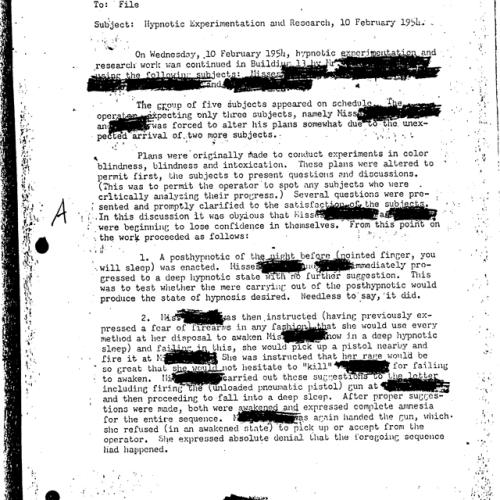
The war on terror is not the CIAs first venture into human experimentation. At the dawn of the Cold War, German scientists and doctors with Nazi records of human experimentation were given new identities and brought to the United States under Operation Paperclip. In 1953, the CIA established the MK-ULTRA program, [which] evolved into experiments in psychological torture. During the Vietnam War, the CIA developed the Phoenix program, which combined psychological torture with brutal interrogations, human experimentation and extrajudicial executions. In 1963, the CIA produced a manual titled Kubark Counterintelligence Interrogation to guide agents in the art of extracting information. An updated version of the Kubark guide [was] produced in 1983 and titled Human Resource Exploitation Manual [for CIA supported] right-wing regimes in Latin America and Southeast Asia. Here we are again. On April 15, 2002, [psychologists hired by the CIA] Mitchell and Jessen arrived at a black site in Thailand to supervise the interrogation of Abu Zubaydah, the first high-value detainee captured by the CIA. From then ... at least thirty-eight people were subjected to psychological and physical torments, and the results were methodically documented and analyzed. That is the textbook definition of human experimentation.
Note: For more along these lines, see this list depicting the rampant use of humans as guinea pigs in government, military, and medical experiments over the last century, or watch "Human Resources", a two-hour documentary on the subject. For more, see the excellent, reliable resources provided in our Mind Control Information Center.
The CIA brought top al-Qaeda suspects close to the point of death by drowning them in water-filled baths during interrogation sessions in the years that followed the September 11 attacks, a security source has told The Telegraph. The description of the torture meted out to at least two leading al-Qaeda suspects, including the alleged 9/11 mastermind Khalid Sheikh Mohammed, far exceeds the conventional understanding of waterboarding, or simulated drowning so far admitted by the CIA. They werent just pouring water over their heads or over a cloth, said the source who has first-hand knowledge of the period. They were holding them under water until the point of death, with a doctor present to make sure they did not go too far. This was real torture. The account of extreme CIA interrogation comes as the US Senate prepares to publish a declassified version of its so-called Torture Report a 3,600-page report document based on a review of several million classified CIA documents. Publication of the report is currently being held up by a dispute over how much of the 480-page public summary should remain classified, but it is expected to be published within weeks. A second source who is familiar with the Senate report told The Telegraph that it contained several unflinching accounts of some CIA interrogations which the source predicted would deeply shock the general public.
Note: For more on this, see concise summaries of deeply revealing intelligence agency operations news articles from reliable major media sources.
A Senate intelligence committee investigation found that the Central Intelligence Agency employed brutal interrogation methods that turned out to be largely useless and then lied about their effectiveness. The Senate report contradicts the main defenses of the Bush-era torture program: That harsh methods were needed to produce "actionable results," and that the program itself helped save American lives by foiling terror attacks. Instead, the CIA overstated the effectiveness of the program and concealed the harshness of the methods they used. Intelligence breakthroughs credited to the enhanced interrogation program by the CIA were instead gleaned through other means, and then used by the agency to bolster defenses of the program. Conservative media figures incessantly hyped former Bush administration officials at times verifiably false claims about the efficacy of the program. The Bush administrations trip to the dark side provided pundits, op-ed columnists, and other media personalities an endless stream of satisfaction from talking like the greased up protagonists of 1980s action films.
Note: For an article explaining how even though this report may be declassified, the public will not have access to most of it, click here. For more on the realities of intelligence agency operations, see the deeply revealing reports from reliable major media sources available here.
The familiar, hierarchical sequence of math instruction ... actually has nothing to do with how people think, how children grow and learn, or how mathematics is built, says pioneering math educator and curriculum designer Maria Droujkova. She echoes a number of voices from around the world that want to revolutionize the way math is taught, bringing it more in line with these principles. The current sequence is merely an entrenched historical accident that strips much of the fun out of what she describes as the playful universe of mathematics, with its more than 60 top-level disciplines, and its manifestations in everything from weaving to building, nature, music and art. Calculations kids are forced to do are often so developmentally inappropriate, the experience amounts to torture, she says. They also miss the essential pointthat mathematics is fundamentally about patterns and structures, rather than little manipulations of numbers, as she puts it. Its akin to budding filmmakers learning first about costumes, lighting and other technical aspects, rather than about crafting meaningful stories. Droujkova ... advocates a more holistic approach she calls natural math, which she teaches to children as young as toddlers, and their parents. This approach, covered in the book she co-authored with Yelena McManaman, Moebius Noodles: Adventurous math for the playground crowd, hinges on harnessing students powerful and surprisingly productive instincts for playful exploration to guide them on a personal journey through the subject.
Note: For a treasure trove of great news articles which will inspire you to make a difference, click here.