





















Search 14,343 Media Articles
The tale of how the Obama economic team was recruited en masse from Robert Rubin acolytes who either facilitated Wall Streets pre-crash recklessness while in the Clinton administration or cashed in on it later (or, like Rubin, did both) never loses its power to shock. Michael Froman, Rubins chief of staff as Clinton Treasury secretary, not only served as the Obama transition teams personnel director but moonlighted as a Citigroup managing director while doing so. Obama essentially entrusted the repairing of the china shop to the bulls whod helped ransack it, [Jeff] Connaughton writes [in The Payoff: Why Wall Street Always Wins]. [In This Town Mark] Leibovich updates the story of the tacky prehistory of the Obama White House with its aftermaththe steady parade of Obama alumni who traded change we can believe in for cash on the barrelhead as soon as they left public service. The starry list includes, among many others, Peter Orszag (director of the White Houses Office of Management and Budget, now at Citi), Jake Siewert (the Treasury Department counselor turned chief flack for Goldman Sachs), and David Plouffe (the campaign manager and senior presidential adviser who did consulting for Boeing and General Electric). When I am president, Obama had said in 2008, I will start by closing the revolving door in the White House thats allowed people to use their administration job as a stepping-stone to further their lobbying careers. Puzzling over how so many colleagues have strayed from this credo, the former press secretary Robert Gibbs has theorized that either somehow we have all changed or, alternatively, maybe Washington changed us.
Note: For more on government corruption, see the deeply revealing reports from reliable major media sources available here.
If you've ever suspected politics is increasingly being run in the interests of big business, ... Jeffrey Sachs, a highly respected economist from Columbia University, agrees with you - at least in respect of the United States. In his book, The Price of Civilization: Reawakening American Virtue and Prosperity, he says the US economy is caught in a feedback loop. ''Corporate wealth translates into political power through campaign financing, corporate lobbying and the revolving door of jobs between government and industry; and political power translates into further wealth through tax cuts, deregulation and sweetheart contracts between government and industry. Wealth begets power, and power begets wealth,'' he says. Sachs says four key sectors of US business exemplify this feedback loop and the takeover of political power in America by the ''corporatocracy''. First is the well-known military-industrial complex. Second is the Wall Street-Washington complex, which has steered the financial system towards control by a few politically powerful Wall Street firms, notably Goldman Sachs, JPMorgan Chase, Citigroup, Morgan Stanley and a handful of other financial firms. Third is the Big Oil-transport-military complex, which has put the US on the trajectory of heavy oil-imports dependence and a deepening military trap in the Middle East, he says. Fourth is the healthcare industry, America's largest industry, absorbing no less than 17 per cent of US gross domestic product.
Note: For deeply revealing reports from reliable major media sources on corporate and government corruption, click here and here.
For nearly four years they lay piled in a Scotland Yard evidence room, six overstuffed plastic bags gathering dust and little else. Inside was a treasure-trove of evidence: 11,000 pages of handwritten notes listing nearly 4,000 celebrities, politicians, sports stars, police officials and crime victims whose phones may have been hacked by The News of the World, a now defunct British tabloid newspaper. Yet from August 2006, when the items were seized, until the autumn of 2010, no one at the Metropolitan Police Service, commonly referred to as Scotland Yard, bothered to sort through all the material and catalog every page. During that same time, senior Scotland Yard officials assured Parliament, judges, lawyers, potential hacking victims, the news media and the public that there was no evidence of widespread hacking by the tabloid. After the past week, that assertion has been reduced to tatters, torn apart by a spectacular avalanche of contradictory evidence. The testimony and evidence that emerged last week, as well as interviews with current and former officials, indicate that the police agency and News International, the British subsidiary of Rupert Murdochs News Corporation and the publisher of The News of the World, became so intertwined that they wound up sharing the goal of containing the investigation. Members of Parliament said in interviews that they were troubled by a revolving door between the police and News International.
Note: Media and government corruption could hardly get worse than seen in this case of the Murdoch phone hacking scandal. Scotland Yard's primary responsibility is to protect the UK public from criminal activity; instead it enabled the activity to continue and shared high-level information and personnel with News Corporation. For lots more on media and government corruption click here and here.
General Electric marketed the Mark 1 boiling water reactors that were used in Japan's Fukushima Dai-ichi plant as cheaper to build than other reactors because they used a smaller and less expensive containment structure. Yet American safety officials have long thought the smaller design more vulnerable to explosion and rupture in emergencies than competing designs. Here's the problem: Profit-making corporations have every incentive to underestimate these probabilities and lowball the likely harms. This is why it's necessary to have such things as government regulators and why regulators need enough resources to enforce the regulations. And it's why recent proposals in Congress to cut the budgets of agencies charged with protecting public safety are so wrong-headed. It's also why regulators have to be independent of the industries they regulate. When there's a revolving door between regulatory agency and industry, officials are reluctant to bite the hands that will feed them. Finally, the tendency of corporations to understate the probabilities of public harms requires that limits be placed on corporate political power. The public cannot not be adequately protected as long as big corporations ... are allowed to bribe legislators with campaign donations and boondoggles.
Note: The author of this opinion, Robert Reich, is a professor at UC Berkeley and former Secretary of Labor.
Former House Intelligence Committee Chairman Mike Rogers has formed a new pressure group ... to serve as the premiere national security and foreign policy organization during the 2016 debate and to help elect a president who supports American engagement and a strong foreign policy. Rogers group, Americans for Peace, Prosperity, and Security, is hosting candidate events and intends to host a candidate forum later this year. A look at the business executives helping APPS steer presidential candidates towards more hawkish positions reveals that many are defense contractors who stand to gain financially from continued militarism. Rogers may have a conflict of interest as well. Explaining the goals of his group to a news outlet in Indiana, Rogers lamented the lack of surveillance capabilities and warned of increasing threat of cyberwarfare. Its not unusual for the arms industry to use front groups to press for a more aggressive foreign policy, says William Hartung, director of the Arms & Security Project at the Center for International Policy. It sounds a lot more credible when a group called Americans for Peace, Prosperity and Security calls for a policy shift than if the same argument comes out of the mouth of an arms executive or lobbyist whose livelihood is tied to the spread of tension and conflict, Hartung said.
Note: Read a powerful essay by a top US general exposing the war machine titled "War is a Racket." For more, see concise summaries of deeply revealing electoral process corruption news articles from reliable major media sources.
After the first revelations of domestic surveillance by NSA whistleblower Edward Snowden, President Obama defended the spying programs by claiming they were subject to congressional oversight and congressional reauthorization and congressional debate. But as Rep. Alan Grayson, D-Fla., and other members of Congress have pointed out, there is essentially a "two-tiered" system for oversight, with lawmakers and staff on specialized committees, such as the House and Senate committees on Intelligence and Homeland Security, controlling the flow of information and routinely excluding other Congress members. A large number of lobbyists and consultants [pass] through the revolving door between the intelligence community and the watchdogs who purportedly oversee the intelligence community. Lobbyist influence is a particularly sensitive issue when it comes to intelligence committees, since those committees oversee secret black budgets in which money is disbursed with greatly reduced public oversight. The potential for self dealing is significant; former Rep. Randy Duke Cunningham, R-Calif., was caught accepting bribes to essentially earmark government contracts into a black budget. Lobbyist control over the House and Senate intelligence and homeland security committees may have a profound impact on a range of surveillance issues debated by Congress this year, including the Cybersecurity Information Sharing Act and the Patriot Act.
Note: The above article details several examples of industry lobbyists now operating in key government oversight positions within an unaccountable intelligence establishment. For more along these lines, see concise summaries of deeply revealing news articles about corruption in government and in intelligence agencies.
By the authority vested in me as President by the Constitution and the laws of the United States of America, ... it is hereby ordered as follows: Section 1. Ethics Pledge. Every appointee in every executive agency appointed on or after January 20, 2009, shall sign ... the following pledge: "As a condition, and in consideration, of my employment in the United States Government in a position invested with the public trust, I commit myself to the following obligations, which I understand are binding on me and are enforceable under law: "1. Lobbyist Gift Ban. I will not accept gifts from registered lobbyists or lobbying organizations for the duration of my service as an appointee. "2. Revolving Door Ban All Appointees Entering Government. I will not for a period of 2 years from the date of my appointment participate in any particular matter involving specific parties that is directly and substantially related to my former employer or former clients, including regulations and contracts. "3. Revolving Door Ban Lobbyists Entering Government. If I was a registered lobbyist within the 2 years before the date of my appointment, in addition to abiding by the limitations of paragraph 2, I will not for a period of 2 years after the date of my appointment: (a) participate in any particular matter on which I lobbied within the 2 years before the date of my appointment; (b) participate in the specific issue area in which that particular matter falls; or (c) seek or accept employment with any executive agency that I lobbied within the 2 years before the date of my appointment.
Note: For lots more on government corruption, click here.
As president, Barack Obama oversaw a civil rights renaissance. But his failure to prosecute Wall Street executives for causing the collapse of the housing market ushered in an era of populist rage ... according to Jesse Eisingers new book, The Chickenshit Club. If they had, the history of the country would be different, Eisinger, a veteran financial reporter at ProPublica whose investigation on shady crisis-era Wall Street practices won a Pulitzer Prize, [said]. There would be a sense of accountability after the crisis, the reforms would be tougher. The book traces Department of Justice impotence on corporate crime back two decades. Changes to the way the Justice Department treated white collar crime came into sharp relief after the 2007 financial crisis. [A] Corporate Fraud Task Force [created in] 2002 boasted nearly 1,300 fraud convictions by the time Obama replaced it in 2009 with the Financial Fraud Enforcement Task Force. The new entity [lacked] the focus or prosecutorial muscle of its predecessor. The first stages of a corporate criminal probe are typically carried out by a law firm hired by the company under investigation. The great secret to corporate criminal prosecution is that we have privatized and outsourced it to the companies themselves, Eisinger said. The company is going to be studiously incurious about following investigative threads that might lead to the CEO or board rooms. Instead, they point the finger at a middle manager or someone expendable, and thats the person who gets indicted by the general government.
Note: The revolving door between Washington and Wall Street leads to corruption in government and in the financial industry.
A U.S. watchdog agency is preparing to investigate whether the Federal Reserve and other regulators are too soft on the banks they are meant to police. Ranking representatives Maxine Waters of the House Financial Services Committee and Al Green of the Subcommittee on Oversight and Investigations asked the Government Accountability Office on Oct. 8 to launch the "evaluation of regulatory capture" and to focus on the New York Fed. The GAO said it has begun planning its approach. The probe, which had not been previously reported or made public, is the first by an outside agency into the perception that government regulators are "captured" by and too deferential toward the bankers they supervise, so that Wall Street benefits at the public's expense. Such perceptions have dogged the U.S. central bank since it failed to head off the 2007-2009 financial crisis. While the GAO has not yet determined the full scope of the investigation, the other main agencies that embed supervisors inside financial institutions are the Federal Deposit Insurance Corporation and the Office of the Comptroller of the Currency. In their letter, Waters and Green said they are particularly concerned about the New York Fed and reports of a "revolving door" between it and banks and "a reluctance to challenge" the firms.
Note: Are Goldman Sachs' suspicious ties to the New York Fed and the revolving door between Congress and Wall Street finally beginning to get serious attention? For more along these lines, see concise summaries of deeply revealing news articles about corruption in government and in the financial industry.
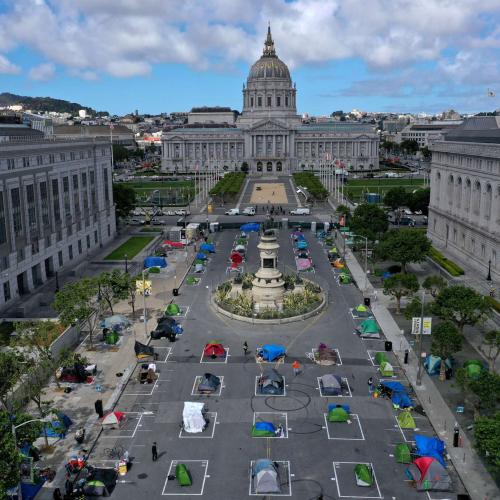
A report showing that more than half the $100 million the city of Los Angeles spends each year on homelessness goes to police demonstrates that the city is focused on enforcement rather than getting people off the streets. This city is doing almost nothing to advance housing solutions but continues down the expensive and inhumane process of criminalization that only makes the problem worse," said Becky Dennison of Los Angeles Community Action Network. Almost 15,000 people the LAPD arrested in 2013 were homeless, or 14% of those arrested, according to the report from the city administrative office. Labor costs for the arrests were estimated between $46 million and $80 million. Officer Deon Joseph, a longtime skid row senior lead officer ... said he frequently arrests the same people over and over because of the revolving door for mentally ill people and others between the jails and prisons and skid row. "I do not believe prison is the answer for most people struggling with mental issues," Joseph wrote. "Sadly in today's system we have to wait until they commit a violent crime to get them 'help' in a jail cell. The report ... was commissioned by the City Councils housing committee, which questioned why the homeless population grew 9% between 2011 and 2013 even as the city contributed millions to the homeless authority.
Note: When poverty and mental illness are criminalized, the prison industrial complex has an endless supply of slave labor under a corrupt government.
From his desk in Lower Manhattan, a banker at Goldman Sachs thumbed through confidential documents courtesy of a source inside the United States government. The banker came to Goldman through the so-called revolving door ... that connects financial regulators to Wall Street. He joined in July after spending seven years as a regulator at the Federal Reserve Bank of New York, the governments front line in overseeing the financial industry. He received the confidential information, lawyers briefed on the matter suspect, from a former colleague who was still working at the New York Fed. The previously unreported leak, recounted in interviews with the lawyers briefed on the matter who spoke anonymously ... illustrates the blurred lines between Wall Street and the government. When Goldman hired the former New York Fed regulator, who is 29, it assigned him to advise the same type of banks that he once policed. And the banker obtained confidential information [that] provided Goldman a window into the New York Feds private insights. The emergence of the leak comes as questions mount about a perceived coziness between the New York Fed and Wall Street banks Goldman in particular. Revelations from a former New York Fed employee, Carmen Segarra, recently stoked that debate. Ms. Segarra released taped conversations suggesting that her supervisors went soft on Goldman. The new accounts of a regulator and a banker actually sharing confidential documents violating a cardinal rule of the regulatory world suggest that ... Goldman, perhaps more than any other Wall Street bank, appears to be entwined with the New York Fed.
Note: For more along these lines, see these concise summaries of deeply revealing articles about widespread corruption in government and banking and finance. For additional information, see the excellent, reliable resources provided in our Banking Corruption Information Center.
Republican presidential candidate Mitt Romney is back on track after winning the Maine caucuses. What the headlines haven't told you is that what happened in Maine is the messiest caucus Republicans have had so far, and it may not be over yet. Maine is not a major state during national primaries. Only 24 delegates come out of Maine to the national convention. But what happened there over the weekend does more than raise eyebrows. It is enough to make you question, was the caucus fixed? Saturday night, February 11, the head of the Maine GOP, Charlie Webster, announced that Governor Mitt Romney won the Maine caucus by a slim margin. Official totals read Romney barely winning the caucus by less than 200 votes. The only problem, the governor was declared the winner with only 84 percent of precincts counted. Two counties, Washington County and Hancock County had not yet held their caucuses. In Hancock, County Republicans had decided to hold their caucus this Saturday on February 18. In Washington County, the state GOP canceled the caucus because of snow concerns. Turns out, the area only got a light dusting. The big problem here, Mr. Webster says even when those caucuses are held this Saturday, the votes won't count. And that is just the beginning of the problems in Maine.
Note: For a great series of diagrams showing the strong links and revolving door between US Government and big business, click here.
Sen. Elizabeth Warren on Tuesday introduced what she describes as the most ambitious anti-corruption legislation since Watergate. Warren's Anti-Corruption and Public Integrity Act ... aims to nix the influence of big money in politics. The legislation would "padlock" the revolving door in Washington by placing a lifetime ban on lobbying by former members of Congress, presidents and agency heads. The legislation would also expand the definition of who is a lobbyist to anyone who spends any time attempting to influence government. The proposal would also prohibit the world's largest companies, something defined by a company's annual revenue or market capitalization, from hiring or paying any former senior government official for four years after they leave government. Former senior officials would also have to file income disclosures for four years after federal employment. Warren's legislation would also ban members of Congress, cabinet secretaries, federal judges and other top government officials from owning and trading stocks. Currently, members simply need to disclose their stocks and trades. The bill would also create an entirely new office designed to police public corruption, called the Office of the Public Integrity, to strengthen enforcement and investigate possible violations.
Note: For more along these lines, see concise summaries of deeply revealing news articles on corruption in government and in the corporate world.
America is ruled by an intelligence-industrial complex whose allegiance is not to the taxpaying public but to a cabal of private-sector contractors. That is the central thesis of Spies for Hire: The Secret World of Intelligence Outsourcing by Tim Shorrock, ... an investigative journalist. His book [provides a] disturbing overview of the intelligence community, also known as the I.C. Mr. Shorrock says our government is outsourcing 70 percent of its intelligence budget, or more than $42 billion a year, to a secret army of corporate vendors. Because of accelerated privatization efforts after 9/11, these companies are participating in covert operations and intelligence-gathering activities that were considered inherently governmental functions reserved for agencies like the Central Intelligence Agency, he says. Some of the books most intriguing assertions concern the permeating influence of the consulting firm Booz Allen Hamilton. In 2006, Mr. Shorrock reports, Booz Allen amassed $3.7 billion in revenue, much of which came from classified government contracts exempt from public oversight. Among its more than 18,000 employees are R. James Woolsey, the former C.I.A. director, and Joan Dempsey, a former longtime United States intelligence official who declared in a 2004 speech, I like to refer to Booz Allen as the shadow I.C. The revolving door between Booz Allen and the I.C. is personified by Mike McConnell, who joined the firm after serving as head of the National Security Agency under President Bill Clinton, only to return as director of national intelligence under President Bush.
Note: For revealing reports on government corruption from reliable sources, click here.
A pilot who wrote a conspiracy theory book about 9/11 is dead after he shot his two teenage children and family dog before turning the gun on himself. Relatives and friends of Phillip Marshall were stunned by the violent crime which took place in Calaveras County on [Feb. 2]. The tragedy came as a shock for those living in the small town. The former airline pilot's controversial conspiracy book The Big Bamboozle: 9/11 and the War on Terror was released last year. While he was writing it, Marshall believed that his life was in danger because of the allegations involved. According to [the] Santa Barbara View, during the editing and pre-marketing process of Marshalls book, he expressed some degree of paranoia because the nonfiction work accused the George W. Bush administration of being in cahoots with the Saudi intelligence community in training the hijackers who died in the planes used in the attacks. Amazon says about Philip Marshall: 'A veteran airline captain and former government "special activities" contract pilot, he has authored three books on "Top Secret America," a group presently conducting business as the United States Intelligence Community. Marshall has studied and written [about] covert government special activities and the revolving door of Wall Street tricksters, media moguls, and their well funded politicians. He is the leading aviation expert on the September 11th attack.'
Note: Does something smell fishy here? Don't miss the even more revealing article written in a local newspaper at this link which questions whether Marshall might have been killed because of his 9/11 conspiracy views.
Organizations in the financial services sector have deployed at least 1,447 former federal employees to lobby Congress and federal agencies since the beginning of 2009, according to a joint analysis of federal disclosure records and other data released today by Public Citizen and the Center for Responsive Politics. This small army of registered financial services sector lobbyists includes at least 73 former members of Congress, of whom 17 served on the banking committees of either the U.S. House of Representatives or the Senate. At least 66 industry lobbyists worked for these committees as staffers, while 82 additional lobbyists once worked for congressional members who currently serve on these key committees. Further, at least 42 financial services lobbyists formerly served in some capacity in the U.S. Treasury Department. At least seven served in the Office of the Comptroller of the Currency, including two former comptrollers. Wall Street hires former members of Congress and their staff for a reason," said David Arkush, director of Public Citizens Congress Watch division. "These people are influential because they have personal relationships with current members and staff. Its hard to say no to your friends."
Note: To read the full report, click here. The nonprofit, nonpartisan Center for Responsive Politics is the nation's premier research group tracking money in federal politics and its effect on elections and public policy. Public Citizen is a national, nonprofit consumer advocacy organization based in Washington, D.C.
In his bid to become Secretary of Defense, former Sen. Chuck Hagel has come under fire from both the left and right for his comments on Iraq, Israel and gays. His membership on the board of one of America's largest oil companies, however, has caused barely a stir. Since 2010, Hagel has served on the board of Chevron Corp., a position he would have to leave if he wins Senate confirmation as defense secretary. He received $301,199 in compensation from the San Ramon company in 2011, including $184,000 in stock. Chevron is a major federal contractor, with more than $501 million in sales to the U.S. government in the last fiscal year. But critics of the "revolving door" between the federal government and the private sector haven't raised any complaints about Hagel. That's largely due to the nature of Chevron's federal contracts. Almost all the money Chevron made from the U.S. government in fiscal year 2012 came from selling fuel to the Pentagon, according to a government website that tracks federal spending. Chevron, the nation's second-largest oil company, has a history of politically connected board members. Condoleezza Rice served on the company's board before becoming national security adviser for President George W. Bush. The practice of former federal officials landing jobs with government contractors - and vice versa - has long angered many government watchdogs. They were appalled when Obama, early in his first term, nominated a lobbyist for the Raytheon Corp. to serve as deputy secretary of defense.
Note: US Defense Secretary nominee Chuck Hagel has also been implicated in serious elections manipulations by none other than the New York Times. For more, see this link.




