













War on Drugs Media Articles
Over 100,000 lives continue to be lost to drug overdose each year in the US. The War on Drugs is a racket designed to fund covert, black budget US operations and inflate the budgets of law enforcement agencies and the incarceration industry. While the War on Drugs targeted everyday people, this war protected the activities of the rich and powerful: rogue elements within the US government, big banks, Big Pharma, and drug cartels.
THE BIG PICTURE:
Our Mindful News Brief video explores who's really behind the War on Drugs.
Our investigative Substack article investigates the dark truths behind the US war on drugs that the mainstream media ignores.

The Taliban ... briefly banned poppy cultivation in 2000 in an effort to gain U.S. diplomatic recognition and aid. When the Bush administration invaded Afghanistan in October 2001, poppies were grown on only 7,600 hectares. Under the American occupation ... poppy cultivation spread to every province, and overall production has increased exponentially ever since -- this year by 60 percent. Within Afghanistan, where perhaps 3 million people draw direct income from poppy, profits may reach $3 billion this year. In-country profit adds up to an estimated 60 percent of Afghanistan's gross domestic product, or more than half the country's annual income. Afghanistan provides 92 percent of the world's heroin. Through many administrations, the U.S. government has been implicated in the Afghan drug trade. Before the American and Pakistani-sponsored mujahedeen took on the Soviets in 1979, Afghanistan produced a very small amount of opium for regional markets, and no heroin at all. By the end of the jihad against the Soviet army, it was the world's top producer of both drugs. The CIA made it all possible by providing legal cover for these operations. The United States [encouraged] Islamist extremists (then "our" soldiers) and ... set the stage for the Taliban. [Currently,] President Hamid Karzai['s] strategy is to avoid confrontation, befriend potential adversaries and give them offices, often in his Cabinet. The trade penetrates even the elected Parliament. Among the 249 members of the Wolesi Jirga (lower house) are at least 17 known drug traffickers, in addition to 40 commanders of armed militias, 24 members of criminal gangs, and 19 men facing serious allegations of war crimes.
Note: Could it be that some U.S. officials are turning a blind eye, or even supporting this drug trade? For some very strong evidence of this from a former award-winning DEA agent turned journalist and author, click here.
Ten years ago today, one of the most controversial news articles of the 1990s quietly appeared on the front page of the San Jose Mercury News. Titled "Dark Alliance"...the three-part series by reporter Gary Webb linked the CIA and Nicaragua's Contras to the crack cocaine epidemic that ripped through South Los Angeles in the 1980s. Most of the nation's elite newspapers at first ignored the story. A public uproar, especially among urban African Americans, forced them to respond. What followed was one of the most bizarre, unseemly and ultimately tragic scandals in the annals of American journalism. Top news organizations closed ranks to debunk claims Webb never made, ridicule assertions that turned out to be true and ignore corroborating evidence when it came to light. The whole shameful cycle was repeated when Webb committed suicide in December 2004. At first, the Mercury News defended the series, but after nine months, Executive Editor Jerry Ceppos wrote a half-apologetic letter to readers that defended "Dark Alliance" while acknowledging obvious mistakes. Webb privately (and accurately) predicted the mea culpa would universally be misperceived as a total retraction, and he publicly accused the paper of cowardice. He resigned a few months later. Meanwhile, spurred on by Webb's story, the CIA conducted an internal investigation that acknowledged in March 1998 that the agency had covered up Contra drug trafficking for more than a decade. History will tell if Webb receives the credit he's due for prodding the CIA to acknowledge its shameful collaboration with drug dealers.
Note: Many thanks to the Los Angeles Times for the courage to report this story. For more on this incredibly revealing, yet very tragic case which reveals corruption in both the government and media at the highest levels: http://www.WantToKnow.info/mediacover-up#webb
In 1996, the award-winning journalist Gary Webb uncovered CIA links to Los Angeles drug dealers. The link between drug-running and the Reagan regime's support for the right-wing terrorist group throughout the 1980s had been public knowledge for over a decade. What was new about Webb's reports, published under the title "Dark Alliance" in the Californian paper the San Jose Mercury News, was that for the first time it brought the story back home. His series of articles ... incited fury among the African-American community, many of whom took his investigation as proof that the White House saw crack as a way of bringing genocide to the ghetto. Webb's reports prompted three official investigations, including one by the CIA itself which ... confirmed the substance of his findings. Webb undeniably made mistakes. But his central thesis - that the CIA, having participated in narcotics trafficking in central America, had, at best, turned a blind eye to the activities of drug dealers in LA - has never been in question. [A 1998] CIA Inspector General's report, commissioned in response to the allegations in "Dark Alliance" ... found that CIA officials ignored information about possible Contra drug dealing; that they continued to work with Contra supporters despite allegations that they were trafficking drugs, and further asserted that officials from the CIA instructed Drug Enforcement Agency officers to refrain from investigating alleged dealers connected with the Contras.
Note: For those interested in the Gary Webb story, this article is possibly the best single summary out there. Read an excellent, concise summary written by Gary Webb himself of what happened on this highly revealing Dark Alliance series. For more along these lines, see concise summaries of deeply revealing intelligence agency corruption news articles from reliable major media sources.
The Justice Department is investigating allegations that officers of a special Venezuelan anti-drug unit funded by the CIA smuggled more than 2,000 pounds of cocaine into the United States with the knowledge of CIA officials - despite protests by the Drug Enforcement Administration. That is a huge amount of cocaine. But it was hardly a first. The agency has never been above using individuals or organizations with known links to drug trafficking. Until recently, no DEA country attach overseas was allowed to initiate an investigation into a suspected drug trafficker ... without clearance from the local CIA station chief. CIA ties to international drug trafficking date to the Korean War. Nowhere, however, was the CIA more closely tied to drug traffic than it was in Pakistan during the Afghan War. As its principal conduit for arms and money to the Afghan guerrillas, the agency chose the Pakistan military's Inter-Services Intelligence Bureau. The ISI in turn steered the CIA's support toward [an Islamic fundamentalist who] received almost half of the agency's financial support during the war. But many of his commanders were also major heroin traffickers. Soon the trucks that delivered arms to the guerrillas in Afghanistan were coming back ... full of heroin. The heroin traffic blossomed in the shadows of a CIA-sustained guerrilla war. The conflict and its aftermath have given the world another Golden Triangle: the Golden Crescent, sweeping through Afghanistan, Pakistan and parts of the former Soviet Union. Many of those involved in the drug traffic are men who were once armed, trained and financed by the CIA.
Note: The entire article at the link above is highy revealing. Read more about the CIA's ongoing involvement with Afghan heroin trafficking. The Taliban banned opium production in 2000 reducing the yield by 90%. Yet shortly after the U.S. defeated the Taliban, Afghanistan quickly returned to supplying 75% of the world's heroin. Do you think the U.S. is serious about stopping the drug trade? For more along these lines, see concise summaries of deeply revealing intelligence agency corruption news articles from reliable major media sources.
Some drug traders first saw him as a heroin smuggler in Thailand. Others met him as a cocaine buyer in Buenos Aires. And others as a gunrunner in Buffalo. He can recall how they all looked into his eyes, trusted him and, as a result, went to jail. Michael Levine, a special agent of the Federal Drug Enforcement Administration ... is described by his agency as an expert in "deep cover" - an agent who assumes invented characters to penetrate underworld organizations. Deep cover means living among criminals for weeks or months at a time, unable to return home or admit to anyone one's real name. After playing the part of underworld figures for the Federal Government for 21 years, Mr. Levine now works as a supervisor in the D.E.A.'s New York office. Deep cover specialists play a crucial role in the D.E.A.'s long-term narcotics investigations, as well as in major investigations of the Federal Bureau of Investigation, the Bureau of Alcohol, Tobacco and Firearms ... and some local police departments. "You have to divide your brain in half," Mr. Levine said. "This half is the character you are playing. This half is always a Federal agent recording the details. If the half that is a Government official becomes inefficient, it can cost you your life." Over the years, [Mr. Levine] has been stationed in New York, Washington, Miami, Buenos Aires and Germany, and has followed investigations to Asia, South America and the Middle East.
Note: Mike Levine went on to blow the whistle about rogue elements in the US government who were directly involved with running drugs and had his life threatened as a result. Read his fascinating and revealing personal story on this webpage.
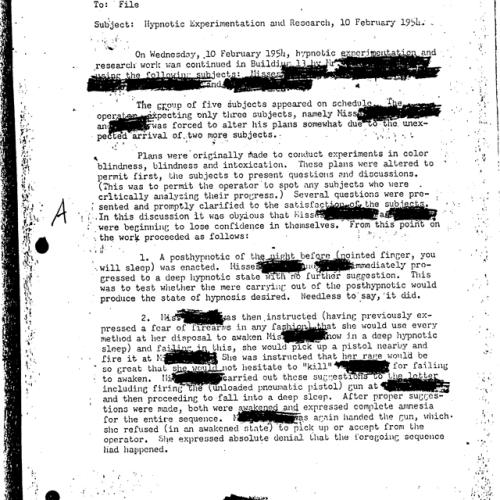
A former Central Intelligence Agency employee told a Senate subcommittee today that he and another C.I.A. employee were sent to San Francisco in 1959 to lure unsuspecting people to a party at which the two agents were to spray the air with LSD 25 as part of the agency's secret drug testing program. The test [was] part of a much larger drug testing program known by the cryptonym MK ULTRA, David Rhodes told the Senate Subcommittee on Health and Scientific Research. Mr. Rhodes, two former C.I.A. employees, two former Bureau of Narcotics agents and Dr. Charles Geschickter, head of a foundation that channeled C.I.A. medical research funds to universities for nine or 10 years, were questioned this morning in the first of two days of hearings into C.I.A. testing of drugs on human beings. Today's testimony by Mr. Rhodes provided the first look the public has had at an LSD test inside a C.I.A. safehouse. The agency carried out other drug tests in both California and New York City from 1953 to 1966 in such safehouses, mainly apartments and motel rooms. These were secretly rented for the agency by George H. White, an official of the old Federal Bureau of Narcotics, which has since been supplanted by the Drug Enforcement Administration. Mr. Rhodes, a psychologist employed by the C.I.A. from 1957 to 1961, said he went to California in 1959 with Walter P. Pasternak. Mr. Pasternak, a former employee of the agency, was also an official with the Society for the Investigation of Human Ecology.
Note: Read more about the CIA's MK ULTRA program. Shortly before his death, George White summed up his CIA career by saying, 'It was fun, fun, fun. Where else could a red-blooded American boy lie, kill and cheat, steal, deceive, rape and pillage with the sanction and blessing of the all highest," as reported in this ABC documentary on MK ULTRA. For more along these lines, see concise summaries of deeply revealing news articles on mind control from reliable major media sources.
Important Note: Explore our full index to key excerpts of revealing major media news articles on several dozen engaging topics. And don't miss amazing excerpts from 20 of the most revealing news articles ever published.