












War on Drugs Media Articles
Over 100,000 lives continue to be lost to drug overdose each year in the US. The War on Drugs is a racket designed to fund covert, black budget US operations and inflate the budgets of law enforcement agencies and the incarceration industry. While the War on Drugs targeted everyday people, this war protected the activities of the rich and powerful: rogue elements within the US government, big banks, Big Pharma, and drug cartels.
THE BIG PICTURE:
Our Mindful News Brief video explores who's really behind the War on Drugs.
Our investigative Substack article investigates the dark truths behind the US war on drugs that the mainstream media ignores.

The roots of Southeast Asia’s billion-dollar drug trade [are] hidden in the picturesque place in northern Thailand, home to only a few hundred people and high up in the hills of the Golden Triangle, which also straddles Myanmar and Laos. This surge in Southeast Asia’s narcotics trade was also achieved with at least some input from America’s Central Intelligence Agency (CIA). Keen to prevent Mao’s Communist message from spreading into Burma, and from there mainland Southeast Asia, the CIA offered support to ... exiled Chinese nationalists, including transportation assistance through Civil Air Transport – the CIA-owned airline that would later become the notorious Air America, which transported U.S. supplies and forces into Vietnam, and the secret war in Laos. Burmese military intelligence reports at the time also noted that the nationalist troops were sporting brand-new American arms in the form of machine guns, bazookas, mortars, and anti-aircraft artillery. A declassified CIA cable from the era said the troops who settled in Mae Salong became the “dominant opium traffickers in the region”, and that the move to the hilltop village had proven a “boon” for their activities, by allowing them to develop networks in Thailand. A series of brutal campaigns throughout the 1970s brought the Communist threat in the area to an end, and Mae Salong’s residents shifted from producing opium to tea and mushrooms.
Note: Read our Substack investigation into the dark truths behind the US War on Drugs. For more along these lines, read our concise summaries of news articles on the War on Drugs.
The first trial against a pharmaceutical opioid manufacturer started Tuesday in Oklahoma in what could be a precedent-setting case for hundreds of other claims around the country. The state's attorney general, Mike Hunter, began the day by accusing Johnson & Johnson of putting profits over responsibility and argued that the company was responsible for the "worst man-made public health crisis in the history of our state and country." In the multibillion-dollar lawsuit against the drugmaker, lawyers for the state argued that Johnson & Johnson knew about the addictive nature of opioids, but misled doctors by downplaying the risks of the drugs while touting its benefits. Brad Beckworth, a lawyer for Oklahoma, argued that Johnson & Johnson was motivated to increase sales on multiple fronts as both the manufacturer of the drugs Duragesic and Nucynta and as a supplier of the raw materials for other opioid manufacturers. He argued that a marketing push by Johnson & Johnson lead doctors to overprescribe opioids in Oklahoma. If you oversupply, people will die, Beckworth repeatedly said in his opening statement while showing email communications from Johnson & Johnson sales representatives. Oklahoma settled with two other drug manufacturers before Tuesdays opening statements. In March, Purdue Pharma settled for $270 million, and on Sunday, Teva Pharmaceuticals settled for $85 million, leaving Johnson & Johnson as the sole defendants in what could a monthslong bench trial.
Note: Many doctors also profited from excessive prescribing of dangerous opioids. And according to a former DEA agent, Congress helped drug companies fuel the opioid epidemic. For more along these lines, see concise summaries of deeply revealing news articles on Big Pharma corruption from reliable major media sources.
The mayor of the West Virginia city that has come to symbolize Americas opioid epidemic has called for the jailing of pharmaceutical company executives he likens to street corner drug dealers. Steve Williams, mayor of ... a city ravaged by prescription pill and heroin addiction, said he wants to see executives face criminal prosecution, after it was revealed that a member of the family that made billions of dollars from the painkiller that unleashed the epidemic stands to profit further after he was granted a patent for an anti-addiction medicine. They are drug dealers in Armani suits, said Williams. The decisions that have been made within the pharmaceutical industry have ravaged our nation. In June, Massachusetts became the first state to sue individual executives and owners of Purdue Pharma, the maker of the drug, OxyContin, which kicked off the biggest drug epidemic in American history, estimated to be killing more than 115 people a day. The lawsuit seeks to recover the billions of dollars in profit banked by members of the Sackler family, which owns Purdue. Massachusetts attorney general Maura Healey, accused the company and its officials of knowingly profiting from overdoses and death. Purdue Pharma and its executives built a multi-billion-dollar business based on deception and addiction. The more drugs they sold, the more money they made, she said in announcing the lawsuit.
Note: According to a former DEA agent, Congress helped drug companies fuel the opioid epidemic. For more along these lines, see concise summaries of deeply revealing Big Pharma corruption news articles from reliable major media sources.
In the midst of the worst drug epidemic in American history, the U.S. Drug Enforcement Administration's ability to keep addictive opioids off U.S. streets was derailed - that according to Joe Rannazzisi, one of the most important whistleblowers ever interviewed by 60 Minutes. Rannazzisi ran the DEA's Office of Diversion Control, the division that regulates and investigates the pharmaceutical industry. He says the opioid crisis was allowed to spread - aided by Congress, lobbyists, and a drug distribution industry that shipped, almost unchecked, hundreds of millions of pills to rogue pharmacies and pain clinics providing the rocket fuel for a crisis that, over the last two decades, has claimed 200,000 lives. His greatest ire is reserved for the ... middlemen that ship the pain pills from manufacturers, like Purdue Pharma and Johnson & Johnson to drug stores all over the country. Rannazzisi accuses the distributors of fueling the opioid epidemic. "This is an industry that allowed millions and millions of drugs to go into bad pharmacies and doctors' offices, that distributed them out to people who had no legitimate need for those drugs," [said Rannazzisi]. In 2013, Joe Rannazzisi and his DEA investigators were trying to crack down. Then ... with the help of members of Congress, the drug industry began to quietly pave the way for legislation that essentially would strip the DEA of its ... ability to immediately freeze suspicious shipments of prescription narcotics to keep drugs off U.S. streets.
Note: See also this informative Washington Post article for more information on this sad topic. Lots more available here. For more along these lines, see concise summaries of deeply revealing news articles on corruption in government and in pharmaceutical industry.
The war on drugs has failed, fuelling higher rates of infection and harming public health and human rights to such a degree that it's time to decriminalize non-violent minor drug offences, according to a new global report. The authors of the Johns Hopkins-Lancet Commission on Public Health and International Drug Policy call for minor use, possession and petty use to be decriminalized following measurably worsened human health. "We've had three decades of the war on drugs, we've had decades of zero-tolerance policy," said Dr. Chris Beyrer, a professor of infectious disease epidemiology at Johns Hopkins Bloomberg School of Public Health in Baltimore and the senior author of the report published Thursday in The Lancet. "It has had no measurable impact on supply or use, and so as a policy to control substance use it has arguably failed. It has evidently failed." Given that the goal of prohibiting all use, possession, production and trafficking of illicit drugs was to protect societies, the researchers evaluated the health effects and found they were overwhelmingly negative. For a role model, the authors point to Portugal, which decriminalized not only cannabis but also possession of heroin, cocaine and methamphetamine. HIV transmission, hepatitis C and incarcerations all decreased, Beyrer said, and there was about a 15 per cent decline in substance use by young people in Portugal.
Note: While the war on drugs has been called a "trillion dollar failure", and the healing potentials of mind altering drugs are starting to be investigated more openly, there remains powerful evidence that the CIA and US military are directly involved in the drug trade.
Don Winslow['s book] The Cartel, a sequel to 2005's The Power of the Dog [is] a sort of Game of Thrones of the Mexican drug wars, a multipart, intricately plotted, blood-soaked epic that tells the story of how America's unquenchable appetite for illegal drugs has brought chaos to our southern neighbors and darkened our own political and criminal culture. Dog ... traces the rise of the narcotraficantes who split Mexico into territories and smuggled cocaine across the U.S. border by the ton. The violence ... spills out into Mexican society, turning cities like Juarez into Fallujah-like battle zones. But the most shocking thing about these books is that almost all the horror stories Winslow tells ... are largely true – from the narcotrafficker who threw children off a bridge to ... countless murders, kidnappings and tortures. The War on Drugs is a trillion-dollar failure. We spend billions of dollars pursuing drugs and billions imprisoning people that probably shouldn't be in prison. This war has killed a hundred thousand people in Mexico. These ISIS beheadings that we're seeing [are] a direct copy of what the cartels were doing in 2007 and 2008. The Zetas had imported Special Forces veterans from the Guatemalan army – and one of their things was to cut off heads. [There's] a direct line between events in Ferguson and Baltimore and Cleveland to the War on Drugs. The fruits that we're reaping now are seeds that were planted back in 1971, when Nixon declared war on drugs. The War on Drugs is more of a problem to the United States than drugs are.
Note: For more along these lines, see concise summaries of deeply revealing news articles on drugs from reliable major media sources on little-known facts about mind-altering drugs. Then explore the excellent, reliable resources provided in our War Information Center.
In a war full of failures, the US counternarcotics mission in Afghanistan stands out: opiate production has climbed steadily over recent years to reach record-high levels last year. One clear winner in the anti-drug effort is ... the infamous mercenary company formerly known as Blackwater. Statistics released on Tuesday reveal that the rebranded private security firm, known since 2011 as Academi, reaped over a quarter billion dollars from the futile Defense Department push to eradicate Afghan narcotics, some 21% of the $1.5 bn in contracting money the Pentagon has devoted to the job since 2002. The company is the second biggest beneficiary of counternarcotics largesse in Afghanistan. Only the defense giant Northrop Grumman edged it out, with $325m. According to the US inspector general for Afghanistan reconstruction, the $309m Academi got from US taxpayers paid for training, equipment, and logistical support to Afghan forces conducting counternarcotics. Far from eradicating the deep-rooted opiate trade, US counternarcotics efforts have ... contributed to the opium boom. In December, the United Nations reported a 60% growth in Afghan land used for opium poppy cultivation since 2011, up to 209,000 hectares. The estimated $3bn value of Afghan heroin and morphine represents some 15% of Afghan GDP. Academi and its former Blackwater incarnation have an infamous history in Afghanistan. It once set up shell companies to disguise its business practices, according to a Senate report, so that its contracts would be unimpeded by company employees killings of Iraqi and Afghan civilians.
Note: Blackwater, now called Academi, got caught systematically defrauding the US government, while serving as a "virtual extension of the CIA". The CIA has been linked to the Afghan heroin trade for decades. In 2000, the Taliban had all but eradicated Afghan opium production. Once Afghanistan was under US control, opium production surged to record levels.
Drug Enforcement Administration agents allegedly had "sex parties" with prostitutes hired by local drug cartels overseas over a period of several years, according to a report released Thursday by the Justice Department's watchdog. The agents, some of whom had top-secret security clearances, received suspensions of two to 10 days. Former police officers in Colombia also alleged that three DEA supervisory special agents were provided with money, expensive gifts and weapons from drug cartel members, according to the report. The findings were part of a much broader investigation into the handling of allegations of sexual harassment and misconduct from fiscal 2009 to 2012 at federal law enforcement agencies. [Justice Department Inspector General Michael E.] Horowitz said the investigation was "significantly impacted and unnecessarily delayed" by repeated difficulties his office had in obtaining relevant information from the FBI and the DEA. When he did receive the information, he said, it "was still incomplete." Sen. Charles Grassley (R-Iowa), chairman of the Judiciary Committee, called on the Justice Department on Thursday to adopt a zero-tolerance policy for employees who purchase sex. "The Department of Justice may not be taking adequate steps to prevent its own employees from buying sex and thereby contributing to the demand for the human sex trade," Grassley wrote to Acting Deputy Attorney General Sally Quillian Yates.
Note: DEA agents caught being supplied prostitutes by drug cartels are merely suspended for a few days? What's up with that? Read the gripping stories of two award-winning journalists giving powerful evidence of direct DEA and CIA involvement in and support of drug running and drug cartels. For more along these lines, see concise summaries of deeply revealing news articles about corruption in government and in the intelligence community.
Gary Webb knew his story would cause a stir. The newspaper report he'd written suggested that a US-backed rebel army in Latin America was supplying the drugs responsible for blighting some of Los Angeles's poorest neighbourhoods and, crucially, that the CIA must have known about it. [Webb's report, titled] "Dark Alliance" has been called one of the most explosive and controversial exposs in American journalism. Nineteen years on, the story of Webbs investigation and its aftermath has been given the full Hollywood treatment. Kill the Messenger, based on his account of what happened and a book of the same name about the saga by journalist Nick Schou was recently released in cinemas. What Webb did that nobody else had was to follow the supply chain right to the poverty stricken streets of Los Angeles. Webb summed up the heart of his ... series thus: It is one of the most bizarre alliances in modern history. The union of a U.S. backed army attempting to overthrow a revolutionary socialist government and the uzi-toting gangstas of Compton and South-Central Los Angeles. Perhaps most damningly, Webb wrote that crack was virtually unobtainable in the citys black neighbourhoods before members of the CIAs army began supplying it. [In 1999], Webb said that after spending three years of his life looking into it, he was more convinced than ever that the U.S. Government's responsibility for the drug problems in South Central L.A. was greater than I ever wrote in the newspaper.
Note: Read an excellent, concise summary written by Gary Webb himself of what happened on this highly revealing Dark Alliance series. For more along these lines, see concise summaries of deeply revealing intelligence agency corruption news articles from reliable major media sources.
As part of their insurgency against the Sandinista government in Nicaragua, some of the C.I.A.-backed contras made money through drug smuggling, transgressions noted in a little-noticed 1988 Senate subcommittee report. Gary Webb, a journalist at The San Jose Mercury News, thought it was a far-fetched story to begin with, but in 1995 and 1996, he dug in and produced a deeply reported and deeply flawed three-part series called Dark Alliance. That groundbreaking series was among the first to blow up on the nascent web, and he was initially celebrated, then investigated and finally discredited. Pushed out of journalism in disgrace, he committed suicide in 2004. [The movie] Kill the Messenger ... suggests that he told a truth others were unwilling to. Mr. Webb was not the first journalist to come across [such matters]. In December 1985, The Associated Press reported that three contra groups had engaged in cocaine trafficking, in part to help finance their war against Nicaragua. Major news outlets mostly gave the issue a pass. Peter Landesman, an investigative journalist who wrote the screenplay, was struck by the reflex to go after Mr. Webb. Planeloads of weapons were sent south from the U.S., and everyone knows that those planes didnt come back empty, but the C.I.A. made sure that they never knew for sure what was in those planes, he said. But instead of going after that, they went after Webb." In 1998, Frederick P. Hitz, the C.I.A. inspector general, testified before the House Intelligence Committee that after looking into the matter at length, he believed the C.I.A. was a bystander or worse in the war on drugs. However dark or extensive, the alliance Mr. Webb wrote about was a real one.
Note: Webb's story was not deeply flawed, as reported in this article. His editor even commented that four Washington Post writers could not find one significant factual error, but then changed his mind after CIA leaders threatened the paper. Read a Sacrament Bee newspaper article for more on Webb and his story. For more along these lines, see the excellent, reliable resources provided in our Mass Media Information Center.
Since [the days of Al Capone,] Chicago officials have awarded "Public Enemy No 1" status to only one other person: cartel billionaire Joaqun Guzmn Loera, better known now to the world over as "El Chapo". But nearly seven weeks before [his February] capture at a beach resort, the Mexican newspaper El Universal reported how US agencies had armed and financed El Chapo's Sinaloa criminal empire for at least 12 years. That link has been substantiated by DEA and Justice Department court testimonies, and even US agents confirmed the financing had been approved by high-ranking officials and federal prosecutors. But the American media barely reported how entrenched the American government has become in the Mexican drug trade. The latest installment of the "war on drugs" has killed 100,000 people since its official declaration by Mexican President Filipe Calderon and US President George W Bush in 2006. During this period, the US-El Chapo partnership was reportedly never closer: under the deal, Washington allowed El Chapo's Sinaloa cartel to carry on business as usual while top Sinaola members, for their part, provided information on their rivals. DEA agents met with their informants more than 50 times, El Universal reported, as the agents offered their whisperers immunity. American patronage goes well beyond stoking the largest and most powerful of the Mexican cartels (Sinaloa), as well as the most heinous (Golfo and Los Zetas). Drug arrests of cartel associates amounted to less than 2% of over 50,000 arrests made in the first four years of the Bush-Calderon partnership.
Note: For more on government corruption, see the deeply revealing reports from reliable major media sources available here.
The deal was announced quietly, just before the holidays. The U.S. Justice Department granted a total walk to executives of the British-based bank HSBC for the largest drug-and-terrorism money-laundering case ever. They issued a fine $1.9 billion, or about five weeks' profit but they didn't extract so much as one dollar or one day in jail from any individual, despite a decade of stupefying abuses. For at least half a decade, the storied British colonial banking power helped to wash hundreds of millions of dollars for drug mobs, including Mexico's Sinaloa drug cartel, suspected in tens of thousands of murders just in the past 10 years. The bank also ... aided countless common tax cheats in hiding their cash. That nobody from the bank went to jail or paid a dollar in individual fines is nothing new in this era of financial crisis. What is different about this settlement is that the Justice Department, for the first time, admitted why it decided to go soft on this particular kind of criminal. It was worried that anything more than a wrist slap for HSBC might undermine the world economy. "Had the U.S. authorities decided to press criminal charges," said Assistant Attorney General Lanny Breuer at a press conference to announce the settlement, "HSBC would almost certainly have lost its banking license in the U.S., the future of the institution would have been under threat and the entire banking system would have been destabilized."
Note: For more on the collusion of government with the biggest, most corrupt banks, see the deeply revealing reports from reliable major media sources available here.
During January 2011, Anabel Hernndez's extended family held a party at a favourite cafe in the north of Mexico City. As one of the country's leading journalists ... Hernndez had to leave early, as so often, "to finish an article". After she left ... gunmen burst in. But this was no robbery it was "pure intimidation, aimed at my family, and at me." Hernndez's offence was to write a book about the drug cartels that have wrought carnage across Mexico, taking some 80,000 lives. Narcoland: The Mexican Drug Lords and their Godfathers [is] about the mafia state; how the old Guadalajara cartel of the 1980s was protected by the Mexican government just as its heir, Guzmn's Sinaloa syndicate, is now. The threats began when Hernndez's book was published in Mexico in 2010. Veteran reporter Mike O'Connor works full-time on behalf of Mexico's menaced reporters, based in Mexico City for the Committee to Protect Journalists. "The silencing of the press and killing of journalists is integral to the reality, the big story, of what is happening here," explains O'Connor. "The cartels are taking territory. For the cartels to take territory, three things have to happen. One is to control the institutions with guns basically, the police. The second is to control political power. And, for the first two to be effective, you have to control the press." Hernndez is "very pleased my book is being published in English, so it can be read in London and New York. I want it published ... where HSBC took Chapo Guzmn's money."
Note: Read more in this revealing article, or find out about the sweetheart deal the U.S. gave to the HSBC executives that were caught knowingly laundering millions of dollars for Mexican drug cartels.
HSBC Holdings Plcs $1.9 billion agreement with the U.S. to resolve charges it enabled Latin American drug cartels to launder billions of dollars was approved by a federal judge. U.S. District Judge John Gleeson in Brooklyn, New York, signed off yesterday on a deferred-prosecution agreement. HSBC was accused of failing to monitor more than $670 billion in wire transfers and more than $9.4 billion in purchases of U.S. currency from HSBC Mexico, allowing for money laundering, prosecutors said. The bank also violated U.S. economic sanctions against Iran, Libya, Sudan, Burma and Cuba, according to a criminal information filed in the case. The bank, Europes largest, agreed to pay a $1.25 billion forfeiture and $665 million in civil penalties under the settlement, prosecutors announced in December. At a hearing the same month, Gleeson told prosecutors there had been publicized criticism of the agreement, which lets the bank and management avoid further criminal proceedings over the charges. Lack of proper controls allowed the Sinaloa drug cartel in Mexico and the Norte del Valle cartel in Colombia to move more than $881 million through HSBCs U.S. unit from 2006 to 2010, the government alleged in the case. The bank also cut resources for its anti-money-laundering programs to cut costs and increase profits, the government said in court filings. Under a deferred prosecution agreement, the U.S. allows a target to avoid charges.
Note: HSBC was founded to service the international drug trade, and is considered too big to criminally prosecute. Big bank settlements often amount to "cash for secrecy" deals that are ultimately profitable for banks. For more along these lines, see concise summaries of deeply revealing news articles about financial industry corruption.
The US Central Intelligence Agency and other international security forces “don’t fight drug traffickers”, a spokesman for the Chihuahua state government in northern Mexico has told Al Jazeera, instead “they try to manage the drug trade”. “It’s like pest control companies,” Guillermo Terrazas Villanueva, the Chihuahua spokesman, [said]. “If you finish off the pests, you are out of a job.” Under the Merida Initiative, the US Congress has approved more than $1.4bn in drug war aid for Mexico, providing attack helicopters, weapons and training for police and judges. “It’s true, they want to control it,” a mid-level official with ... Mexico’s equivalent to the US Department of Homeland Security, told Al Jazeera of the CIA and DEA’s policing of the drug trade. Jesús Zambada Niebla, a leading trafficker from the Sinaloa cartel currently awaiting trial in Chicago, has said he was working for the US Drug Enforcement Agency during his days as a trafficker, and was promised immunity from prosecution. “Under that agreement, the Sinaloa Cartel under the leadership of [Jesus Zambada’s] father, Ismael Zambada and ‘Chapo’ Guzmán were given carte blanche to continue to smuggle tonnes of illicit drugs into the United States, and were protected by the United States government from arrest and prosecution in return for providing information against rival cartels,” Zambada’s lawyers wrote as part of his defence. “Indeed, the Unites States government agents aided the leaders of the Sinaloa Cartel.”
Note:The US helped arm and finance the Sinaloa cartel for decades, which was barely covered in the American media. For more, read our Substack on the dark truth of the war on drugs.
Executives with Europe's biggest bank, HSBC, were subjected to a humiliating onslaught from US senators on Tuesday over revelations that staff at its global subsidiaries laundered billions of dollars for drug cartels, terrorists and pariah states. HSBC's subsidiaries transported billions of dollars of cash in armoured vehicles, cleared suspicious travellers' cheques worth billions, and allowed Mexican drug lords buy to planes with money laundered through Cayman Islands accounts. Other subsidiaries moved money from Iran, Syria and other countries on US sanctions lists, and helped a Saudi bank linked to al-Qaida to shift money to the US. The committee had released a damning report on Monday, which detailed a collapse in HSBC's compliance standards. Executives at the bank [were] consistently warned of problems. HSBC's Mexican operations moved $7bn into the bank's US operations, and according to its own staff, much of that money was tied to drug traffickers. Leigh Winchell, assistant director for investigative programs at US immigration & customs enforcement ... said 47,000 people had lost their lives since 2006 as a result of Mexican drug traffickers. The senators highlighted testimony from Leopoldo Barroso, a former HSBC anti money-laundering director, who told company officials in an exit interview that he was concerned about "allegations of 60% to 70% of laundered proceeds in Mexico" going through HSBC's affiliate.
Note: HSBC may have been founded to service the international drug trade. They eventually settled this case for $1.92 billion. The corrupt bankers were not criminally prosecuted. Settlements like this often amount to "cash for secrecy" deals that are ultimately profitable for banks. For more along these lines, see concise summaries of deeply revealing banking corruption news articles from reliable major media sources.
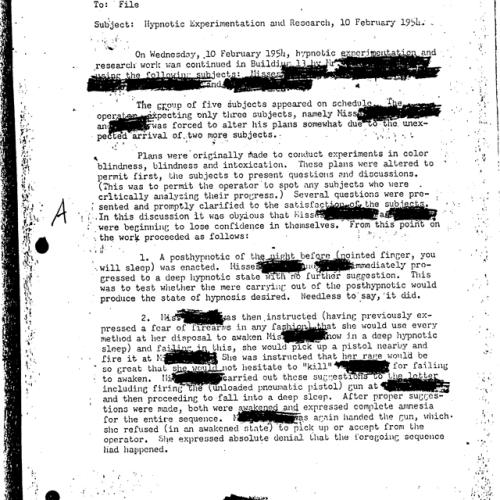
It's been over 50 years, but Wayne Ritchie says he can still remember how it felt to be dosed with acid. Ritchie may be among the last of the living victims of MK-ULTRA, a Central Intelligence Agency operation that covertly tested lysergic acid diethylamide (LSD) on unwitting Americans in San Francisco and New York City from 1953 to 1964. Seymour Hersh first exposed MK-ULTRA in a New York Times article in 1974 that documented CIA illegalities, including the use of its own citizens as guinea pigs. There were at least three CIA safe houses in the Bay Area where experiments went on. Chief among them was 225 Chestnut. Inside, prostitutes paid by the government to lure clients to the apartment served up acid-laced cocktails to unsuspecting johns, while martini-swilling secret agents observed their every move from behind a two-way mirror. The main man behind the mirror was ... George H. White, a Bureau of Narcotics maverick. He oversaw the San Francisco program, gleefully dubbing it Operation Midnight Climax. But, as a 1976 Senate Select Committee on Intelligence Activities noted, there was no medical pre-screening. White [wrote] in a 1971 letter to [Sidney] Gottlieb, "Of course I was a very minor missionary, actually a heretic, but I toiled wholeheartedly in the vineyards because it was fun, fun, fun. Where else could a red-blooded American boy lie, kill and cheat, steal, deceive, rape and pillage with the sanction and blessing of the All-Highest?"
Note: Read more about MK-ULTRA. This is just one of many programs that treated human beings like guinea pigs. For more along these lines, see concise summaries of deeply revealing news articles on intelligence agency corruption from reliable major media sources.
During a 22-month investigation by agents from the US Drug Enforcement Administration, the Internal Revenue Service and others [beginning in 2006], it emerged [that drug cartels had laundered huge sums of money] through one of the biggest banks in the United States: Wachovia, now part of the giant Wells Fargo. In March 2010, Wachovia settled the biggest action brought under the US bank secrecy act, through the US district court in Miami. Now that the year's "deferred prosecution" has expired, the bank is in effect in the clear. The bank was sanctioned for failing to apply the proper anti-laundering strictures to the transfer of $378.4bn a sum equivalent to one-third of Mexico's gross national product into dollar accounts from ... currency exchange houses with which the bank did business. [The case demonstrates] the role of the "legal" banking sector in swilling hundreds of billions of dollars the blood money from the murderous drug trade in Mexico and other places in the world around their global operations, now bailed out by the taxpayer. At the height of the 2008 banking crisis, Antonio Maria Costa, then head of the United Nations office on drugs and crime, said he had evidence to suggest the proceeds from drugs and crime were "the only liquid investment capital" available to banks on the brink of collapse. "Inter-bank loans were funded by money that originated from the drugs trade," he said. "There were signs that some banks were rescued that way."
Note: For lots more from reliable sources on the illegal activities routinely engaged in by the largest banks and financial corporations, click here.
The United States continues to spend hundreds of millions of dollars on "good governance" initiatives [in Afghanistan]. This $760 million program, to strengthen government agencies, was America's single largest nonmilitary expense in Afghanistan over the past year. All of it was money thrown away. Last year, the U.S. Agency for International Development began promoting what it calls "Afghanization of aid." Well, in Afghanistan, government leaders have only one use for foreign aid. They stuff the cash into suitcases and fly it to secret bank accounts in Dubai. Afghanistan remains the world's largest grower of opium poppies. It supplies 90 percent of the world's heroin. Many thousands of its citizens are addicts. Earlier this month, the United Nations put out its annual "Afghanistan Opium Survey" and found that, even after the United States has spent more than $2 billion on drug enforcement there, "the total area under cultivation" during 2010 "and the number of families growing opium poppy, remained the same as in 2009" - but for one thing. The U.N. found "an alarming increase of 97 percent" in opium-poppy cultivation among northeastern provinces that are not traditional poppy-growing areas.
Note: For shocking stories by two award-winning journalists suggesting direct involvement by government agencies in the drug trade, click here. And for key reports from reliable sources on government corruption, click here.
Wachovia [Bank] ... made a habit of helping move money for Mexican drug smugglers. San Francisco's Wells Fargo & Co., which bought Wachovia in 2008, has admitted in court that its unit failed to monitor and report suspected money laundering by narcotics traffickers - including the cash used to buy four planes that shipped a total of 22 tons of cocaine. The admission ... sheds light on the largely undocumented role of U.S. banks in contributing to the violent drug trade that has convulsed Mexico for the past four years. Wachovia admitted it didn't do enough to spot illicit funds in handling $378.4 billion for Mexican currency exchange houses from 2004 to 2007. That's the largest violation of the Bank Secrecy Act, an anti-money-laundering law, in U.S. history - a sum equal to one-third of Mexico's current gross domestic product. "Wachovia's blatant disregard for our banking laws gave international cocaine cartels a virtual carte blanche to finance their operations," said Jeffrey Sloman, the federal prosecutor who handled the case. "It's the banks laundering money for the cartels that finances the tragedy," said Martin Woods, director of Wachovia's anti-money-laundering unit in London from 2006 to 2009. Woods says he quit the bank in disgust after executives ignored his documentation that drug dealers were funneling money through Wachovia's branch network. "If you don't see the correlation between the money laundering by banks and the 22,000 people killed in Mexico, you're missing the point," he said.
Note: For abundant reports from reliable sources on the many dubious ways in which major financial firms make their profits, click here.
Important Note: Explore our full index to key excerpts of revealing major media news articles on several dozen engaging topics. And don't miss amazing excerpts from 20 of the most revealing news articles ever published.