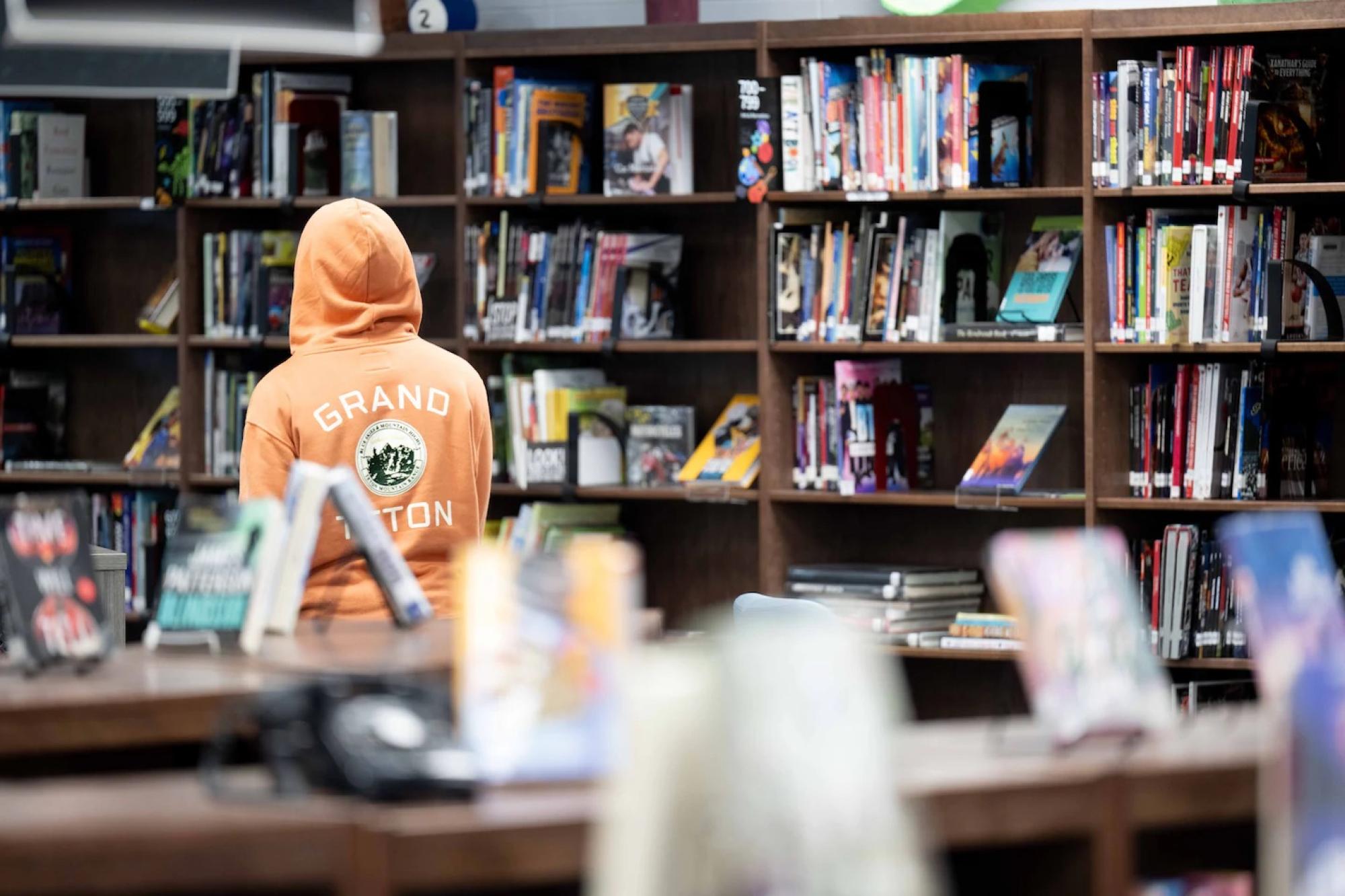
The cafeteria at Ballard High School during lunch is a loud place. Students are talking and laughing, playing card games and going out to the courtyard for an informal recess. This year the high school in Louisville instituted a cellphone ban from "bell to bell" meaning, not just during instructional time, as is now required by state law in Kentucky, but also during lunch and time between classes. Kentucky joins a growing number of states, schools and districts that have been implementing new phone bans. In the first month of school this year, students took out 67 percent more books than the same month last year. "Even my library aides who do the bulk of the circulating were like, 'Gosh, there's a lot of kids checking out books,'" said Stephanie Conrad, the school's librarian. Conrad was prepared for the uptick in library use because of similar phenomena at other schools that instituted cellphone bans, but she said it has still been exciting to see how much kids are reading " and engaging more with their peers. "Like, a minute or two of downtime with kids, they used to have their phone. They were kind of in this little cellphone cocoon. Very quiet, not interacting," Conrad said. And now " "it's wonderful. They're interacting, and they're not isolated online." Neuss, the principal, acknowledges that ... most students would still prefer to have their phones during lunch, but from where he sits, they look like they're having more fun without them.
Latest
Latest News
Each news summary is created according to strict standards. Here's how we do it.
Each summary is created using a consistent editorial procedure. The target length is approximately 16 lines of 11-point Arial text in a 650-pixel-wide column. Up to 25% of a summary may be set in bold to emphasize the most important ideas. Summaries are composed of verbatim excerpts presented in the same sequence as they appear in the original news source, with very minor editorial additions. Where material has been omitted between excerpts, the omission is indicated with ellipses (...). Any words added by an editor for clarity or context appear in [brackets]. Our original news editor was Fred Burks. Tod Fletcher edited most summaries from 2007 through 2014, and Mark Bailey has served as news editor since 2014.