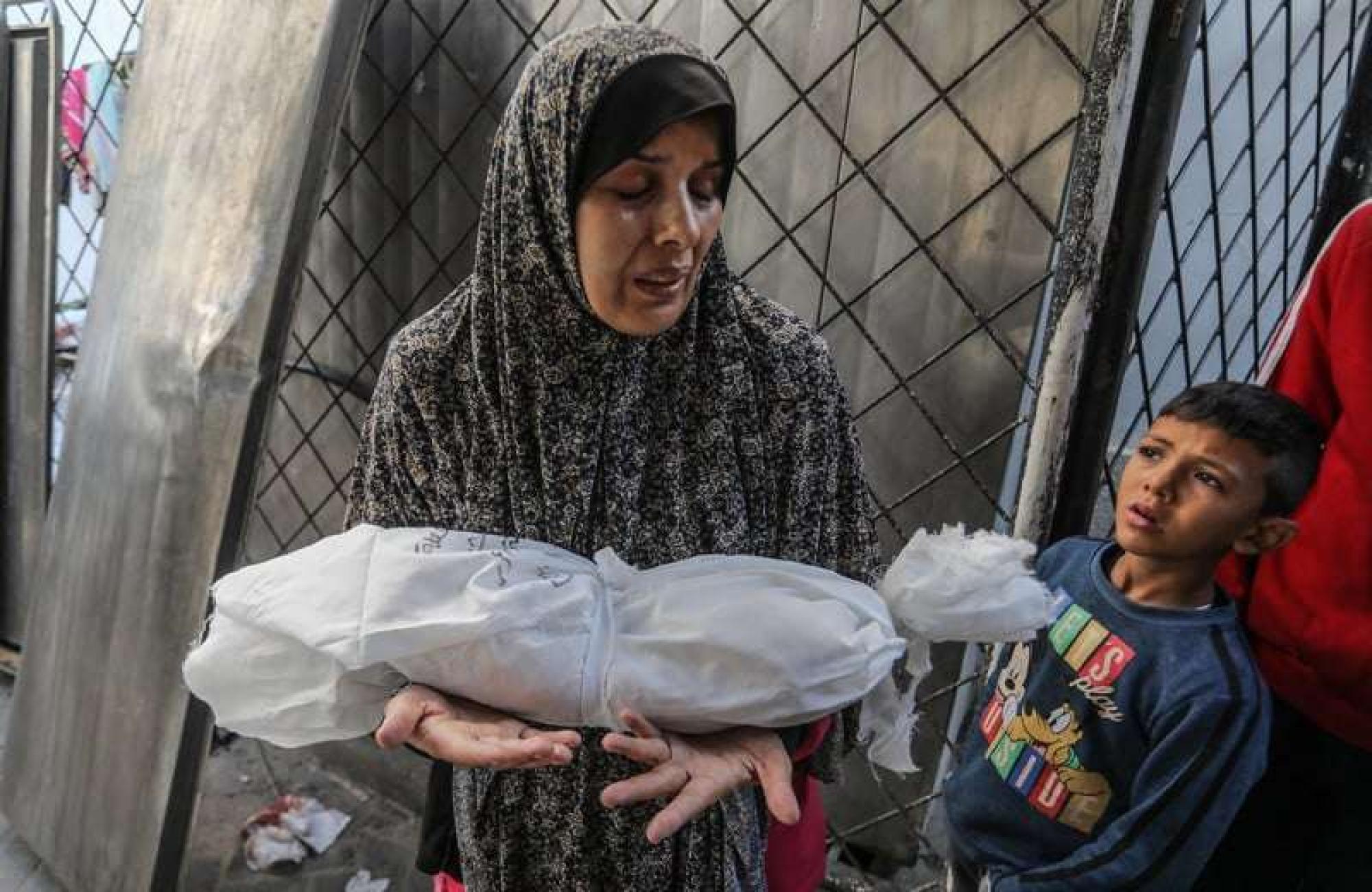
Children on top of rubble… playing with ammunition casings. A close look reveals where they come from -- printed on the side: USA... DOD for the Department of Defence. Hala Rharrit was an American diplomat who ... worked on human rights and counterterrorism. Part of her job was to monitor Arab press and social media to document how America's role in the war was perceived in the Middle East. Daily reports Rharrit sent to senior leadership in Washington [contained] gruesome images: Hala Rharrit: I would show the complicity that was indisputable. Fragments of U.S. bombs next to massacres of ... mostly children. And that's the devastation. It's been overwhelmingly children ... I would show images of children that were starved to death. I was basically berated, 'Don't put that image in there. We don't wanna see it.'" Three months into the war ... she was told her reports were no longer needed. The U.S. has sent $18 billion in American military assistance to Israel since the war began, largely in the form of taxpayer-funded weapons. Most of the bombs come from America. Most of the technology comes from America. And all of the fighter jets, all of Israel's fixed-wing fleet - comes from America. Andrew Miller was the deputy assistant secretary of state for Israeli-Palestinian affairs. He ... has since become the highest ranking Biden administration official to go public with his concerns about the U.S. role in the war. The State Department issued a report saying it is "reasonable to assess" that Israel may have used American weapons in violation of international law. Hala Rharrit: "Protests began erupting in the Arab world ... with people burning American flags. We worked so hard after the war on terror to strengthen ties with the Arab world."
Latest
Latest News
Each news summary is created according to strict standards. Here's how we do it.
Each summary is created using a consistent editorial procedure. The target length is approximately 16 lines of 11-point Arial text in a 650-pixel-wide column. Up to 25% of a summary may be set in bold to emphasize the most important ideas. Summaries are composed of verbatim excerpts presented in the same sequence as they appear in the original news source, with very minor editorial additions. Where material has been omitted between excerpts, the omission is indicated with ellipses (...). Any words added by an editor for clarity or context appear in [brackets]. Our original news editor was Fred Burks. Tod Fletcher edited most summaries from 2007 through 2014, and Mark Bailey has served as news editor since 2014.